
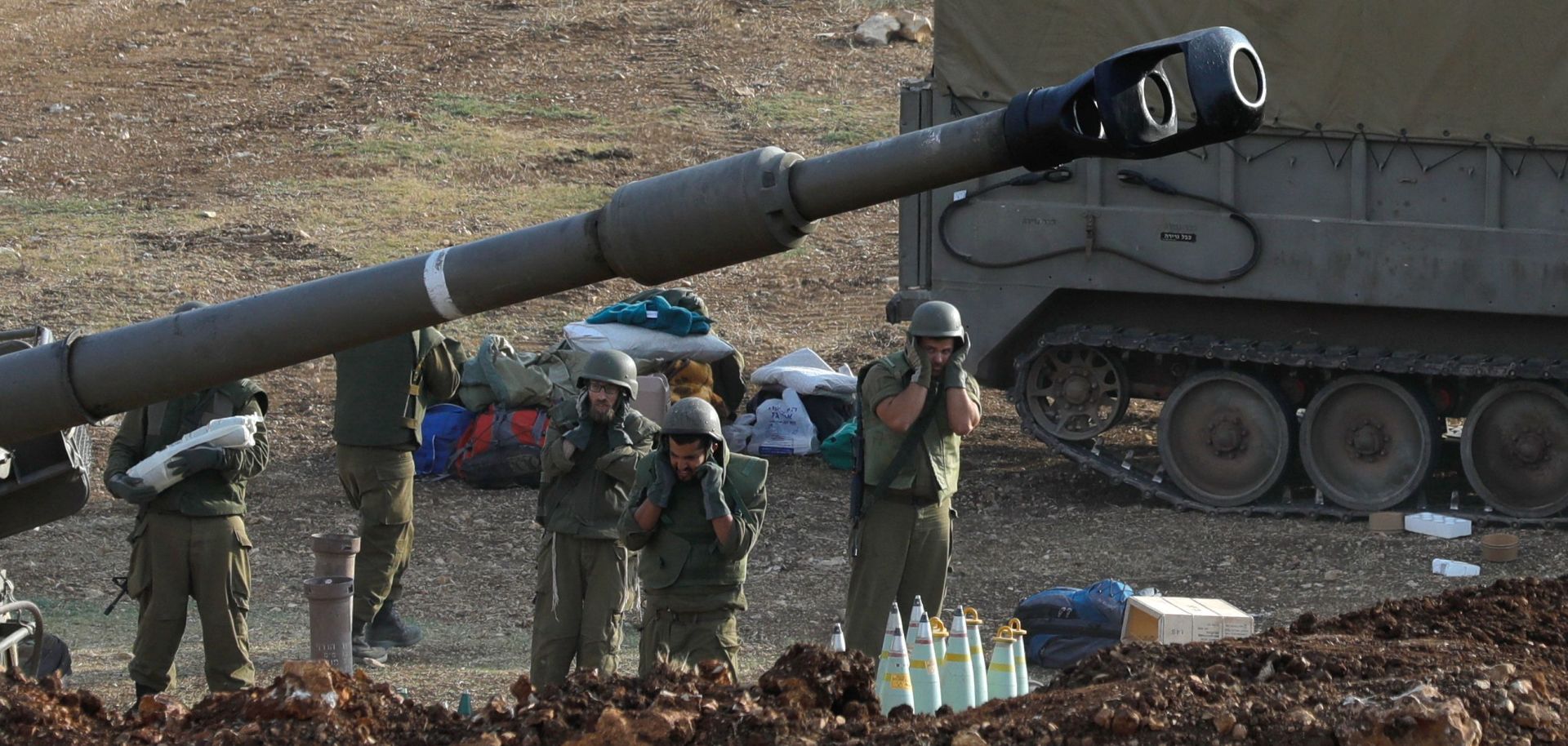
The latest clashes between Israel and Hezbollah suggest that the constraints on direct confrontation are weakening, threatening to worsen political and economic conditions in Lebanon and significantly increase security threats in both countries. While Israel prepares for an expected ground incursion into the Gaza Strip, tensions are also rising in the north along the border with Lebanon. On Oct. 10, Palestinian militants (including Hamas) fired rockets from southern Lebanon into northern Israel. Israeli military officials claim the militants fired 15 rockets and an anti-tank guided missile in the incident, adding that Israeli air defenses intercepted four of the incoming missiles, while the 11 remaining rockets landed in unpopulated areas of Israeli territory. Further incidents in northern Israel have occurred since the rocket barrage. In response to the attacks, Israeli tanks fired shells into Lebanon, destroying an observation post belonging to the large militant group Hezbollah, which has largely stayed out of the conflict so far. There were no reports of casualties in Israel or Lebanon due to the Oct. 10 cross-border exchanges, though other clashes in recent days have killed as many as nine Hezbollah fighters and three members of the Israeli military. The attacks are the latest between Israel and Lebanon-based militants since Oct. 7, when the Gaza-based militant groups Hamas, Palestinian Islamic Jihad (PIJ) and others launched Operation Al-Aqsa Flood, which included ground raids and rocket attacks into southern Israel. The militants killed 1,000 Israelis and abducted as many as 150 others.
- On Oct. 9, a number of PIJ militants operating from southern Lebanon crossed into northern Israel and clashed with Israeli forces, killing three members of the Israeli military, including a brigade commander. Meanwhile, Israeli retaliatory strikes in response to a series of clashes with Lebanon-based militants on Oct. 8-9 killed a total of nine members of Hezbollah, which controls southern Lebanon.
- In response to the continuing clashes, the United Kingdom's Foreign, Commonwealth and Development Office on Oct. 10 updated its travel advice for Lebanon, recommending against all but essential travel to the country as a whole, and against all travel to southern Lebanon.
- Israel deployed additional troops on Oct. 9 to secure the northern border as part of its activation of 300,000 reserve troops in preparation for ground conflict in Gaza.
The clashes on Israel's northern border occur in the broader context of heightened Israel-Hezbollah tensions stemming in part from Israel's shadow conflict with Iran. Israeli tensions with Hezbollah have been high since May 2021, when Palestinian militants in Lebanon fired rockets into Israel during the Gaza War. Since then, Hezbollah has allowed more aggressive attacks by Palestinian militant groups from Lebanese soil, with the group itself reportedly conducting an attack earlier in 2023. This is likely because Iran, Hezbollah's main sponsor, has recently focused on building the capacity of the group's militia, along with that of Palestinian militant groups, to deter Israel from attacking Iran. In recent years, Israel has been widely suspected of carrying out a number of assassinations of Iranian nuclear personnel and sabotage attacks against Iranian nuclear and missile infrastructure. In addition, the Israeli military conducts frequent airstrikes on Iran-associated targets in Syria, including airports in Damascus and Aleppo, which Israel alleges that Iran uses to smuggle weapons and equipment to Hezbollah in neighboring Lebanon.
- Israel and Lebanon last fought a direct conflict in 2006, which started after Hezbollah militants launched a cross-border raid into Israel, killing eight Israeli soldiers and kidnapping two others. The approximately one-month conflict resulted in 165 Israeli deaths and over 1,300 Lebanese fatalities. During the war, Israel struck targets in and around Beirut, including the Rafik Hariri International Airport and other critical infrastructure.
- More recently, the movement of Hezbollah weapons within Lebanon has led to sectarian clashes. For example, on Aug. 9 sectarian clashes between local Christian militias and Hezbollah broke out in the northern Lebanese village of Kahaleh after a Hezbollah vehicle carrying weapons from Syria overturned. The clashes killed one villager and one Hezbollah operative.
Despite constraints on escalation, continuing clashes on the Israel-Lebanon border increase the likelihood of an Israel-Hezbollah confrontation, which would worsen the political and economic crises in Lebanon, and greatly elevate security risks on both sides of the border. International efforts are reportedly underway aimed at ensuring Hezbollah will not escalate, with the United States warning Hezbollah against making the ''wrong decision'' in attacking Israel. While Iran has voiced support for Hamas' actions from Gaza and Iran may have helped plan and approve the attacks, Iran also has vested interests in preventing escalation to a full-scale war so it can use Hezbollah to deter future Israeli attacks on Iran. Were Israel and Hezbollah to resume mass conflict, Israeli strikes would weaken Hezbollah's capabilities and limit its capacity to serve as a credible deterrent. Hezbollah for its part also is concerned that a war with Israel may weaken its power in Lebanon, and so domestic considerations are also an important constraint on action. That being said, continuing clashes, combined with Israel's impending ground offensive into Gaza, make escalation increasingly likely. The most likely escalatory path is a tit-for-tat escalatory cycle where Hezbollah and Israel increase strikes on each other amid growing casualties on both sides. Another less likely scenario is one where significant Palestinian casualties in Gaza prompt Hezbollah to escalate, as the group views itself as the vanguard of anti-Israeli resistance movements in the region and would not want to lose legitimacy by being seen as staying out of a fight. Under either pathway, Israel-Hezbollah escalation would have serious political and economic consequences for Lebanon and increase security risks in both Israel and Lebanon. An Israel-Hezbollah escalation would threaten to further undermine the tenuous political environment in Lebanon. For instance, other armed groups in Lebanon, such as Christian-based Lebanese Forces, could seize the opportunity to attack what they may see as a distracted Hezbollah, which would increase the likelihood of political deadlock in Lebanon and could also potentially trigger a sectarian conflict. Moreover, as Lebanon is currently facing a large-scale economic crisis, a Hezbollah escalation with Israel would exacerbate Lebanon's large-scale economic crisis, especially if Israeli strikes target critical infrastructure in the country. Finally, from a safety and security standpoint, a Hezbollah-Israel escalation would dramatically increase risks for businesses and travelers both in Israel — especially in cities in northern Israel, like the port of Haifa — and for Lebanon in terms of Israeli strikes. While Israeli strikes pose the highest risk to southern Lebanon, Israel has struck targets throughout the country in the past, including in and around Beirut. Israeli officials have reportedly gone so far as to warn Hezbollah leaders that the Israeli military may increase attacks on Syria, a key hub for arms shipments to Hezbollah, in the event Hezbollah enters into direct conflict with Israel, illustrating how an Israel-Hezbollah conflict could expand to encompass a third country.
- Lebanon's political class is currently deadlocked on choosing a new president and the post has been vacant since 2022. As a key political party in Lebanon, Hezbollah has veto power over the post, and a war with Israel at this stage would only further increase the deadlock.
- Lebanon is currently in the midst of a multi-year currency and economic crisis, with high exchange rates between the dollar and the Lebanese pound making the import of goods harder, and local banks facing dwindling currency reserves. The crisis would only worsen if Israel begins more aggressive strikes against Lebanon as they would likely damage critical infrastructure, possibly up to and including Beirut International Airport.
- Finally, an Israel-Hezbollah escalation would have security consequences for businesses on both sides of the border. Sustained Hezbollah strikes on northern Israel, combined with the ongoing Gaza conflict, would limit where businesses could safely operate in Israel, creating essentially an island of safety in central Israel. The attacks may also cause supply chain disruptions as the key port of Haifa in northern Israel would be among Hezbollah's likely targets for attack. Meanwhile, Israeli retaliatory strikes on Lebanon would cause significant collateral safety risks for businesses across Lebanon, including the capital Beirut.
