
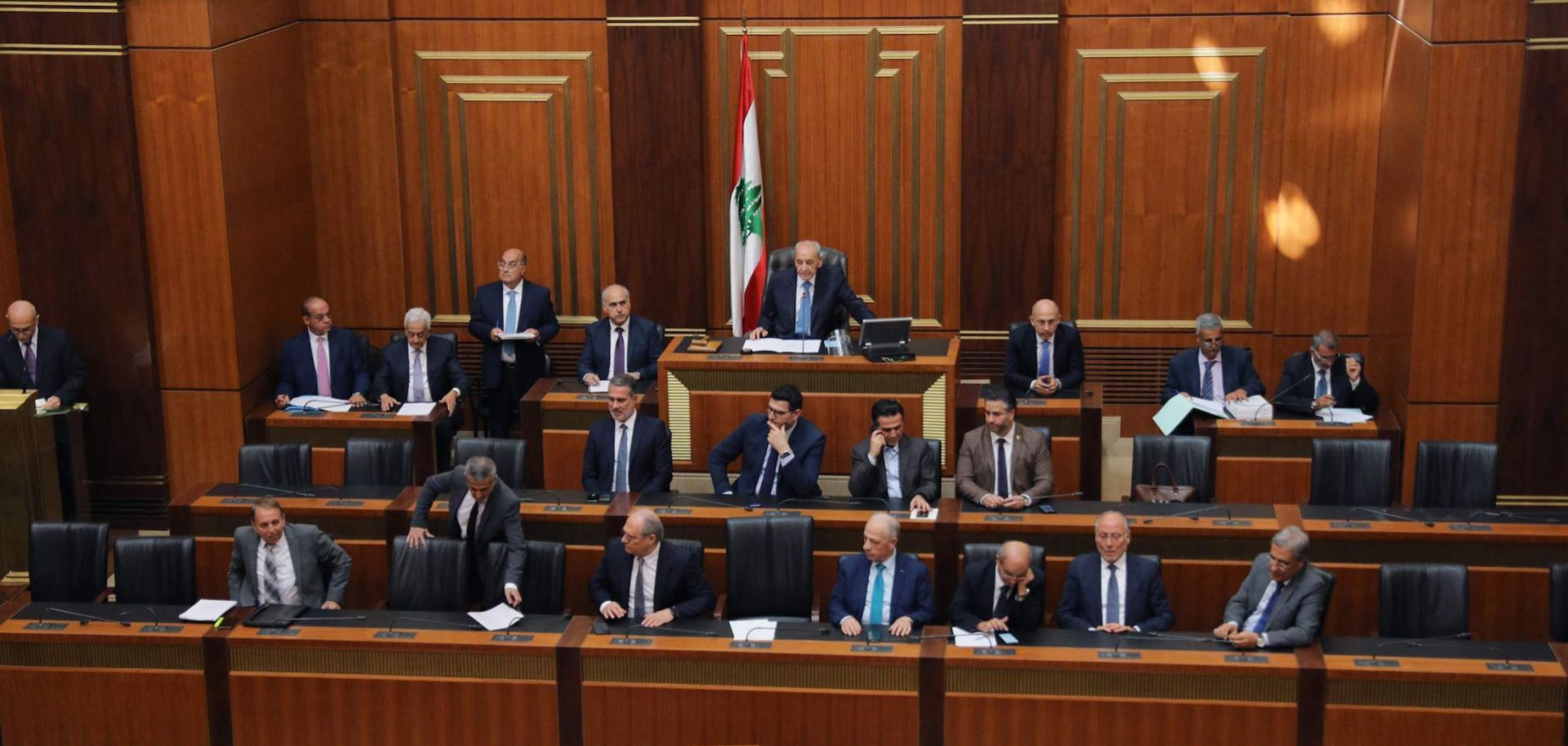
Lebanon's political factions remain mired in internal disputes, making them unlikely to pass reforms that could improve the country's economic outlook, absent a major shock. The first vice governor of Lebanon's central bank, Wassim Mansouri, took over as interim bank chief on July 31 after the National Assembly failed to appoint a formal successor for embattled bank head Riad Salameh, who just stepped down after 30 years. This political indecision is not new, as Lebanese lawmakers have been unable to elect a president in the 12 sessions held for this purpose since former President Michel Aoun's term expired in October 2022. As a result, legislation passed by the National Assembly cannot be signed into law, nor can the mandate of caretaker Prime Minister Najib Mikati's Cabinet be certified. This caretaker role severely limits Mikati's powers, leaving the country without strong leadership. These institutional shortcomings are the result of Lebanon's deeply fragmented National Assembly, where divisions between newly-established reformist parties, older establishment parties and pro-Iran parties have prevented consensus.
- A major obstacle to Lebanon's political unity is its sectarian quota system that requires key positions to be held by different sects. For example, the president must be a Christian, the prime minister a Sunni and the speaker of the National Assembly a Shiite.
- Additionally, each sect encompasses parties that have diverging regional and ideological alignments. While some parties are aligned with France, Saudi Arabia and the United States, others are aligned with Iran and Syria. There are even some new, pro-reform parties that do not have foreign leanings, instead favoring independent Lebanese nationalism.
Lebanon's political impasse has facilitated one of the most severe economic crises in modern times, and international aid that could alleviate this emergency is locked behind demands for structural reforms. Since the crisis began in 2019, the Lebanese pound has lost 98% of its value against the dollar, and the economy has contracted 40%, leaving most of the population unable to afford basic goods, medicines and services. To help alleviate this crisis, international donors have offered aid, but most of these funds are contingent upon economic, legal, political and institutional reforms. For example, in April 2022, the International Monetary Fund (IMF) offered Lebanon a $3 billion bailout in a staff-level agreement in return for reforms, including a weakening of banking secrecy to improve accountability and transparency. Since these reforms have not come to pass, the funds remain untouched. And at a 2018 conference known by its French acronym, CEDRE, attendees pledged another $11 billion that awaits economic and political reforms. In the absence of this qualified aid, Lebanon's economy has continued to spiral.
- Lebanon has increasingly struggled to afford food, energy and medicine imports since the economic crisis began in 2019, but the country was particularly hard-hit by food shocks sparked by the Russia-Ukraine war in the spring of 2022. Ukraine accounted for over 50% of Lebanon's wheat imports in 2021.
Despite the depth of Lebanon's economic crisis, the country's political elites have resisted implementing reforms in order to preserve their power. Lebanese political factions believe the economic crisis will eventually force their rivals to make concessions regarding Cabinet appointments and/or legislative changes that shield them from the effects of possible reforms. However, the crashing economy does not seem to have affected the holdings or lifestyles of most elites, especially since outside sponsors like Iran, the United States, France and the United Nations are providing emergency humanitarian and security assistance to their preferred factions. As a result, it is unlikely that financial strain will push any one faction to compromise. Additionally, some party leaders oppose reforms due to worries about accountability, especially if reforms expose corruption to Lebanese and international courts. And still other parties, especially pro-Iranian ones like Hezbollah, oppose reforms because they, unlike their rivals, would not be able to reap the subsequent economic benefits due to Western sanctions. Until Lebanon's political factions are willing to compromise, the National Assembly is unlikely to pass a national budget, make official appointments like a new central bank head, elect a president or formalize the Cabinet.
- The United States has maintained sanctions on Hezbollah's leaders since the 1990s, but tightened them after pulling out of the Iranian nuclear deal in 2018. These sanctions leave Hezbollah and its associated banks largely reliant on Iran and Syria for financial support, which is not dependent on reforms.
- In January, the United States, through the United Nations, provided $72 million in direct cash payments to the Lebanese military to offset the impact of inflation on soldiers' salaries and prevent the erosion of the army's cohesion. And in March, the European Union announced another 60 million euros ($66 million) in support for refugees and vulnerable people in Lebanon. Meanwhile, Iran provides fuel and direct cash subsidies to its allies via a land bridge through Iraq and Syria.
Over time, Lebanon's lack of reform could make food and fuel shortages so severe that sustained, nationwide unrest takes hold, possibly devolving into civil war. If left unchecked, Lebanon's economic and institutional crises will continue to devalue the country's currency, which will likely result in sustained food and fuel shortages as imports become increasingly unaffordable. External events like the end of the Black Sea grain deal, El Nino, global drought and climate change could contribute to food shortages, and rising energy prices over the summer could exacerbate energy scarcity. If these conditions continue for months or years, mass protests would likely break out against the government and sectarian factions. These protests could escalate into a security challenge and even reignite Lebanon's civil war, which ended in 1990. While the prospect of a civil war could convince Lebanon's political parties to cooperate, such cooperation would not be guaranteed to result in structural reforms that alleviate economic strain.
- Since the beginning of Lebanon's crisis, there have been reports of isolated acts of violence sparked by fuel shortages at gas stations, while banks are regular targets of violent vigilantes who try to retrieve their deposits despite informal capital controls.
- Lebanon has largely avoided sustained mass unrest thanks to widespread fear of violence and the easing of the worst food and fuel shocks over time. Fresh emergency humanitarian aid and remittances from Lebanese living and working abroad have also helped mitigate the most severe impacts of these shortages.
While Lebanon's economy and institutions will likely continue to gradually deteriorate, there are several low-probability, high-risk events that could break the political impasse. Lebanon's political environment is so fragmented and complex that it would probably take a major security or economic shock to convince the different political groups to cooperate. Such shocks include:
- War with Israel: Lebanon's security relationship with Israel remains fraught, despite some improvements like the Israeli-Lebanese maritime deal in 2022. Tensions have risen especially high since Palestinian factions like Hamas started using Lebanon as a base from which to harass the Israeli northern frontier. If Israel conducts another large-scale operation in Lebanon to combat these factions, it could cause enough economic and humanitarian damage to spur some parties within the National Assembly to compromise in order to unlock reconstruction aid.
- Foreign aid or sponsorship cut-off: Political changes or military emergencies among one or more of Lebanon's sponsors could interrupt foreign international aid to Lebanon's varying factions. For example, the United States will hold a presidential election in 2024, and if presumptive Republican nominee Donald Trump wins, his skepticism of open-ended aid programs could change U.S. policy toward Lebanon. And a still-unlikely regional military escalation against Iran over its nuclear program would jeopardize Iranian aid to its favored Lebanese parties. In such cases, a newfound lack of cash would make Lebanese politicians more likely to reach a compromise to obtain aid and begin an IMF bailout process.
- Major natural disaster: Lebanon sits near earthquake fault lines that may produce a catastrophic disaster similar to the February earthquakes that struck Syria and Turkey and also damaged parts of Lebanon. A major earthquake that affects Lebanon directly might force political elites to compromise to secure foreign aid and focus on reconstruction efforts.
