
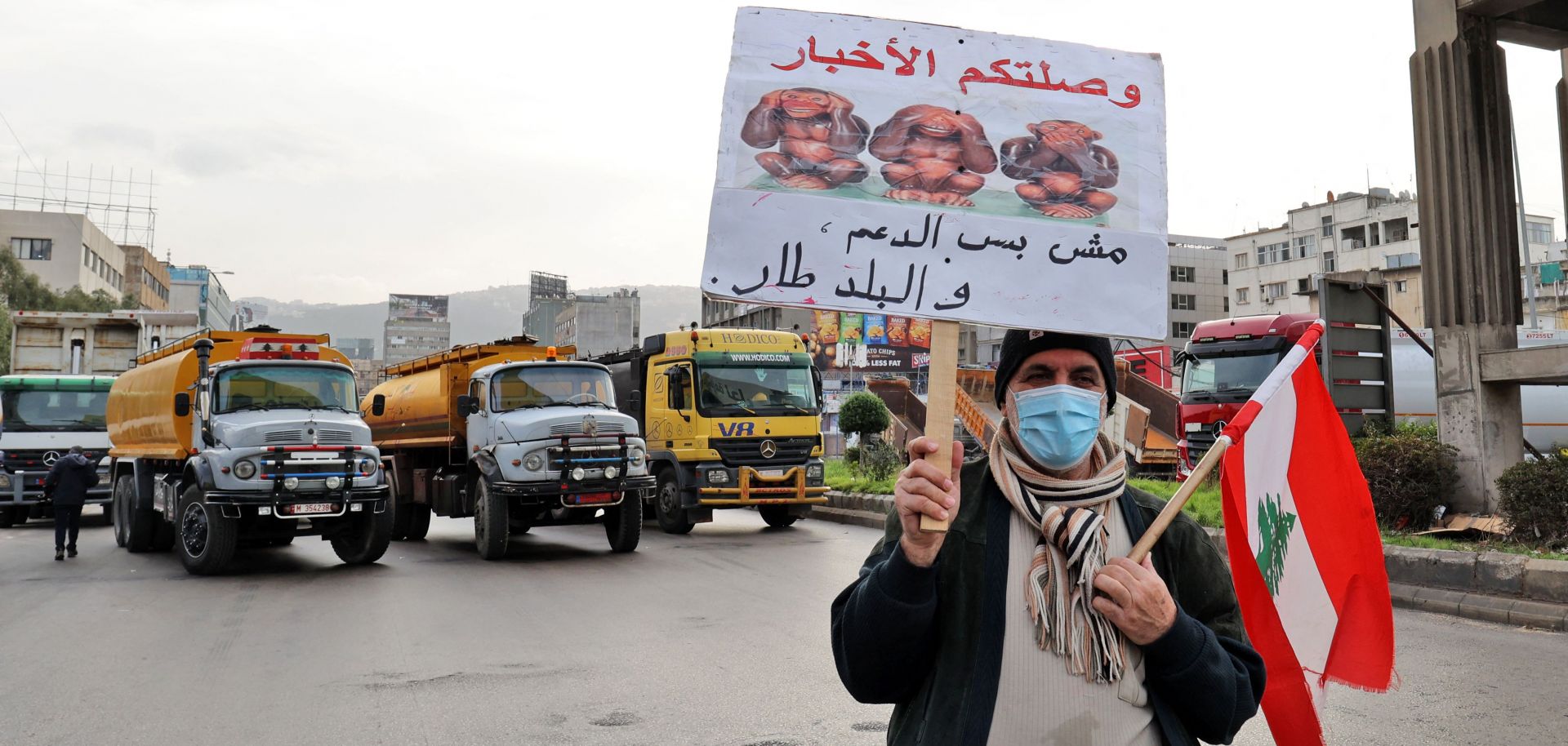
A protester holds a sign as fuel tankers block a road in Lebanon's capital of Beirut during a general strike by public transport and workers unions on Jan. 13, 2022.
As Lebanon’s economic or political crises continue to spiral, more people living in the country — including Palestinian and Syrian refugees — will seek to flee to Europe, potentially creating a new migrant crisis. On Jan. 13, another “day of rage” led by Lebanon’s transport unions highlighted the challenges facing people in the country and the factors compelling an increasing number of them to risk a sea journey to Europe. In protest of skyrocketing fuel prices, the nationwide strikes temporarily crippled transport routes, shut schools and universities, and were accompanied by threats of future violence from some demonstrators. But the strikes were largely ignored by the Lebanese government, which has done little to mitigate the acute fuel crisis, let alone the country’s greater economic collapse. Indeed, by the afternoon of Jan. 13, the rallies had dwindled — a sign that even protesters themselves saw limited value in them.
- Lebanon’s increasingly dire financial situation has left the government unable to afford shipments of fuel among other imports, which are typically priced in U.S. dollars (the Lebanese pound is now trading below 30,000 to the U.S. dollar — a massive decline since 2019, when it was officially pegged at 1,500 to the dollar). This, combined with the central bank’s move to lift fuel subsidies in August, has caused fuel in Lebanon to become increasingly expensive and scarce.
- The recent fuel crisis has further deteriorated living conditions in Lebanon, where 80% of people are now estimated to be living in poverty. It’s also increased the country’s reliance on the Iran-backed group Hezbollah, which has been arranging shipments of Iranian fuel through Syria.
More disruptive strikes and violent unrest are likely as the government continues to delay the deeper reforms needed to reverse Lebanon’s downward trajectory. The Lebanese government is in talks with the International Monetary Fund for a rescue package. But Beirut has made little effort to reduce fuel prices or begin the political process that might bring the country out of its larger economic crisis. Political paralysis has left the government unable to carry out even basic functions, with Lebanon’s Cabinet not having met since October 2021. And in the run-up to elections in the spring, no new political parties or leaders have emerged that might shake up the ongoing paralysis. The unrest caused by Lebanon’s confluence of crises is thus more likely to further deteriorate economic and social conditions in the country than incentivize the government to seriously address them. And as protests fail to spur reforms, more Lebanese will also conclude that political and social action to pressure the government is futile.
With little chance for any near-term improvement of Lebanon’s economic or political conditions, more citizens and residents will try to leave the country. Middle-class Lebanese are already fleeing the country for Europe, the Americas, and the Arab Gulf states through a formal migration process. But as living conditions continue to deteriorate, a growing number of poorer and increasingly desperate Lebanese citizens — along with Palestinian and Syrian refugees living in the country — will likely also attempt to escape to Europe as well via illegal sea routes.
- Between 10,000-12,000 Palestinians left Lebanon in 2020 compared with the roughly 6,000-8,000 who left in 2019, according to government estimates.
- The United Nations has also noted an uptick of attempted border crossings by Lebanese migrants into Cyprus (the closest point of entry to the European Union from Lebanon). According to U.N. records, at least 1,570 people from Lebanon tried to reach Cyprus by sea in 2021 compared with the only 270 people who tried doing so in 2019.
The threat of another migrant crisis might spur Europe to provide financial aid to the Lebanese government, though this would only enable those who created the country’s crises to stay in power. In recent years, the European Union has become less receptive to taking in irregular (or undocumented) migrants, as demonstrated by the bloc’s aggressive response to the recent migrant crisis on the Polish-Belarus border. As part of this shift, Brussels has also become more willing to help governments in countries where migrants are either coming from or transiting through (as it has with Turkey), even if it’s critical of those governments’ other policies. Compared with other countries, EU aid has a greater ability to improve the drivers of migration in Lebanon, where people are primarily fleeing poor economic conditions as opposed to war and violence. France’s close ties with Beruit also grant Brussels greater influence over the government. But greater financial support from the European Union would not address the core of Lebanon’s problems, which is rooted in the country’s political system — making it a salve rather than a solution to the growing number of migrants coming over from Lebanon.
