
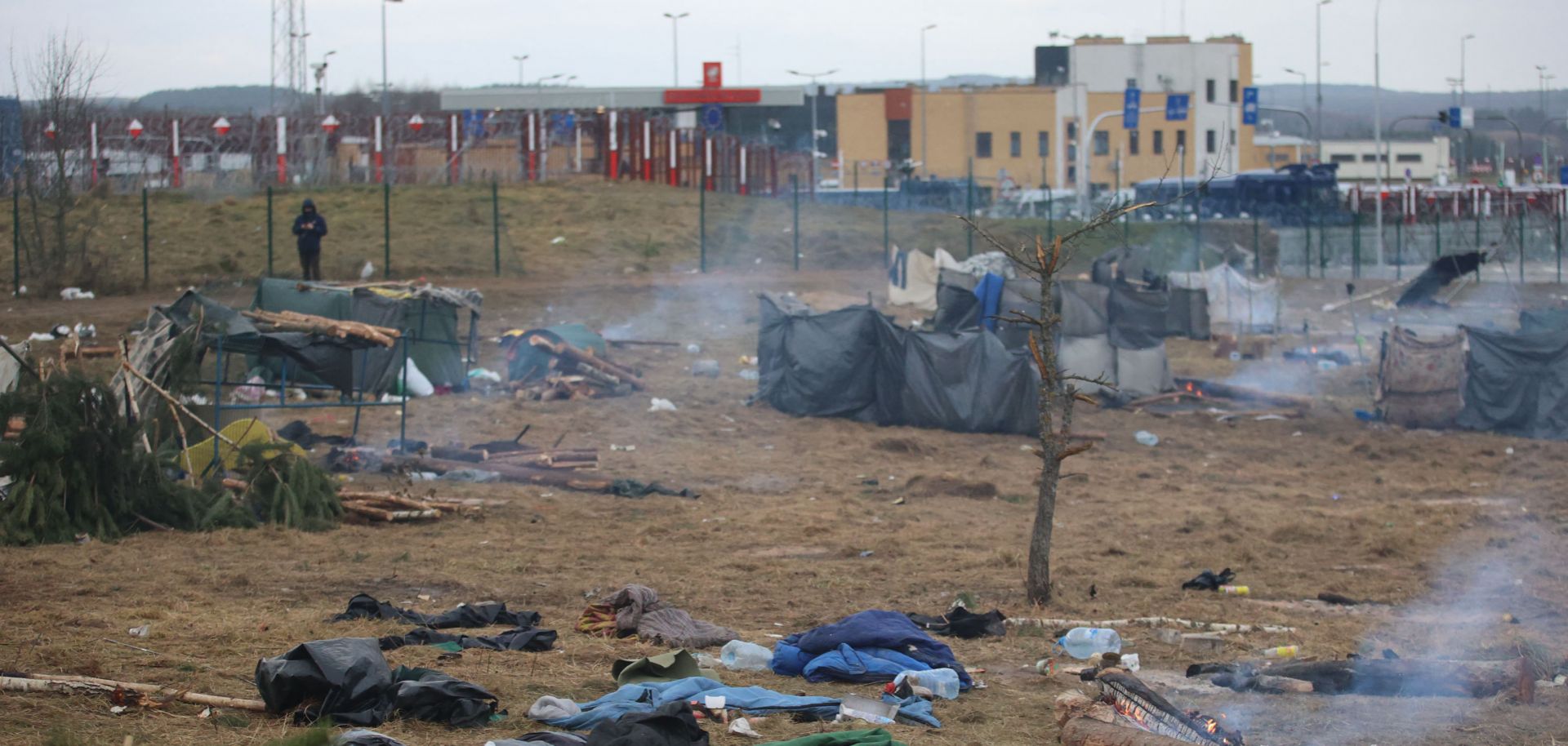
A deserted migrant camp is seen on the Belarus-Poland border in the Grodno region on Nov. 18, 2021.
Germany’s recent outreach to Belarus may temporarily improve the migrant crisis at the latter’s borders, but simmering tensions with the European Union will likely ultimately push Minsk to resume its pressure tactics. On Nov. 15, German Chancellor Angela Merkel held a phone call with Belarusian President Alexander Lukashenko to discuss the growing migrant crisis at the Belarus-Poland border, which European states have accused Minsk of orchestrating in retaliation for EU sanctions imposed after Lukashenko’s disputed electoral victory last year. That same day, EU foriegn ministers also approved the fifth package of sanctions targeting Belarussian entities implicated in the transit of migrants from the Middle East to the country. Merkel and Lukashenko then held another call on Nov. 17 in which Merkel stressed the need to allow the access of international organizations to provide humanitarian aid for the migrants. Lukashenko’s press office also claimed the two leaders “came to a certain understanding” on how to act to resolve the situation on the border. Some Central European governments have expressed fear that the increase in Germany-Belarus dialogue could erode the European Union’s strategy of isolating and sanctioning Lukashenko’s regime. However, cooperation on the migrant crisis alone is unlikely to fundamentally change Brussels’ greater pressure campaign on Minsk, and is instead probably intended to enable the Belarusian president to temporarily save face and avert a humanitarian catastrophe before the winter settles in and leaves migrants in below-freezing temperatures.
- Belarus’s neighbors have claimed the migrant crisis is also being conducted in close cooperation with Russia, with Polish Prime Minister Mateusz Morawiecki calling Russian President Vladimir Putin the “mastermind” behind the effort on Nov. 9. European leaders called on Russia to get Minsk to cut off the migrant flows, but Moscow dismissed the request, insisting they speak directly with Lukashenko about the issue.
- The Nov. 15 call between Merkel and Lukashenko was the first contact between the Belarusian president and any major Western leader since Lukashenko secured another term in the contested August 2020 presidential election. Most Western countries have yet to recognize Lukashenko as Belarus’s formal leader following last year’s election; the German press releases issued after Merkel’s two calls refer to him only as “Mr. Lukashenko” and not as the president of Belarus.
The European Union’s expanding sanctions against Belarus and deals with governments and airlines to reduce the inflow of migrants are pushing Minsk to cooperate with the bloc to reduce the humanitarian crisis at the border. The onset of winter weather and the recent cessation of many of the flights from the Middle East to Belarus mean that, at least in the short term, Belarus’s use of migrants as a lever against the European Union is likely to significantly wane. Contacts with Merkel amid the prospect of even more EU pressure may encourage Lukashenko to finally take real steps to temporarily wind down the migrant crisis, as the Belarusian leader wants to demonstrate to Brussels that the cooperation the calls represent, rather than confrontation, can lead to benefits. However, if the current conversations fail to alleviate the humanitarian crisis, both sides are likely to retrench and revert to increasing pressure.
- On Nov. 12, Turkey’s civil aviation authority said it would stop selling airline tickets to Iraqi, Syrian and Yemeni citizens to Belarus. Iraq has also cut flights to Belarus and Lebanon announced that only people with Belarussian residency permits will be allowed to fly to Minsk. These announcements show that the European Union can cooperate with airlines transporting migrants and the countries they’re coming from to eventually reduce the arrival of migrants in Belarus.
- Compared with other EU leaders, Merkel was arguably the best positioned to hold a one-off dialogue with the Belarusian leader on the current border crisis. For one, her government’s stake in the situation grants her credibility with Lukashenko, as most of the migrants trying to enter the European Union ultimately want to settle in Germany. But Merkel will also soon be out of office once ongoing coalition talks in Germany conclude, yielding a new government in Berlin that will likely not feel obligated to continue talking with Lukashenko after she’s gone. Contacts between the Belarusian president and any other non-lame duck leader, by contrast, would have represented a much greater erosion of the European Union’s isolation strategy against Minsk.
Despite the recent increase in dialogue, Belarus may still continue hybrid warfare tactics against the European Union, including using migrants, again next year. The threat of another migrant crisis is one of Belarus’s greatest leverage points in convincing the European Union to reverse sanctions and resume cooperation with Minsk, given that illegal immigration is a highly controversial issue in the bloc. Lukashenko may thus weaponize migrants again in the future to push the EU toward a partial lifting of the sanctions in exchange for Belarus moving to cooperate on stopping further flows of migrants through its territory. As part of this strategy, Minsk may also conduct cyberattacks against EU targets, as well as make but not act on threats to disrupt energy exports and the transit of other Europe-bound goods through Belarus.
- In February, Belarus will hold a referendum on constitutional reforms that will be mostly symbolic and highly unlikely to change the West’s stance toward his government, despite being originally hatched by the Belarusian regime in part to get the West to back off more sanctions.
