
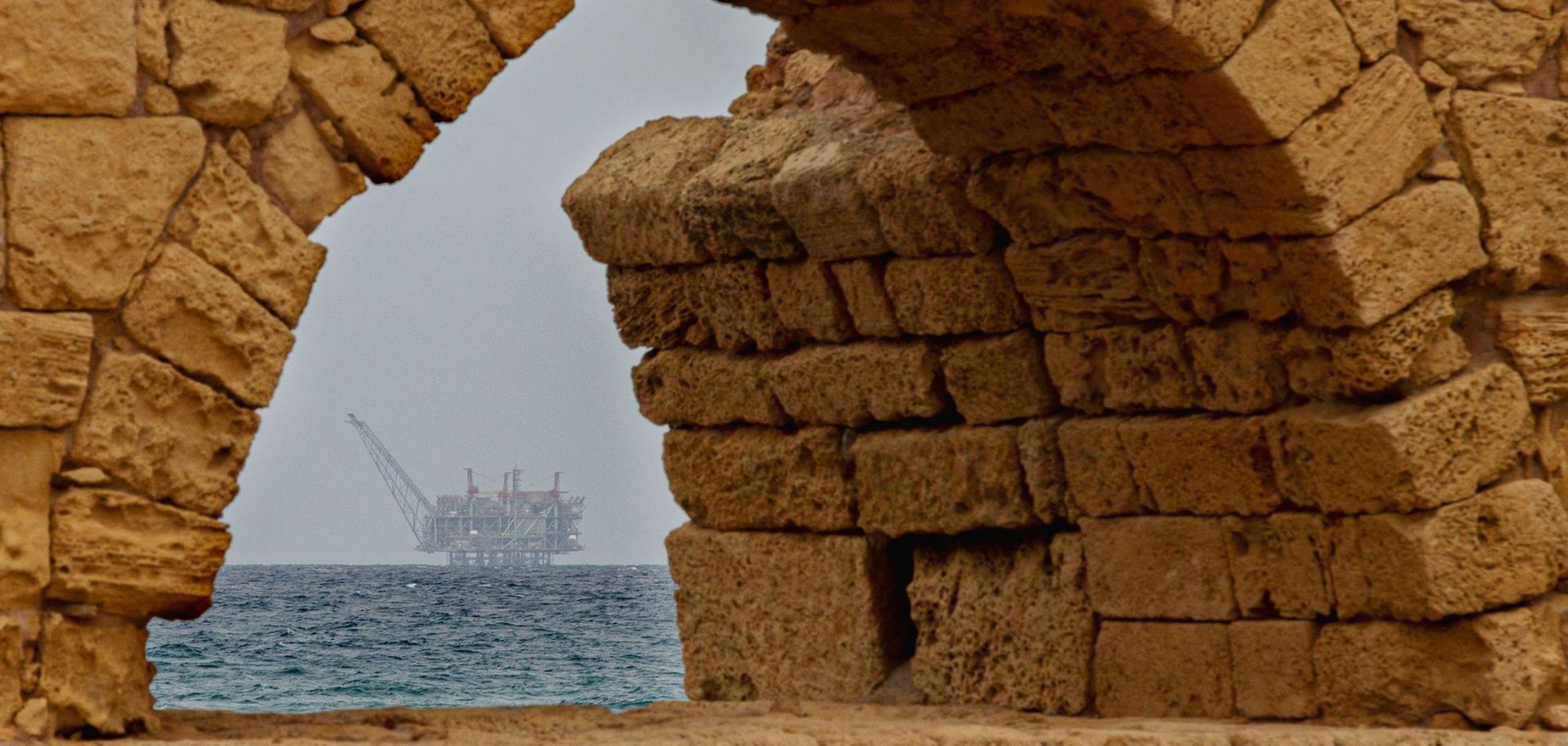
The platform in the Leviathan natural gas field in the Mediterranean Sea is pictured through an arcade in the Israeli northern coastal city of Caesarea on Feb. 24, 2022.
A Lebanese-Israeli maritime deal will ease tensions caused by the natural gas fields off the Levantine coast, pave the way for Lebanese energy extraction and increase calls in Lebanon for deeper economic ties with Israel. On Oct. 11, Israeli Prime Minister Yair Lapid and Lebanese President Michel Aoun announced they had signed a U.S.-mediated deal on divvying up energy resources in disputed waters in the Eastern Mediterranean. The agreement grants Israel exclusive control over the disputed Karish gas field, which is estimated to have 1.75 trillion cubic feet (tcf) of reserves. In exchange, Lebanon will be able to develop the Qana gas field on the basis that Israel is still compensated for resources extracted in nominally Israeli waters. The same day the agreement was announced, Hezbollah — the Iran-backed Lebanese political party and militant group who had initially staunchly opposed ceding the Karish field over to Israel — signaled it would not use its influence in Lebanon's parliament to block the deal's ratification. Other details (like the final delineation of Israel and Lebanon's maritime border) were not settled by the agreement, and appear to await more negotiations.
- Israel and Lebanon remain in a state of war and do not have a formalized border. For decades, the regional rivals have disputed a piece of land on their mutual frontier called the Shebaa Farms.
- Israel and Lebanon also have overlapping maritime claims, with Israel's claim extending around the Qana prospect while Lebanon's claim covers roughly half the Karish gas field. Following the discovery of those gas fields in the 2000s, both countries have sought to establish a final maritime border to enable energy exploration and development in the region.
- U.K.-based Energean is already preparing to extract gas from the Karish field, with tests now underway, while Lebanon has called on French multinational TotalEnergies to explore the Qana gas field.
- As negotiations were underway and energy company Energean brought in equipment to extract gas from Karish, Hezbollah threatened to attack the field if Lebanese demands were not met and flew drones to harass the rigs several times. Israel threatened to respond with strikes on Hezbollah inside Lebanon if they carried out such an attack.
- The Karish and Qana fields are smaller than Israel's other gas fields, Leviathan and Tamar, which together are estimated to have nearly 30 tcf of gas reserves. Qana's reserves have yet to be proven and are widely suspected to be smaller than Karish's reserves. But if the deal is ratified, Qana would be Lebanon's first gas field for a country that imports all its energy needs.
Israeli and Lebanese lawmakers are ultimately likely to ratify the agreement, though political factions in both countries could still try to modify or jettison it for ideological reasons. Israel's Security Cabinet approved the agreement on Oct. 12 and sent it to lawmakers in the Knesset for review. Under Israeli law, Knesset members cannot block the maritime deal but they can signal their opposition to it, which could, in theory, embolden Israel's nationalist Interior Minister Ayelet Shaked to formally vote against the motion when it returns to the Security Cabinet for a final vote — a move that could pressure the deal to go to the Knesset, where it's uncertain it would pass. Shaked abstained in the initial vote on the maritime deal on the basis that it didn't go far enough to secure Israel's interests. However, with his Jewish Home party currently polling below the threshold needed to enter the Knesset in Nov. 1 elections, Shaked appears unlikely to politically benefit from blocking the agreement, which could trigger a backlash from Israel's security establishment for bringing back tensions to the fields just as Israel begins production from Karish at the end of the month. In Lebanon, individual members of parliament could complain that the deal grants the country a less valuable gas field while it also brings Lebanon closer to normalization with Israel, which is deeply unpopular. However, Lebanese politicians are aware that TotalEnergies will not explore Qana without a deal in place, while Hezbollah knows that it is not well-positioned to stop Israel from extracting from Karish with or without an agreement. These calculations suggest that Lebanon will also ratify the deal.
- Israel's opposition parties, led by former Prime Minister Benjamin Netanyahu, have slammed the agreement as a surrender to Hezbollah because it gives up Israeli claims to the Qana field. While Shaked's Jewish Home party is tempted to echo those arguments to potentially be part of a future right-wing government, it's unlikely such a gambit would work to win supporters in the upcoming election. Right-wing voters have already soured on Jewish Home for joining the current coalition that includes left-wing and Islamist rivals to the right wing.
- Lebanon's economic crisis is making it hard for Hezbollah to credibly threaten to use military force to stop Israel's production in the Karish field, which would go ahead with or without an agreement. Hezbollah cannot politically afford another expensive war with Israel over the fields, while its patron, Iran, has shown little interest in ordering Hezbollah to escalate over the issue as well.
If the deal goes through, it would substantially decrease the threat of military escalation over the gas fields, allow Lebanese energy development, remove one stumbling block to an Israeli-European and/or Turkish pipeline, and increase calls in Lebanon for other ties with Israel. Hezbollah's surrender to the agreement signals that the militant group will likely reduce provocations and rhetorical threats against the Karish field. However, they may continue to conduct harassment flights and will likely threaten the rigs if Israel's tensions with Lebanon and Iran increase in a broader context. Additionally, TotalEnergies would be able to proceed with gas development in the Qana field, possibly leading to gas production if substantial reserves are found. The agreement also brings Israel closer to the reality of a European or Turkish undersea gas pipeline, though it will still need to find ways through Syria- and Cyprus-controlled waters to do so. Meanwhile, some Lebanese political figures will likely try to build on the deal by calling for deeper cooperation with Israel, which could unblock needed humanitarian aid and mitigate the risk of the crisis-ridden country entering another costly war with Israel.
- The patriarch of Lebanon's Maronite Christian church, Bechara Boutros al-Rahi, and other influential Lebanese leaders have sought to ease anti-Israeli sentiment among their followers in the hopes of reducing the risk of a public call for war during future periods of tension with Israel.
- Israel has offered humanitarian aid to Lebanon multiple times, including after the 2020 Beirut port explosion and in 2021 as its financial crisis continued. Hezbollah rebuffed these offers.
- The proposed EastMed pipeline could theoretically connect Eastern Mediterranean gas fields to Europe. But the project is running into economic viability challenges because of the cost stemming from the pipeline's need to go through deeper waters. Meanwhile, attempts to connect these fields to Turkey could run into more diplomatic disputes north of Lebanon. Syria and Israel remain technically at war, and Turkey has maritime disputes with both Greece and Cyprus that make a pipeline project too risky to complete.
