
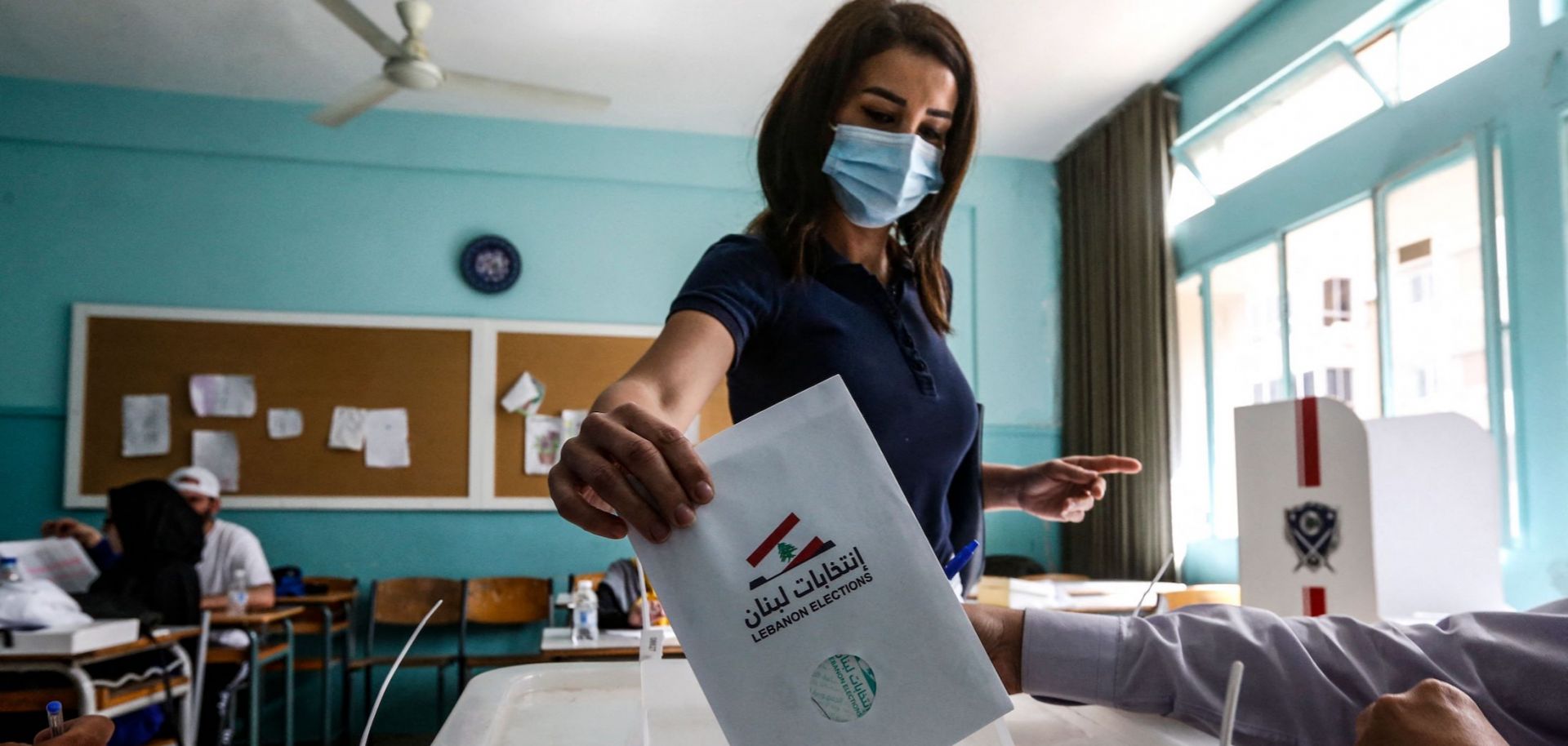
A voter casts her ballot in Lebanon's May 15, 2022, parliamentary election at a polling station in the southern suburbs of Beirut.
Parliamentary election results in Lebanon highlight voters' growing desire to escape Beirut's political paralysis, but small changes in the legislature probably won't be enough to produce the sort of economic reforms needed to ease the country's financial crisis. Preliminary results for Lebanon's May 15 parliamentary elections indicate some small but notable shifts to the likely make-up of the next legislative body. The Christian Free Patriotic Movement, an ally of the Shiite militant group Hezbollah, lost votes to the Western-leaning Christian Lebanese Forces. Meanwhile, independents likely won 11 seats and Hezbollah might have lost some seats. The early elections were the first since the country's severe financial crisis began in 2019 and since the deadly Beirut Port explosion in August 2020.
- Domestic voter turnout was 41%, less than the 49% that turned out in 2018, indicating voter apathy and a general lack of interest and trust in the government.
- Final results also do not indicate the existence of any bloc holding a clear majority, which could slow government formation and latter economic policy talks.
Independent lawmakers will be a new source of pressure on their parliamentary counterparts to engage in economic reforms. A handful of anti-government independent movements, parties and politicians emerged in the aftermath of major economically motivated protests in October 2019. These independents seemed to have captured some of the votes that might have gone to establishment parties. Once in office, they will channel popular demands for change and remind establishment politicians of the electoral cost of ignoring those demands. These independents will likely push for the new parliament to implement some IMF-backed reforms because their own financial fortunes are not tied to Lebanon's stagnant and corrupt economy, unlike established political leaders.
- Groups like Taqqadom and Li Haqqi, some of which will hold seats in the new parliament, promote breaking down established civil war-linked sectarian parties' monopoly over Lebanon's government. These groups grew in popularity after the Beirut Port explosion underscored government inefficiency's social and economic cost. In protests that broke out in 2019, citizens began demanding early elections in response to the country's social and economic crises.
Hezbollah's diminished popularity highlights frustration with the group's domestic performance, but this will not necessarily reduce Iranian influence in Lebanon. Hezbollah’s loss of parliamentary seats will hamper the group’s ability to shape government formation talks in the coming weeks. The group's popularity has been declining in recent years as more and more Lebanese focus on staying afloat economically rather than on Hezbollah's international goals. Saudi Arabia will likely try to take advantage of the apparent victory of its ally, the Lebanese Forces, over the Hezbollah-allied Free Patriotic Movement to reduce Iranian influence in Lebanon. But Hezbollah exerts most of its influence not via government office, but rather via informal means like localized, neighborhood distribution of goods and its monopoly on the use of force in much of the country.
- The Hezbollah-led coalition won 61 seats out of the 128 total seats in parliament, a decline of 10 seats from 2018 elections.
- Since its inception in the early 1980s, Hezbollah has functioned as a nonstate militia, providing a foothold for Iranian political influence in Lebanon. Hezbollah's presence in parliament is a relatively new phenomenon. Boosting its popularity, Hezbollah is smuggling much-needed fuel into the country via Syria. Even so, the fewer votes it obtained in this election compared to 2018 suggest a weakened rapport with Lebanese voters, undermining its influence in the long term.
The new parliament's makeup suggests that Beirut's political paralysis and the financial crisis it enables will endure, intensifying anti-establishment sentiments in the long run. Beirut's political system has long seen its 18 confessional groups enjoy a protected status that affords them political influence in order to reduce sectarian conflict. But the system has given rise to political infighting, gridlock and corruption. If the next parliament looks similar to the current parliament, the legislative body will struggle to implement economic reforms, as each sect fights to preserve its share of political and economic influence. Even though the financial crisis has resulted in hyperinflation, shortages of goods and hoarding, and a marked decline in consumer confidence, lawmakers have not agreed to restructure Lebanon's economy. A slightly new parliamentary lineup likely will not change this dynamic, so new waves of social unrest and anti-establishment groups' continued political growth are likely in the coming months and years.
- Lebanon's government signed a staff-level agreement with the International Monetary fund in April 2022, agreeing to look at reforms to state-backed companies, banking recapitalization, debt restructuring, social safety net reform, and much more. The political will does exist for some small-scale, easy-to-implement reforms, including working on the 2022 budget. But the larger reforms the IMF has encouraged will be difficult to achieve without a solid parliamentary mandate — something the May 15 election has failed to produce.
