
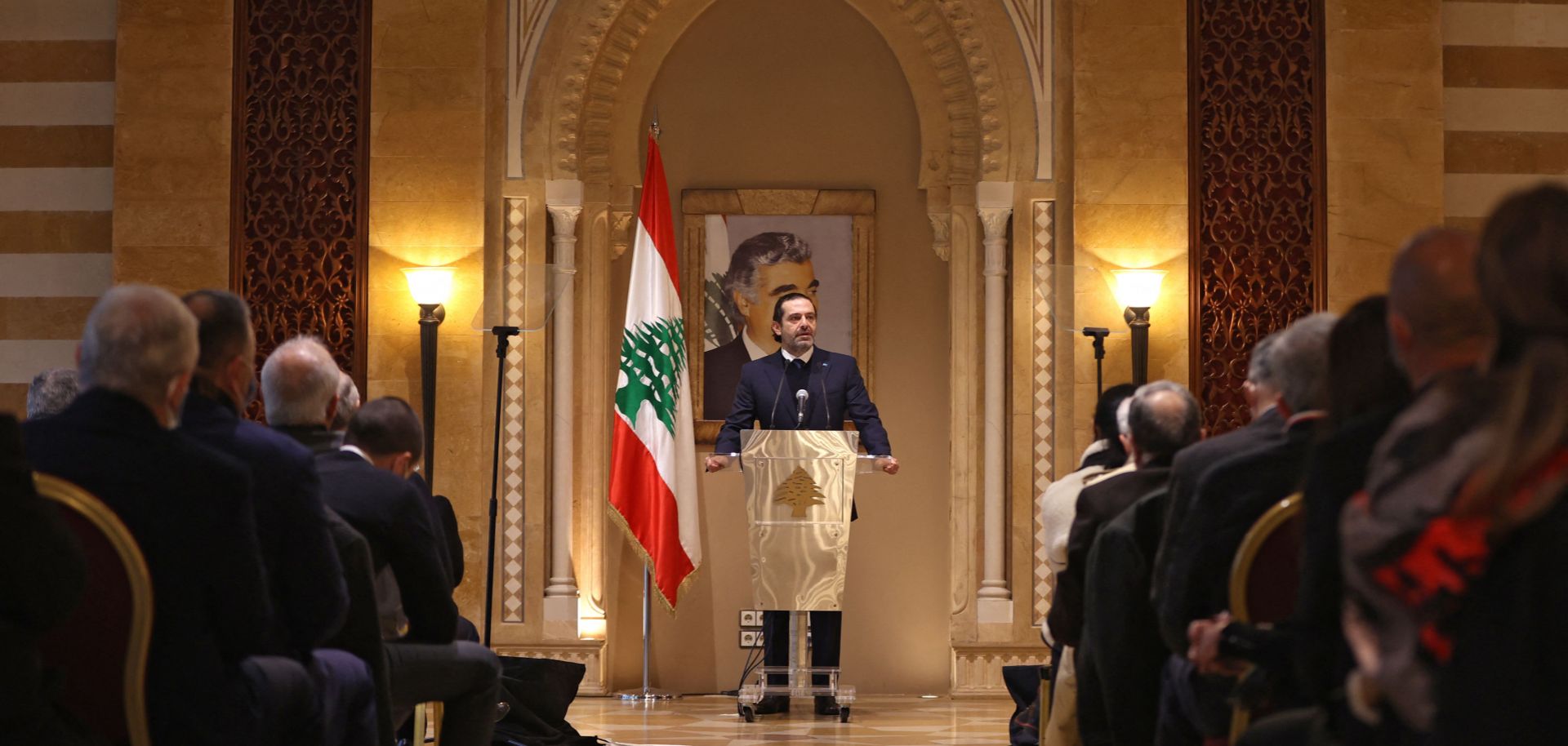
Lebanon's former prime minister, Saad Hariri, announces his withdrawal from political life during a press conference in the capital Beirut on Jan. 24, 2022.
Former Lebanese Prime Minister Saad Hariri’s decision to boycott the country’s May 15 elections will give anti-establishment politicians and pro-Hezbollah figures an opportunity to enter Lebanon’s parliament, which could spark violence if Hezbollah uses intimidation to support its Sunni allies. On Jan. 24, Hariri announced that he and his Sunni Future Movement party would not run in upcoming parliamentary elections for the first time since the end of the country’s civil war in 1990. Per Lebanon’s electoral system, the seats freed up by Hariri’s party must be filled by other Sunnis, but there is currently no party with a major following in the community that goes beyond the pro- and anti-Hezbollah political alliances of the past. Hariri’s exit from Lebanese politics thus leaves a major hole in the country’s political establishment, with no clear leader for Sunnis in the wings.
- The boycott is an apparent bid by Hariri to influence Lebanon from outside the political system rather than continuing to participate in elections where his party has been losing public support.
- Hariri headed up the influential Future Movement party that his father Rafik Hariri founded after the end of Lebanon’s civil war, using the position to become prime minister twice (2009-2011 and 2016-2019). Future Movement, in turn, led the anti-Hezbollah March 14 political alliance in Lebanon’s parliament, which was instrumental in forcing Syria to withdraw troops in 2005 after pro-Syrian elements were accused of assassinating Hariri’s father in a car bomb. Since then, the March 14 alliance has served as a political check on Syrian and Iranian influence in the country.
Pro- and anti-Hezbollah Sunnis, as well as anti-establishment Sunnis, will fiercely compete for seats in Lebanon’s legislature in the coming weeks. At least seven of the 128 seats that Sunnis have in parliament are held by independent Sunnis who served under Hariri’s Future Movement party. These politicians could run as independents despite Hariri’s boycott, leaving at least some of the anti-Hezbollah March 14 alliance’s influence intact. However, Hezbollah already counts several Sunni allies in parliament. And if the Hezbollah-led March 8 alliance is able to fill the vacancies left by Future Movement, pro-Hezbollah lawmakers could gain enough seats to form a government that excludes Hariri’s rival March 14 alliance. Anti-establishment civic organizations, galvanized by Lebanon’s three-year economic crisis, may also try to fill the power vacuum by attempting to take Sunni seats in the upcoming elections. While these organizations currently lack a formal party label, they can still run candidates as independents.
- Hezbollah’s influence in Lebanese politics has steadily increased in recent years. In the country’s last national election in 2018, the Iran-backed political party and the militant group won enough seats that Hariri’s March 14 alliance was forced to give Hezbollah lawmakers power over important cabinets like the Health Ministry.
- If Hezbollah is able to dominate the next government, the group would be able to structure much-needed economic reforms to favor supporters and punish rivals, while ensuring that reforms would not reduce the influence of its patron, Iran.
This competition could produce violence if establishment militias try to intimidate anti-establishment politicians from running and/or if Hezbollah tries to gain control of the power vacuum through force — raising the risk of a wider humanitarian crisis in Lebanon and a return to sectarian civil war. Political violence is often used to intimidate rivals in Lebanon, as exemplified by the high-profile assassination of Rafik Hariri in 2005 and the more civil society-focused killing of Lokman Slim, an anti-Hezbollah journalist, in 2021. Anti-establishment figures are unlikely to have access to the same armed group backing as establishment politicians, making them a more vulnerable group. But there’s a chance Hezbollah may even use force against establishment politicians with militia supporters in an attempt to tip the election in its favor. Such violent intimidation tactics would risk setting off a cycle of escalation that breaks down relationships between sects in Lebanon, especially if anti-establishment politicians are killed and prompt calls for revenge from their families and tribes. In addition to setting the stage for a fresh civil war, such renewed sectarian violence could also cause the current trickle of Lebanese migrants fleeing to Europe to become a flood.
