
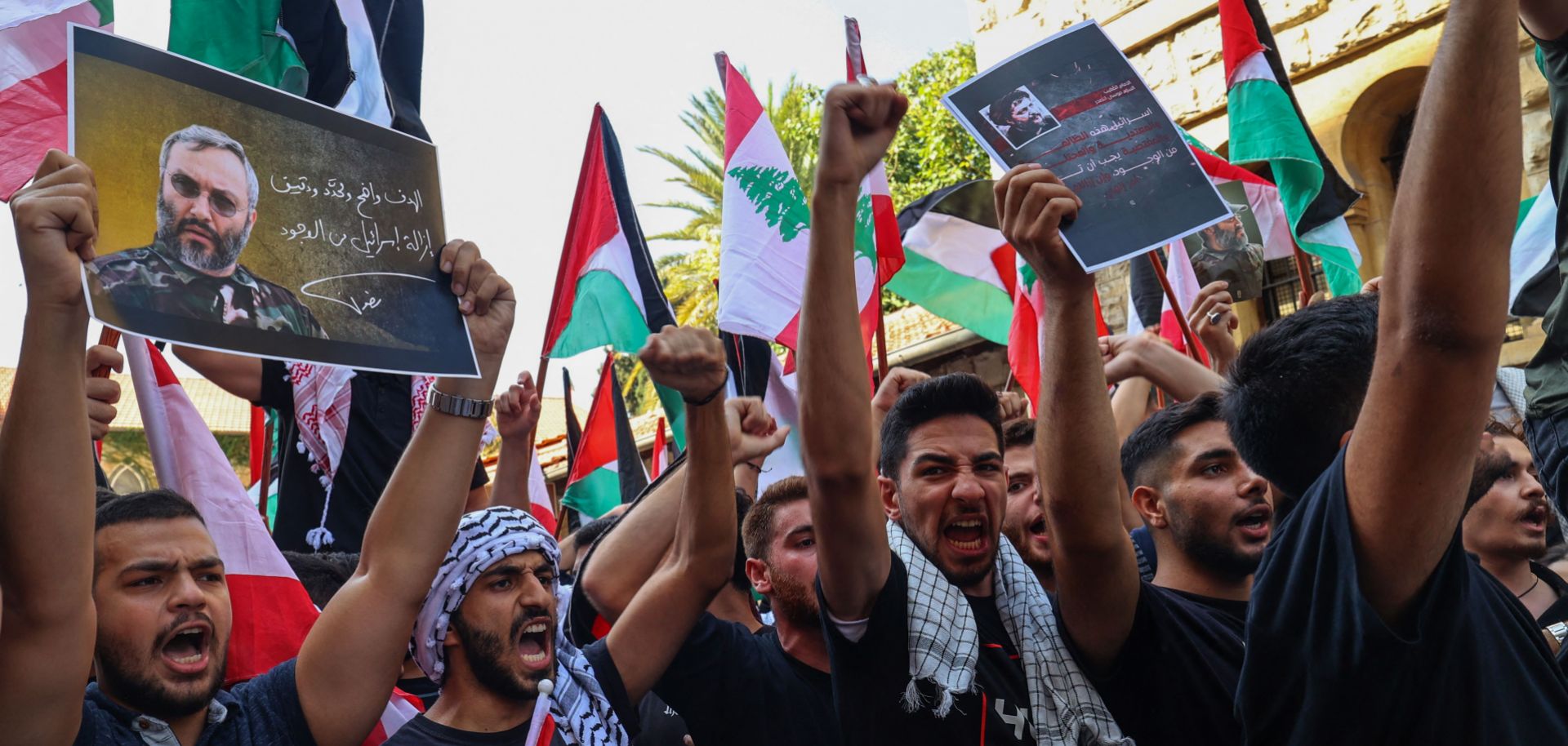
The fallout from Israel's likely ground invasion of Gaza will ripple across the Middle East and North Africa, alienating many Muslims in the region while pressuring their governments to respond, though the impact will vary significantly from country to country. In retaliation for the Oct. 7 Hamas attacks that killed at least 1,200 Israelis, Israel has conducted an assault on the Gaza Strip that has so far killed over 1,000 people — sparking an outcry in neighboring countries that will likely only intensify in the coming days, as regional media outlets put out coverage in Arabic and other local languages depicting Israel as killing hundreds or thousands of Palestinians, including women and children. Israel's expected ground invasion of Gaza will likely exacerbate this discontent across the region, as the operation will probably result in an even higher number of casualties.
- On Oct. 9, the influential Iraqi Shiite cleric Muqtada al-Sadr called on Iraqis to hold a 1 million-man demonstration in Baghdad to support the Palestinian people.
- On Oct. 11, Turkish President Recep Tayyip Erdogan called Israel's airstrikes on Gaza as ''shameful,'' adding that Israel was behaving like an ''organization'' and not ''like a state.''
- Other government and religious leaders have taken a more muted approach. While the United Arab Emirates has donated more money to Palestinian humanitarian efforts, it said that ongoing war will not affect its economic deals with Israel, called Hamas' attack a ''serious and grave escalation,'' and warned Syrian President Bashir al Assad not to get involved. The different stances can partially be explained by the different ways Middle Eastern governments must respond to their citizens' anger over Israel's action against the Palestinians and, in the Emirati case, how effectively the UAE government's own domestic media narrative has de-stigmatized Israel.
As the war in Gaza escalates, Lebanon's connections to Iran — Hamas' key ally — will increase its exposure to Western financial sanctions. The breakout of conflict on the Israeli-Lebanese border also cannot be ruled out. Lebanon will likely see frequent rallies in support of Gaza, which will put Lebanese political leaders (who are operating in a government without a president) and the Lebanese armed group Hezbollah (which is a close ally of both Hamas and Iran) in a difficult position on how to respond. Lebanon is a critical money laundering and smuggling artery for funneling Iranian (and Lebanese, Iraqi and Syrian) support to Gaza and the West Bank. On Oct. 8, The Wall Street Journal also reported that Lebanon hosted some of the meetings where Hamas leaders — along with Iranian military officials and Hezbollah figures — allegedly planned the Oct. 7 assault on Israel. In response to Hamas' attacks and Iran's links to the Palestinian militant group, the United States and Europe will likely increase their enforcement of sanctions on both Iran and countries with ties to Iran, like Syria and Lebanon. For Lebanon, such sanctions could result in tighter restrictions on its financial markets and banking sector, exacerbating the ongoing hard currency and liquidity crisis that has fueled economically motivated protests and violence in recent years. For now, Hezbollah appears to be trying to avoid getting directly involved in the Gaza conflict, which would risk spurring a significant Israeli bombardment of its forces; retaking arms against Israel would also rob Hezbollah (and consequently Iran) of its ability to escalate if the Israeli military carries out direct strikes on Iran or Lebanon in the future. However, the Lebanese militant group will likely still allow Palestinian groups to use southern Lebanon as a launching point for operations against Israel, which will nonetheless invite the risk of a proper Israeli invasion of the area to establish a buffer zone. An Israeli incursion in southern Lebanon would invariably force Hezbollah to get involved in the conflict, causing knock-on effects for the rest of Lebanon ranging from violence to supply chain and economic challenges.
The Gaza conflict could also expand to other Middle Eastern countries with connections to Iran, including Syria, Iraq and even Yemen.
- Syria: After 12 years of civil war and recurrent Israeli airstrikes, the Syrian government has a limited ability to escalate against Israel. Nevertheless, the country hosts large numbers of Iranian military troops, Hezbollah fighters and other Iranian-aligned militants, some of whom are positioned near the Golan Heights. These Iranian and Iranian-linked groups — in particular Hezbollah and other Shite militia — will likely harass the Golan Heights, as they did on Oct. 10, with mortars and other attacks designed to pin down IDF forces to prevent their deployment elsewhere. Meanwhile, these same groups may also target the 900 U.S. troops still in northwest Syria, where they are conducting a campaign against the Islamic State. These tit-for-tat U.S.-Iranian clashes have escalated to U.S. airstrikes, though the United States prefers to remain proportional in how it responds to such provocations. The U.S.S. Gerald Ford now deployed in the Mediterranean may also deploy combat aircraft to strike targets in Syria in case of an escalation. But this will also potentially create complications between the United States and Russia, as Russia retains military forces in the country, and where Russia has been using its aircraft to harass U.S. aircraft.
- Iraq: In addition to Sadr's calling for a mass protest in Baghdad, at least five pro-Iranian Shiite militias in Iraq have warned they would target U.S. interests in the country if Washington supports Israel in Gaza. Those interests include oil and gas companies operating in southern Iraq, as well as presumably the U.S. military presence in the country. Moreover, Iran's close relationship with Iraqi militias and political actors, including financing and arming of militia groups, will increase U.S. scrutiny over Baghdad's financial ties to Tehran. Indeed, earlier this month, the United States declined to send $1 billion to Iraq's central bank amid concerns that the dollars could be smuggled to Iran, which then prompted Iraq to announce it would ban dollar withdrawals and transactions beginning Jan. 1 to help de-dollarize its economy. In addition, Israel's Gaza ground invasion may prove to be the catalyst for Sadr to revive his political movement, which he suspended in April 2023 after announcing his ''retirement'' from politics in August 2022. Such a revival would come ahead of Iraqi provincial elections in December 2023 and ahead of Iraqi general elections in 2025, and would entail mass demonstrations and sit-ins that could become violent.
- Yemen: On Oct. 10, the leader of Yemen's Iran-backed Houthi rebel group said his fighters would take military action, including drones and missile strikes, if the United States intervened in the Gaza conflict on Israel's behalf. By making it more difficult for Saudi Arabia to offer the Houthis significant concessions in peace talks, such military action could collapse the de-facto cease-fire that has been in place in Yemen since October 2022. Moreover, if the crisis escalates regionally, Iran could pressure the Yemeni rebel group to revive its attacks against Saudi oil and gas infrastructure.
In the meantime, Egypt will face a potential refugee crisis and rising anti-Israel sentiment, while Jordan could see rising pro-Palestinian protests.
- Egypt: Amid Israel's expected ground invasion, Egypt is concerned that some of the over 2 million Palestinians in Gaza could try to flee to the Sinai, where they could become permanent refugees if Israel decides to bar them from returning home. This refugee burden would strain Egypt's already struggling economy, and there is no clear indication that the international community, which has already been cutting aid to the Palestinians, will arrive with financial support for Egypt. In addition, Egypt's government will try to keep anti-Israeli sentiment from producing protests, strikes and riots that could morph into an anti-government movement, especially since Egypt's treaty with Israel and its role in managing Israel's blockade of Gaza are highly unpopular. Egypt will likely tolerate some protests in specific locations, like around the Israeli embassy, which could also spread to protests against the U.S. embassy and other U.S.-related institutions. Individual attacks are possible on Israeli and U.S. interests and citizens as well.
- Jordan: The Gaza conflict will result in a surge of pro-Palestinian sentiment in Jordan, especially among its own Palestinian citizens. Jordan's parliament will likely condemn the Israeli military campaign and demand the expulsion of Israel's ambassador, while the government will likely tolerate mass protests in major cities like Amman that exclusively criticize Israel. But in actually responding to protesters' demands, Amman will be limited by its peace treaty obligations with Israel and its defense ties with the United States. This could lead to public violence — particularly in southern cities like Ma'an (where the government has struggled to contain Islamist militants), along with individual and mob attacks on sites associated with Israel and potentially the United States.
Compared with other Middle Eastern governments, the monarchies of the Arab Gulf do not have to respond as strongly to their citizens' calls to support the Palestinian cause, which will free them to take a more pragmatic approach. But in the immediate aftermath of Israel's expected ground invasion of Gaza, Gulf Cooperation Council (GCC) countries will likely freeze normalization efforts and new business deals with Israel.
- Saudi Arabia: The Gaza conflict will temporarily put Saudi-Israeli normalization talks on ice by making it virtually impossible for Riyadh to sell normalization as a concept to Saudis. Moreover, it will further incentivize King Salman, who has long been a strong supporter of the Palestinian cause, to try to slow the normalization process spearheaded by his son Crown Prince Mohammed bin Salman. Ultimately, the conflict may only temporarily derail normalization efforts as many of the underlying drivers pushing Israel and Saudi Arabia to deepen their relationship — including the shared security threat of Iran — still exist, though the delay could last years.
- Oman and Qatar: Similarly, the Gaza war will prevent Oman and Qatar from moving quickly to normalize ties with Israel, though both will retain their working relationships with Israel. Qatar, in particular, will also likely try to position itself as a mediator for the conflict.
- Bahrain and the United Arab Emirates: Both Bahrain and the United Arab Emirates have normalized ties with Israel, and both have more freedom to take a flexible approach in their response to the latest surge in Israeli-Palestinian violence. While Bahrain and the United Arab Emirates will call for Israeli restraint in Gaza, it's unlikely that either will break off ties with Israel, barring a major incident that makes Israeli action look like genocide or summary executions. Instead, the two countries will likely pause or slow down any new economic deals with Israel.
- Kuwait: Kuwait faces few challenges from the Gaza war as it was not pursuing quick normalization with Israel.
- The GCC at large: The GCC as a whole will work to keep the Gaza conflict from devolving into a larger regional conflict that could see Iran and/or the U.S. get directly involved. This is because each member of the Arab Gulf bloc has close defense ties with the United States and could find their oil and gas sector (and other critical infrastructure) targeted as a part of any Iranian military escalation strategy against Israel and the West.
Turkey, for its part, will likely try to be a mediator to end the conflict, though Israel will probably reject such efforts due to Ankara's criticism of its Gaza campaign. Turkey initially gave even-handed statements after the Oct. 7 Hamas attacks, calling for de-escalation and stability. But Ankara has since become more critical of Israel's military campaign following its mass air strikes on Gaza in response to the Hamas assault. Once Israel launches its ground invasion, Turkey will likely offer to mediate a cease-fire, relying on its pro-Palestinian and Islamist bonafides to open channels with Hamas. But the Israeli government will not want to reward Turkey after its criticism of its Gaza military strategy, likely leaving Turkey on the sidelines. Though Turkey will offer the Gaza reconstruction aid in the aftermath of the Israeli campaign, its strained economy means Turkey will only play a marginal role in the humanitarian aftermath of the war.
- Erdogan and his ruling Islamist party have been vying for the mantle of being the biggest supporter of the Palestinian cause in the region. During their tenure, Erdogan and the Justice and Development Party (AKP) have repeatedly demonstrated a willingness to cut off ties with Israel in response to Israeli action in Gaza, which Ankara did in 2010 when Israeli forces raided a Turkish-flagged vessel that was part of a flotilla designed to break the Israeli blockade on Gaza. The 2010 incident caused a rupture in Israel-Turkish ties that took six years to repair. Another such rupture, or downgrade, is certainly possible if Israel occupies Gaza indefinitely, as the two countries did not fully normalize ties until 2022.
In North Africa, countries across the Maghreb will express support for the Palestinians, but the political risk will be particularly high in Morocco due to its normalization with Israel and public discontent after last month's earthquake. The Maghreb region is largely insulated from the threat of broader escalation because it's not a theater where Israel-Iran, U.S.-Iran or even Iran-Saudi Arabia proxy competition plays out. The fact that Algeria, Tunisia and Libya are not making serious attempts to normalize ties with Israel will also limit the overall political impact of the Gaza war on Northwest Africa. But of the Maghreb countries, Morocco and Tunisia's response to the Gaza conflict will be the most important to monitor.
- Morocco: Morocco is the only Maghreb country that has normalized relations with Israel, a decision that was protested by many Moroccans when it occurred and has since continued to fuel discontent. On Oct. 9 hundreds of Moroccans took part in demonstrations to protest their country's normalization with Israel. More of these rallies are likely as Israel's military response in Gaza escalates. While unlikely to seriously threaten King Mohammed VI's monarchy, the Gaza conflict will increase Moroccans' anger over their government's outreach to Israel, which, in turn, will only exacerbate their public anger over Rabat's response to the September 2023 Marrakech earthquake that killed roughly 3,000 people. Because Morocco's elected government and prime minister are often used by the monarchy as a scapegoat to divert blame away from King Mohammed, any long-running protests could put more pressure on high-ranking officials to resign. It is unlikely that Rabat will break off ties with Israel altogether, but similar to GCC monarchies, it will probably freeze new agreements.
- Tunisia: While unlikely to pose a threat to Tunisian President Kais Saied's increasingly authoritarian rule, the fallout from the Gaza conflict could increase reputation risks for Western companies operating in Tunisia. President Saied has made provocative statements against Israel, including blaming ''Zionist'' influence for the devastating floods in September that caused two dams to collapse in nearby Libya, which wiped out entire neighborhoods and killed up to 20,000 people. As Saeid continues to consolidate power at home, and undermine popular support for Tunisian political parties and civil society groups, he may ramp up similar rhetoric in connection to the Gaza war. This creates a reputational risk for companies operating in Tunisia and working with the Tunisian government. Such rhetoric could also sour the country's relations with the European Union, potentially jeopardizing further EU aid for Tunisia, which could have a negative impact on the country's economy as Saeid has so far been unwilling to meet the International Monetary Fund's conditions for a bailout.
