
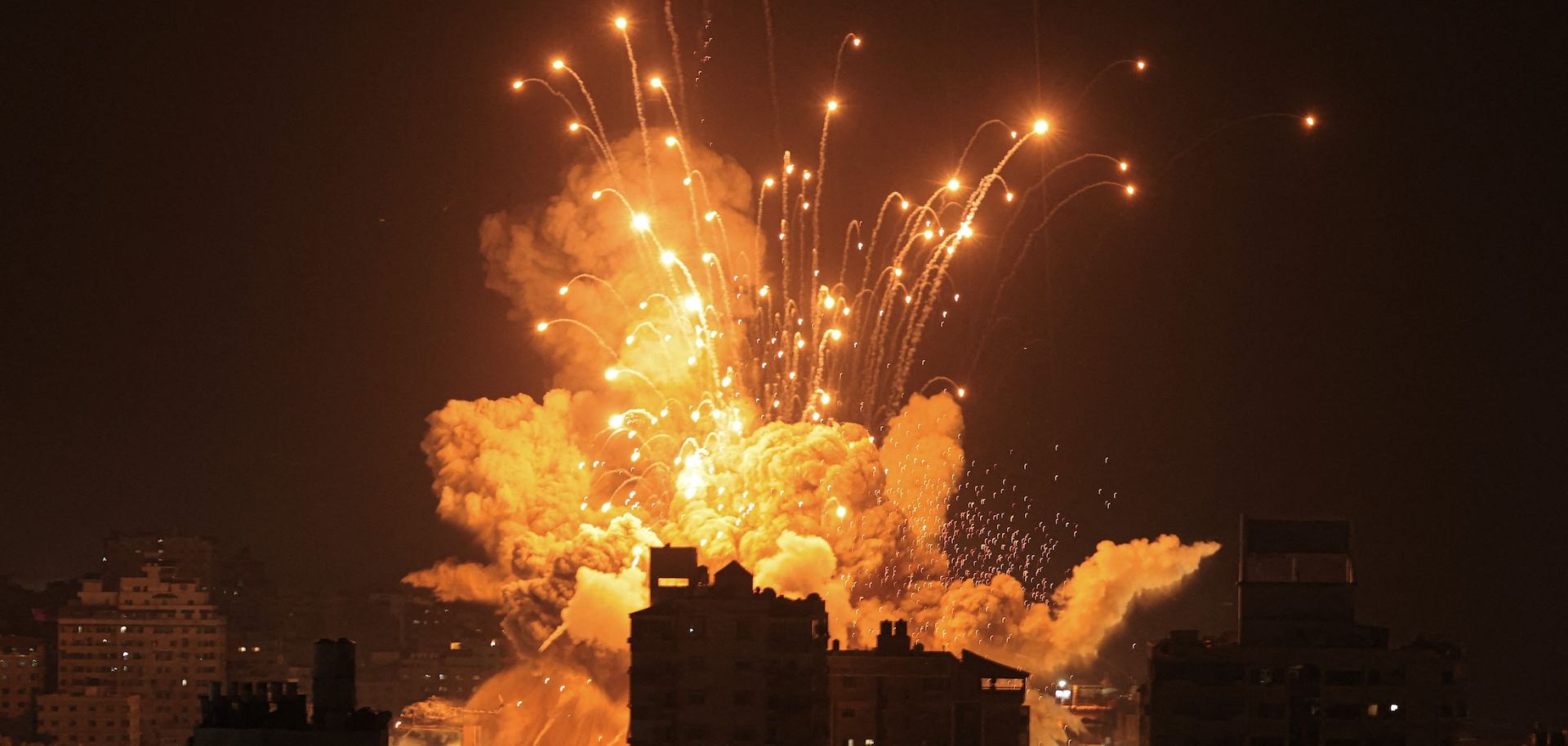
A seemingly imminent Israeli ground invasion of the Gaza Strip will threaten to spark another intifada, raise the risk of other armed groups joining the conflict, and force Israel to choose among unattractive options for potentially re-occupying the territory. It would also threaten Israel's normalization with Saudi Arabia, trigger anti-Israeli unrest in other regional countries and possibly spark a refugee crisis in Egypt. On Oct. 9, Israel's chief military spokesperson said the Israel Defense Forces had called up a record 300,000 reservists, including key units needed for a ground invasion, and is ''going on the offensive.'' These actions set the stage for a likely Israeli ground invasion of the Gaza Strip in retaliation for the attacks that Gaza-based Palestinian militant group Hamas began on Oct. 7. Through an invasion, Israel hopes to degrade Hamas' military infrastructure and ability to carry out future attacks, as well as rescue hostages when possible. The same day, citing three Israeli and U.S. sources, Axios reported that Israeli Prime Minister Benjamin Netanyahu told U.S. President Joe Biden during a call on Oct. 8 that ''we have to go in,'' seeming to imply that a ground invasion is all but assured. Already, Israeli authorities have ordered a ''complete siege'' of the strip to cut off supplies of electricity, food, fuel, water and other goods and services to its approximately 2.3 million inhabitants.
- Since the Hamas-led attacks against Israel started on Oct. 7, the Israeli military has launched barrages of airstrikes that have reportedly hit more than 1,000 targets in the Gaza Strip, killing more than 500 people.
- Israel (supported by Egypt) has blockaded the strip since Hamas took power in 2007, but Israeli authorities have allowed in some goods (like food) seen as having less of a risk of being used to make weapons.
An Israeli incursion of the Gaza Strip would involve a high casualty count on both sides, dramatically raise the risk of violence in the West Bank, and increase the scale of attacks from Lebanon that force Israel to fight on multiple fronts. Despite the high number of well-trained and equipped Israeli troops, plus airpower dominance, an Israeli invasion of the strip would be both tactically and strategically very challenging. Hamas and other groups like Palestinian Islamic Jihad (PIJ) have erected a vast series of hideouts, tunnels and traps from which to hide and attack Israeli soldiers, especially younger reservists who have no experience fighting in urban warfare in the strip, which is extremely densely populated and therefore carries a high risk of collateral damage. Moreover, the fact that Hamas and PIJ are holding dozens of hostages (reportedly 100 in the case of Hamas and 30 in the case of PIJ) means that Israeli troops will not be able to rely on overwhelming firepower and to some extent will have to fight on the ground in more nuanced, cautious ways. There will be many casualties on both sides, raising the risk of another intifada (Palestinian uprising) not only in Gaza but also in the West Bank, where tensions are already at a boiling point after months of violent unrest and tit-for-tat targeted attacks between Israelis and Palestinians. The Lions' Den, a militant group in the West Bank whose growing influence has challenged Hamas for leadership of the Palestinian resistance, has reportedly already called on West Bank residents to ''take up arms immediately,'' adding credence to the risk of a new intifada. In addition, Hezbollah and Palestinian factions in Lebanon appear poised to increase their involvement to force Israel to fight a multi-front war, and an Israeli invasion of the Gaza Strip would give these groups an even greater incentive to join the conflict more aggressively.
- On Oct. 9, Hamas claimed that Israeli airstrikes had already killed four hostages in Gaza. Later the same day, the group also threatened to begin killing Israeli civilian hostages if the Israeli military continued to strike the territory without warning.
- Israeli leaks allege that Iran is pushing Hezbollah to join the war and that the branches of Palestinian factions in Lebanon — including Hamas, Fatah, the PIJ and the Popular Front for the Liberation of Palestine — are reportedly examining attack options as well. On Oct. 9, Hezbollah and Israeli forces traded artillery, rocket and drone strikes across the border, while PIJ claimed responsibility for a brief infiltration of northern Israel. In preparation for a major escalation on the northern front, the Israeli military has ordered civilians to take appropriate measures, like stockpiling food and water.
- During the First Intifada (1987-1993) and the Second Intifada (2000-2005), Palestinians engaged in frequent violent riots, protests and targeted attacks against Israeli security forces and civilians in not only the Palestinian territories but Israel itself.
Following a ground incursion, Israel's options for reoccupying Gaza would all have major drawbacks, pointing to further instability and insecurity in the territory. Prime Minister Netanyahu has promised that Israel's reaction will ''change the Middle East'' and that ''what Hamas is going to experience will be difficult and terrible,'' suggesting that he intends to take back control of the Gaza Strip. Israel seemingly has three main options for occupying and governing the territory, none of which is likely to lead to long-term stability or security. First, Israel could turn control over to the Palestinian Authority (PA), which already governs the West Bank. Doing so could add a figleaf of legitimacy by leaving Palestinians ostensibly in control of the territory, but support for the PA has plummeted in the West Bank and Gaza, and Israeli authorities are highly skeptical of its ability to rule. Transitioning PA governance to Gaza is thus unlikely to occur and even less likely to be successful (that is, assuming the PA would even agree to take over the territory, which remains an open question). Second, Israel could try to set up an alternative form of governance through a different Palestinian intermediary, but it would also suffer from little legitimacy in the eyes of Gazans and, after the unprecedented violence over the weekend, Israel is unlikely to want to experiment with an untested Palestinian government that would probably be seen as a puppet. Finally, Israel could seek to directly rule the territory, potentially under its existing Coordinator of Government Activities in the Territories (COGAT) body within the Ministry of Defense. The far-right parties that support Netanyahu's government have long been pressing for Israel to retake control of Gaza from Hamas since Israel evacuated settlers and its forces from the territory in 2005. However, doing so would impose direct Israeli administration upon a population that is vehemently opposed to it — requiring a long-term and significant Israeli security deployment to the territory and likely sustaining new rounds of violent pushback from both organized groups and the grassroots (similar to what has been seen recently in the West Bank), while also risking an erosion of Western and Arab support for Israel.
- Israel directly governed the Gaza Strip after capturing it from Egypt in 1967 until 2005. During that time, Israel established settlements and used the territory as a military operations center. But starting with the Oslo Accords in 1993, Israel declared its intention to withdraw from Gaza and hand it over to the PA. Israel withdrew in 2005 and forcibly dismantled its settlements, and in 2007, Hamas took power after a brief civil war with Fatah, the PA's controlling party.
An Israeli ground invasion of the Gaza Strip would also put efforts toward Israeli-Saudi normalization on ice and trigger anti-Israeli protests and targeted attacks throughout the region and beyond. In recent months, Riyadh has been negotiating with Washington about a potential defense pact as part of a larger deal for Saudi Arabia to normalize relations with Israel. So far, the kingdom has largely kept its public statements on the Gaza conflict confined to calling for the prevention of further violence. However, an Israeli invasion of the strip would make it virtually politically impossible for Riyadh to proceed with normalization discussions, at least in the near term, due to the reputational blowback of being seen as working with the Israelis while Palestinians are under siege. Israel and Saudi Arabia may still maintain backchannel talks, as they have mutual interests in cooperating against Iran. But any major deal in the coming weeks is now all but off the table. Similarly, the other states that have normalized their Israeli ties under the Abraham Accords — Bahrain, Morocco, Sudan and the United Arab Emirates — will likely pull back on some of their public cooperation with Israel, such as suspending travel and curtailing investment. Regardless, anti-Israeli (and anti-Jewish) protests and attacks can be expected throughout the Middle East and beyond, especially if Israel invades Gaza. Some protests and isolated acts of violence have already occurred (including the Oct. 8 police killing of two Israeli tourists in Egypt), but the likelihood of massive Palestinian casualties and physical destruction during an Israeli incursion into Gaza would likely spark much larger protests and significantly raise the potential for targeted anti-Semitic attacks.
- An Egyptian policeman killed two Israeli tourists and wounded an Egyptian guide in a shooting in Alexandria on Oct. 8 as anti-Israeli sentiment surged across the country. Egypt's security forces regularly have to combat Islamist militants in the Sinai and respond to attacks on Israeli tourists. Elsewhere, anti-Israeli protests have been seen not only in multiple Middle Eastern countries, but also in the United States and Europe.
Finally, an Israeli invasion could send an influx of Gazan refugees into neighboring Egypt, creating a major crisis that worsens the North African country's economic challenges. Already, Cairo is reportedly fearing ''a humanitarian catastrophe that we would not know how to deal with.'' In combination with the Israeli imposition of a total blockade, an invasion would push Gazans to try to flee into Egypt through the Rafah border crossing, which is the only one still open connecting the territory with Egypt. While Cairo is trying to mediate between Israel and Hamas to prevent further escalation, it would likely be forced to accept large numbers of Palestinian refugees and the financial cost of caring for them. In the event of an Israeli re-occupation of Gaza, refugees who left for Egypt may also be unable to return, meaning Egyptian authorities could be on the hook for their care for a longer period.
- High inflation, a devalued currency and increasing unemployment have increasingly strained Egypt's economy. Absent significant foreign support to cover the cost of hosting refugees, any redirection of government financial support for refugees could come at the cost of more support for Egyptian citizens, many of whom are struggling to purchase food and other necessities.
- Egypt has bolstered resources in North Sinai for medical, food and fuel aid and supplies. On Oct. 8, North Sinai Governor Mohamed Abdel Fadel Shousha reportedly held an emergency crisis meeting to prepare for the coming influx of refugees, and to assess the humanitarian aid in storage that could be sent to the Gaza Strip via the Rafah border crossing. Authorities in North Sinai are also allegedly identifying sites that could be used as potential humanitarian shelters.
