
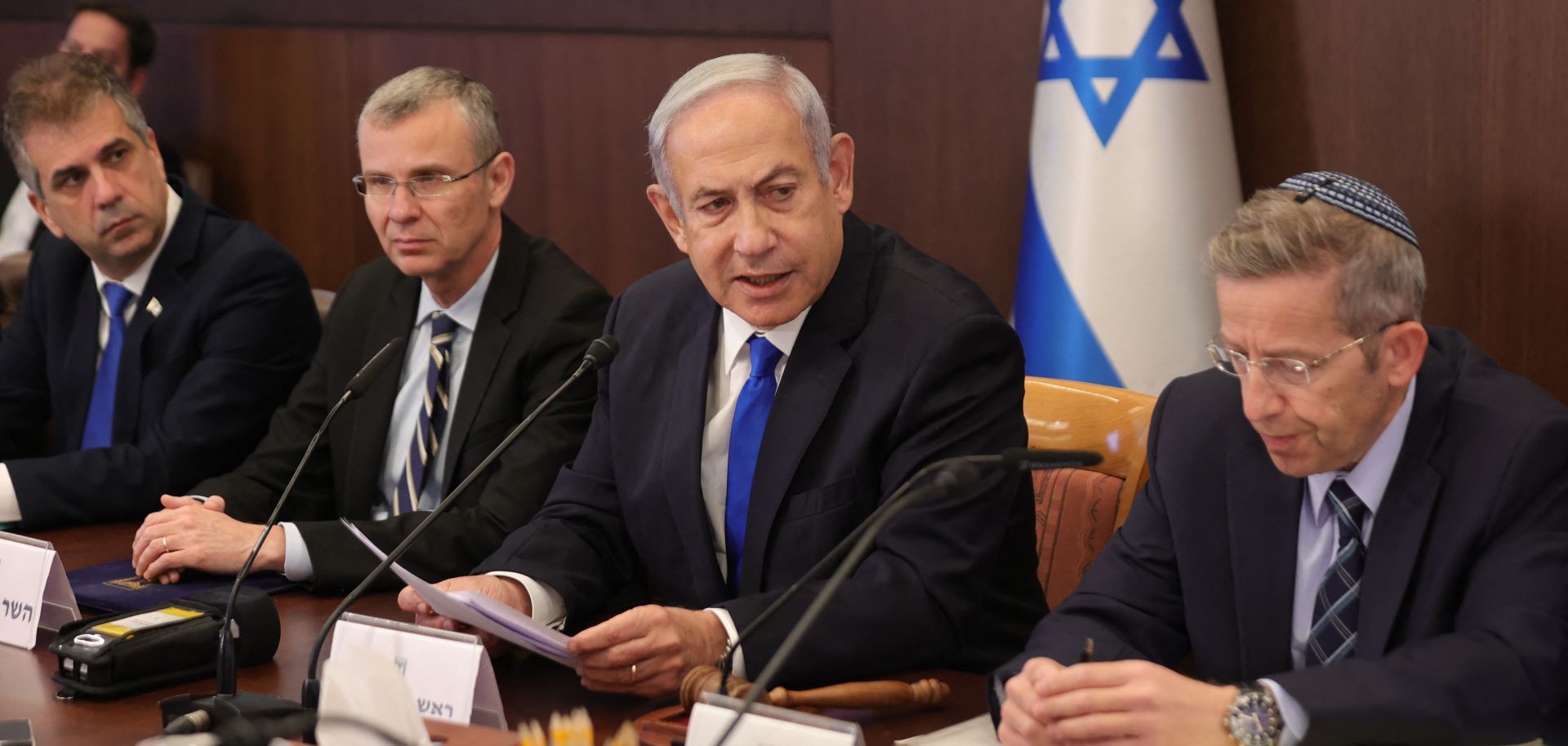
Israel's far-right policies will undermine U.S.-mediated efforts to expand the Abraham Accords to Saudi Arabia in the near term and will cause friendly Arab and Muslim countries to increasingly turn to diplomatic and potentially economic measures to signal their opposition to Israel's push to impose a one-state solution on the Palestinians. On June 23, Moroccan Foreign Minister said that his country had pulled out of hosting the Abraham Accords' Negev Summit (which was tentatively scheduled for June 25) in protest of violence and Israeli settlement expansion in the West Bank, marking the latest setback to Israeli and U.S. attempts to integrate Israel into the region's diplomatic fabric. In March, U.S. media also reported that Saudi Arabia had demanded U.S. support for a Saudi civilian nuclear program and a U.S. defense pact in exchange for Riyadh's normalization with Israel. Later in the spring, Israeli officials began to sound more downbeat about normalization prospects as well, as they admitted that hoped-for flights between Israel and Saudi Arabia for Israeli Muslims embarking on hajj this year were unlikely to materialize in the near term.
- In 2020, the United Arab Emirates, Bahrain, Morocco and Sudan signed the Abraham Accords, which established formal diplomatic relations with Israel. After this diplomatic milestone, observers turned to Saudi Arabia as a possible next member, as Riyadh and Israel have long-standing covert intelligence, political and economic ties, as well as a mutual foe in Iran. In fact, Saudi Arabia opened its airspace to Israeli overflights in August 2022, reformed school textbooks to de-emphasize anti-Semitism and anti-Israeli themes, and hosted numerous Israeli businesspeople.
- However, the ideological composition of the Israeli government has changed significantly since the Abraham Accords were signed, because Prime Minister Benjamin Netanyahu’s current coalition government (which took over in early 2023) includes far-right, anti-Arab political parties like Religious Zionism.
- Violence in the West Bank and Gaza Strip, which was already on the rise in 2022, has accelerated since the appointment of the new Israeli government. There was a short war between Israel and Palestinian Islamic Jihad (PIJ) in Gaza in May 2023, along with attacks and gun battles in the West Bank and Israel. 2023 is already set to outpace 2022 in terms of overall deaths: by June, up to 170 Palestinians and 24 Israelis had been killed, compared with 231 Palestinians and 24 Israelis in all of 2022.
- Saudi Arabia has publicly tied normalization with Israel to a Palestinian state, though there was speculation that this policy was tied to King Salman and not his son, Crown Prince Mohammed bin Salman, who reportedly met with Netanyahu in late 2020.
The slowing signs of normalization come as the Israeli government races to construct more settlements in the West Bank, stoking instability in the region and increasing public and official outrage against Israeli policies across the Muslim and Arab world. In recent years, the Palestinian issue has dropped as a public priority in international affairs, in part due to the geopolitical shocks of COVID-19, Russia's invasion of Ukraine, and generational and political weariness with the long-standing Israeli-Palestinian conflict. But public interest in the Muslim and Arab world has also been waxing in the face of the rise of the far-right Israeli government and the acceleration of settlements that are sparking violence. This increase in regional attention to the Israeli-Palestinian conflict has led to increasingly strident public condemnation of Israeli policies by Saudi Arabia, the United Arab Emirates, Oman, Jordan, Morocco and Turkey, even as they retained diplomatic and covert ties with Israel. While such public criticism cannot reverse Israeli-Arab normalization, it may have factored into Saudi Arabia's decision to make new demands of the United States in exchange for normalizing ties with Israel.
- The governments of Saudi Arabia, the United Arab Emirates, Bahrain and Jordan have condemned the policies of Israel's far-right government with increasing frequency in recent months, including Israeli military operations like the Gaza war in May, the storming of the al-Aqsa Mosque in April, and the recent violence in Jenin in June. This suggests that officials in these states have become more critical of Israeli behavior.
- According to a 2022 survey by the Washington Institute for Near East Policy, support for the Abraham Accords fell in the United Arab Emirates to 25% from 47% from 2020 to 2022. Bahrain also saw a large drop: 20% of the population supports the deal, down from 45% in 2020.
- According to a 2022 survey by the Washington Institute for Near East Policy, support for the Abraham Accords in the United Arab Emirates fell from 47% to just 25% between 2020 and 2022. Bahrain also saw a large drop, with 20% of the population saying they supported the deal in 2022 compared with the 45% who said so in 2020.
U.S.-mediated efforts to normalize relations between Saudi Arabia and Israel are unlikely to achieve a breakthrough in the near term as Riyadh makes demands that Washington will not want to meet. Meanwhile, public and official opinion in Saudi Arabia will harden against normalization as long as violence continues to escalate in the West Bank and Gaza, and as Iran's threat to the kingdom wanes. In exchange for normalization, Saudi Arabia wants U.S. aid to develop a civilian nuclear program. But Israeli and U.S. officials oppose such a program without appropriate safeguards to ensure it doesn't result in a Saudi nuclear weapons program, which Riyadh has balked at. Additionally, before it agrees to sign the Abraham Accords, Saudi Arabia has demanded to see progress on the Palestinian issue, which has also been met with pushback from Israeli far-right ministers who want to annex the West Bank and potentially even re-occupy the Gaza Strip. Both U.S. National Security Advisor Jake Sullivan and U.S. Secretary of State Antony Blinken have made several recent visits to Saudi Arabia where they've discussed normalization. But despite this, U.S. and Israeli officials have downplayed the prospects of Riyadh joining the Abraham Accords anytime soon due to the kingdom's disapproval of Israel's Palestinian policies, as well as its nuclear and defense demands. In addition, Saudi Arabia's signing of the Chinese-brokered deal to restore diplomatic ties with Iran earlier this year has undermined one of Riyadh's biggest drivers for normalization with Israel: a mutual fear of Iran.
- Compared with its successor, the administration of former U.S. President Donald Trump was more willing to shift U.S. policy in order to convince Arab countries to normalize their ties with Israel, as it did by lifting sanctions on Sudan and recognizing Morocco's territorial claims in the disputed Western Sahara region. But the Trump administration also opposed a civilian Saudi nuclear program without appropriate safeguards, and showed little sign of wanting a defense pact with Riyadh as well — policies that have remained consistent under U.S. President Joe Biden.
- For years, mutual fears of Iran had driven Israel and Saudi Arabia to deepen their covert ties, and it was widely speculated that Saudi Arabia would allow Israeli warplanes to cross its airspace in case of a direct strike on Iran's nuclear program. However, the historic detente Iran and Saudi Arabia agreed to in March has since eased diplomatic tensions between the two former rivals. It's also reduced direct attacks on Saudi Arabia from Houthi rebels in Yemen and other Iranian proxies in the region.
Other governments in the region are likely to downgrade diplomatic relations with Israel and might pull back investment, support anti-Israeli consumer boycotts, and limit Israeli tourism — especially if there is an outbreak of widespread violence in the West Bank and/or another major war between Israel and Palestinian militants in Gaza. As Israel expands settlements and carries out military crackdowns in the West Bank, and as Palestinian militants and civilians respond violently, Arab and Muslim states will likely focus on symbolic measures to oppose Israeli policies, like withdrawing their ambassadors or expelling Israeli diplomats. Jordan routinely utilizes this tactic to offset public pressure to take stronger steps against Israel. But Egypt, Morocco, the United Arab Emirates and Bahrain may also follow suit, depending on the scale of violence between Israelis and Palestinians and the public perception of Israel's culpability in the bloodshed. Some state-backed investment companies, like those based in the United Arab Emirates, might slow investment into Israel as well, though such firms may cite economic uncertainty surrounding the government's ongoing push to enact controversial judicial reforms as their rationale in order to avoid confrontation with Israel. Formal and informal boycotts of Israeli goods, services, companies and tourists could also grow across the region. The extent to which Israel's diplomatic and economic isolation deepens will hinge on the level of violence in the West Bank and Gaza Strip, with the trends toward the country's regional alienation strengthening if the situation approaches a full-scale intifada and/or major war with Hamas, the Palestinian militant group that rules over Gaza.
- In April, Jordan's symbolic parliament voted to expel Israel's ambassador to Amman after Israeli Finance Minister Bezalel Smotrich made controversial remarks in which he said ''There are no Palestinians, because there isn't a Palestinian people,'' though Jordan's King Abdullah has so far demurred expelling the ambassador. In 2019, Jordan also recalled its ambassador to Israel to protest the detention of two Jordanian nationals by Israel, and only returned the ambassador once the pair was released to Jordanian custody two weeks later.
- Between 2019 and 2022, trade between Israel and the United Arab Emirates grew from $11.2 million to $1.2 billion between 2019 and 2022, driven largely by increased flows of tourists, technology products and agricultural exports. There are numerous ways the Emirati government can leverage this expansion of economic ties to signal its displeasure with Israel's behavior, including by interfering in trade flows, denying Israelis visas to visit and/or reducing investment into Israel.
