
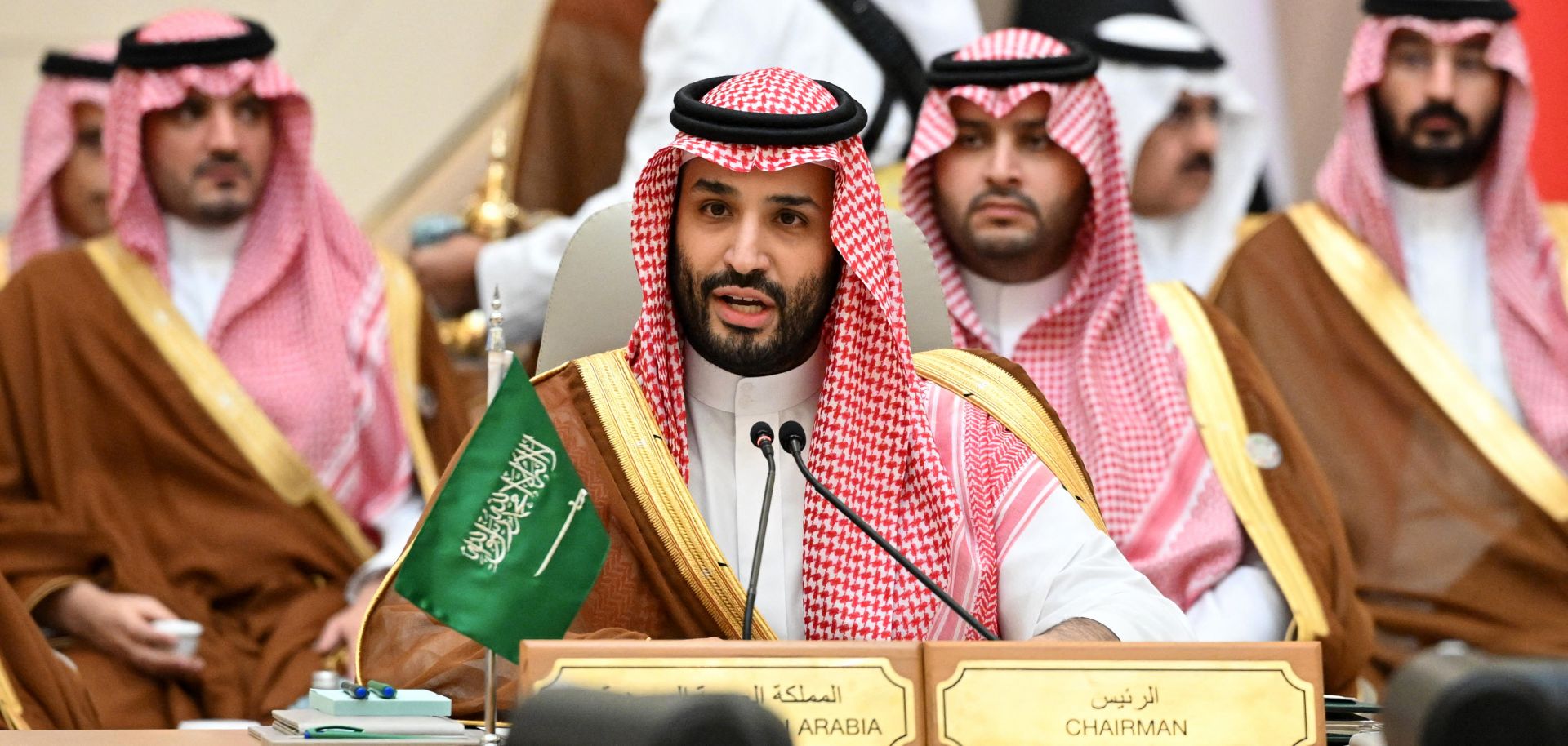
Saudi Crown Prince Mohammed bin Salman speaks during a regional summit in Saudi Arabia's Red Sea coastal city of Jeddah on July 16, 2022.
U.S. President Joe Biden’s trip to Saudi Arabia has come and gone, with hopes that there might be more than just baby steps on Riyadh’s path toward normalization with Israel gone with it. Saudi Arabia did agree to let Israeli airlines fly through its airspace, as well as let Israeli hajj pilgrims directly visit the kingdom (prior to this, they had to travel through Jordan). But these were comparatively small concessions and further tempered by statements from Saudi officials that little else would happen without a Palestinian state being put on the map.
For now, Saudi-Israeli normalization looks sure to remain slow under King Salman. But Crown Prince Mohammed bin Salman (commonly known as MbS) will eventually ascend to the throne once his 86-year-old father dies. And when he does, MbS’s characteristic brash approach to geopolitics could see Saudi Arabia normalize ties with Israel sooner rather than later.
At stake, however, could be the legitimacy of Saudi Arabia’s monarchy, which binds together a diverse nation of some 22 million citizens under a single ruler based on the enduring belief that the royal family has Saudis’ best interests at heart. But if MbS decides to normalize with Israel upon being crowned king, he will be testing the limits of that relationship, because while the case of normalization may be in the strategic interest of the Saudi state, it’s less clear how it is in the interest of the Saudi people.
The Issue of Saudi Opposition
On the surface, there are plenty of reasons why Saudi Arabia might normalize ties with Israel. The two countries have no historical antagonism: they’ve never been directly at war (though Saudi Arabia did send some forces to the 1948 war under Egyptian command). Both Saudi Arabia and Israel also fear Iranian hegemony and its advancing nuclear program. Saudi Arabia’s economy could use access to Israel’s technologies as well, and the kingdom’s developing military could utilize Israeli military systems — especially anti-rocket and ballistic missile systems like the Iron Dome and David’s Sling, which could help protect Saudi cities from airstrikes launched by Iran and Iran-backed Houthi rebels in Yemen.
However, many Saudis remain opposed to normalization — including, most notably, King Salman. Though 86 years old and in poor health, he is the Saudi state. And his personal opposition to normalization is well-known, with the question of the Palestinian state being at the root of that opposition. With the absolute monarchy still in place, there is little that pro-normalization forces, like MbS (who called Israel a “potential ally” in an interview with The Atlantic in 2022), can do to overcome his veto. The king can be influenced by tribes, royals, businesspeople and others. However, the legal reality is that so long as King Salman keeps normalization off the table, this issue is a dead letter in terms of policy. And there isn’t much reason to think the king will change his mind. He’s at the end of his life and doesn’t appear ready to jettison Saudi Arabia’s role as a pro-Palestinian champion as one of his final acts.
Normalization also remains highly controversial among the greater Saudi populace. What limited information is available on public sentiment in the kingdom suggests that citizens still widely oppose the idea of officially recognizing Israel before the establishment of a Palestinian state. As custodians of the world’s holiest Muslim sites, including Mecca, many Saudis (including King Salman) believe their country cannot be seen as legitimizing the Israeli occupation of Palestinian land, the continued construction of Israeli settlements in the West Bank, or Israel’s denial of Palestinian rights.
Within the current context, any effort by the government to normalize relations with Israel would be met with stiff public resistance and even unrest, which might mirror the Shiite protests of the 2010s or the al Qaeda uprising of the 2000s. If Riyadh is intent on normalization and wishes to avoid such backlash, it must maintain its current approach of slowly building ties with Israel, allowing the public to digest those ties, and then letting the benefits steadily chip away at Saudi citizens’ hostility toward the idea of officially recognizing Israel before the establishment of a Palestinian state.
But Does Opposition Matter in an Absolute Monarchy?
Once King Salman dies, however, MbS will be free to embrace normalization fully. And he may justify that effort by telling himself Saudis are either too cynical about the Palestinian cause, too busy modernizing, or too fearful of his security forces to put up a significant fight.
Indeed, Palestinian activism in Saudi Arabia isn’t as widespread as it used to be — a trend that will likely continue, as the Saudi state and, in turn, Saudi citizens de-prioritize the Palestinian cause. Saudi state activism on behalf of the Palestinians has declined significantly in recent years amid increased political infighting within the Palestinian Authority (PA) and the dimming prospect of a two-state solution. With its donations to the PA declining by 81% from 2019-2020, Riyadh’s shift away from supporting Palestinian leaders sets the tone for the public: as the monarchy de-emphasizes Palestine in media, policy and donations, Saudi citizens encounter the Palestinian question less often. This may not necessarily change underlying attitudes in Saudi Arabia that overwhelmingly favor a Palestinian state, but it certainly reduces its urgency. The 2021 Gaza War, for example, did not cause any notable domestic disturbances in Saudi Arabia. Saudi social media also largely hewed close to the state line and avoided demands for escalation during last year’s flare-up between the Israeli military and Palestinian militants. MbS could well conclude that this reduction in urgency also might mean a weakening of public pushback for normalization as well.
Many Saudis, especially young Saudis, are also busy navigating the turbulent political and social changes that have emerged in the past few years. Survey after survey shows that Saudis are focused on housing affordability, education and work (though admittedly many of the surveys, often state-funded, do not ask questions about the Palestinian cause). Saudi social media teems with gaming videos and pop culture rather than controversial politics. Even one of its most popular social media preachers, Mohammed al-Arefre, has hewed close to the government line on Israel, staying mum during the Gaza War last year, without taking an overt dent in popularity. Ordinary Saudis’ minds are, apparently, simply focused on things other than politics. Even the kingdom’s ongoing military intervention in Yemen’s civil war, while largely unpopular among Saudis, hasn’t created an opposition movement or serious threat to MbS’s rule, despite the conflict’s growing cost in terms of killed Saudi soldiers and until recently increased Houthi attacks on Saudi soil.
But even if there is pushback against normalization, it’s unlikely to pose a serious threat to the authoritarian Saudi state, which is well-equipped to readily handle (and quickly quash) such dissent. Within Saudi Arabia’s closed political system, there are few outlets for citizens to voice their political grievances beyond staging illegal protests, which would be met by the kingdom’s capable security forces. Even the potential for more violent terror attacks would merely inspire military crackdowns. Saudi Arabia already showed how it would handle protests during the Arab Spring, crushing the Shiite Eastern Province popular movement and demolishing much of the Shiite town of al-Awamiya. Its tactics against dissidents are equally harsh, leading to the Ritz crackdown in 2017 and the assassination of Jamal Khashoggi in 2019. And it has plenty of softer ways to approach opposition as well, from cutting government benefits to families to pressuring their companies to lay off dissenting workers.
And should Riyadh need to crush dissent, it is clear the kingdom can do so without much in terms of international pushback. Biden’s recent visit appears to send a signal that, for all the Western condemnation of Saudi abuses, the kingdom’s economic and strategic heft in both regional affairs and the global oil market ultimately trumps the United States and its allies’ human rights concerns. U.S. pressure on Saudi Arabia’s human rights record would likely erode further if former Donald Trump or another Republican retakes the White House in early 2025. A Republican administration would likely see Washington more avidly push for Saudi-Israeli normalization as well, given that it was Trump who started the recent Arab normalization process by inking the Abraham Accords in 2020 — a policy that much of his Republican Party has since embraced.
MbS the Gambler
With such assumptions, MbS could thus readily conclude that the much-feared public blowback to Saudi-Israeli normalization may never manifest. After all, Bahrain, Sudan and Morocco recently normalized their ties with Israel without major pushback, and each of those countries has either more vibrant opposition groups, weaker social contracts, and/or poorer security environments than those which exist in Saudi Arabia.
And the impacts of normalizing with Israel could bring real benefits to the kingdom just as they have Bahrain, Sudan and Morocco — from giving Saudi Arabia a new arms partner (with powerful anti-missile and drone technologies) that won’t criticize how it uses such systems (unlike U.S. lawmakers in Congress), to granting Saudi pilgrims access to holy sites in Jerusalem and the West Bank. Normalization can also bring Israel’s cutting-edge agricultural and climate technologies to the rapidly modernizing kingdom that’s already feeling the effects of water scarcity and warming global temperatures.
But pursuing normalization without considering Saudi public opinion won’t come without risks. And in Saudi Arabia’s case, that risk may include weakening the monarchy’s legitimacy.
To some foreign observers, Riyadh’s hold on power is pulled together by redistributed oil wealth and brute force. It’s deeper than that, however; there are plenty of poor Saudis and yet political violence remains relatively rare in the kingdom. Rather, many Saudis see their monarchy in paternal terms, which in Western terms might be analogous to the relationship between a fiduciary financial advisor and their client. The royals, Saudis believe, have an ethical, religious and personal responsibility for the well-being of their subjects.
But monarchy’s legitimacy is frail, as it is not backed by a constitution or political institutions, but by personal and tribal allegiances, overlaid with a royal mystique that imbues the king and royal family with an unassailable position in the kingdom (it is, after all, Saudi Arabia, a country named after a family). And if MbS ignores public opinion and normalizes with Israel, he might finally take a step too far for the public.
Many of his other controversial acts, like intervening in Yemen and even the Ritz crackdown, had an element of patriotism to them, as they sought to beat back the rival Yemeni Houthis or break corruption among Saudi Arabia’s elite, respectively. Pushing aside the religious police and ulema class was largely popular, especially among much-stifled youth. Normalizing with Israel, on the other hand, is neither popular nor can be, at least for now, crafted as a patriotic move for the good of Saudi Arabia. Instead, Saudis risk cynically viewing a formal Israeli partnership as nothing more than an alliance against Iran at the expense of long-held Saudi foreign policy goals. That might not cause a major uprising, but it could dent MbS’s relationship with his subjects, with uncertain effects on his assuredly long reign.
In such a scenario, some Saudis might decide that the MbS-led monarchy no longer rules in their interest, and demand adjustments to the political system — either by empowering moribund institutions like the king-appointed Allegiance Council or the rubber-stamp legislative Shura Council or by inventing new institutions that might better represent them (akin to the United Arab Emirates popularly-elected though still-consultive Federal National Council). There may also be flashes of violence that, while probably not threatening the power of the monarchy, would spook away tourists and investors. Finally, it could add to the complaints of MbS’s excesses that have now fomented a foreign-based opposition movement to his rule, spreading such opposition deeper into Saudi Arabia itself. If that happens, it would leave a scar on the legitimacy of the monarchy for all of MbS’s reign — something from which he (and the mystique of the Saudi monarchy) may never fully recover.
