
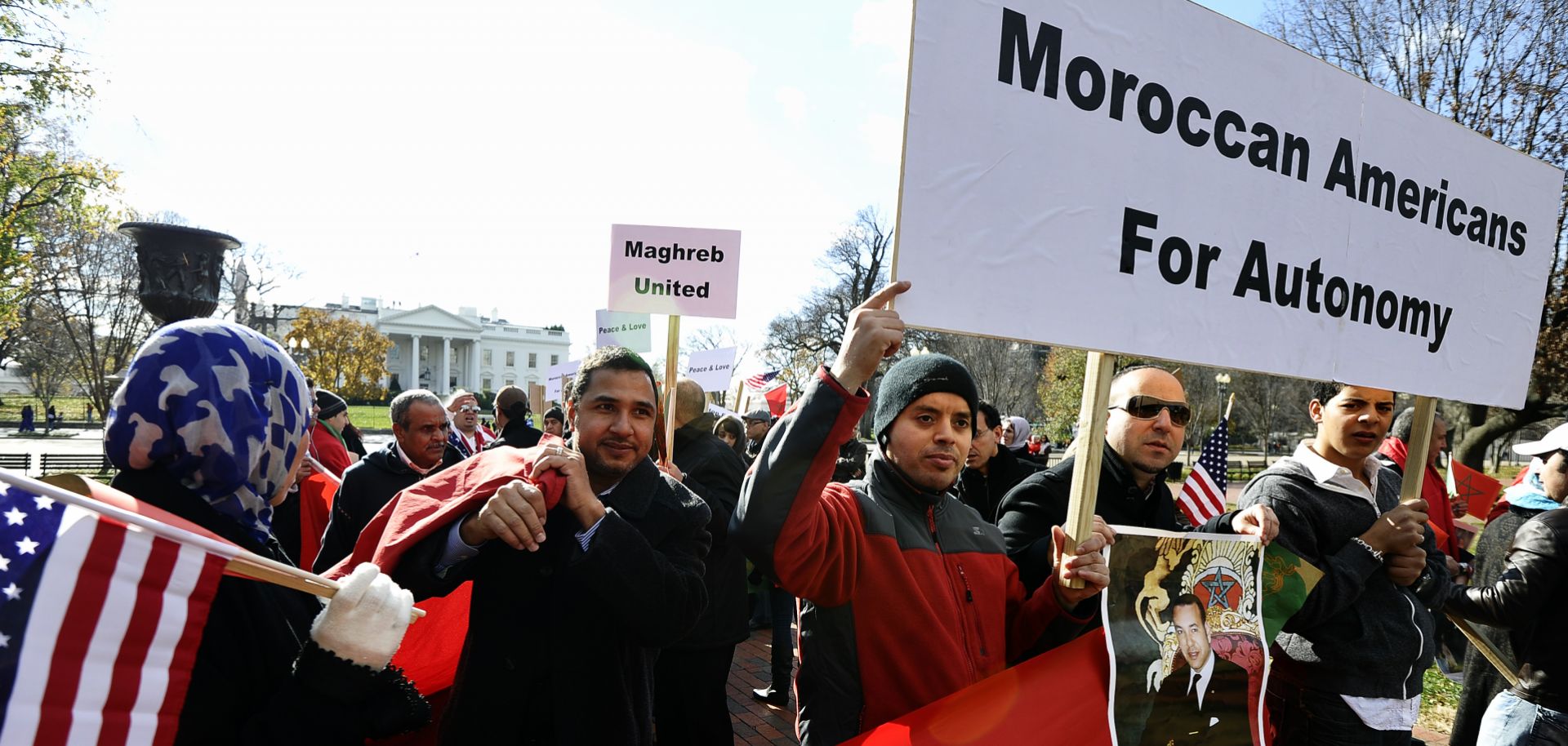
Moroccan Americans demonstrate in support of Morocco’s “Autonomy Plan” for Western Sahara in front of the White House in Washington D.C. on Nov. 27, 2010.
If upheld by the next U.S. administration, Washington’s move to recognize Moroccan control over the disputed Western Sahara region would mark a major diplomatic feat for Rabat, though it will risk inflaming tensions both at home and with Morocco’s African neighbors. The White House and the Moroccan royal court confirmed on Dec. 10 that Israel and Morocco have decided to establish full diplomatic relations. As part of the normalization deal, the United States said it will also recognize Morocco’s “full sovereignty” over Western Sahara. These concurrent agreements suggest that Washington promised its recognition in exchange for Rabat normalizing its ties with Israel. Should U.S. President-elect Joe Biden follow through on this pledge by establishing a U.S. consulate in the disputed territory, it would be a huge boost to Morocco’s diplomatic strategy of claiming de facto sovereignty over the territory, as Washington’s global influence far exceeds that of the African and Middle Eastern countries who have recently opened consulates in Western Sahara.
- Rabat has lobbied for broader recognition of its sovereignty claims in Western Sahara for decades.
- Morocco claims control of roughly 80% of the disputed territory, which is rich in phosphates, fish and potential oil and gas reserves. The remaining territory is controlled by the Algeria-backed Sahrawi Arab Democratic Republic (SADR) and militant group, Polisario Front.
Moroccans largely welcome more external support to their country’s sovereignty claims over Western Sahara, though the quid pro quo of Israeli normalization will carry the risk of domestic backlash. The direct flights and deeper commercial ties with Israel will generate economic benefits that are bound to prove popular among the Moroccan public. But many Moroccans fear that a new relationship with Israel could translate to Rabat abandoning its push for Palestinian statehood. To help defuse this tension, the Moroccan king has made it clear that the new agreement has not changed the government’s official pro-Palestinian position. Such reassurances will be critical in keeping Moroccans from questioning how quickly their government’s pan-Arab and pan-Islamic values are shifting.
- Moroccan King Mohammed VI held a phone call with Palestinian President Mahmoud Abbas on Dec. 10, the same day Israeli normalization was announced, assuring the Palestinian leader that Morocco still wants full statehood for the Palestinian territories.
U.S. support to Morocco’s claims in Western Sahara will further stoke simmering, low-level conflict with Algeria and the Polisario Front it supports. For decades, the United Nations has promised a self-determination referendum to the Sahrawi people who inhabit the region. Morocco has also proposed autonomy for the Sahrawi in exchange for recognizing the full territory as Moroccan. Outright U.S. support to Morocco’s side makes it all the more unlikely this delayed referendum will take place. This will, in turn, pressure the Polisario Front, the SADR and their Algerian backers to use political and military means to slow such inroads. The potential establishment of a U.S. consulate, in particular, would deeply upset Algeria, which would likely raise the issue in diplomatic channels such as the African Union, United Nations and Arab League. A U.S. consulate could also prompt Algiers to supply more arms and material support to the Polisario Front to help the group pressure Morocco against further encroachment.
- The Polisario Front has grown increasingly frustrated with the lack of meaningful peace talks since 2008 and what it sees as continued Moroccan encroachment in Western Sahara.
- In November, the Polisario Front announced it had decided to stop abiding by the 1991 cease-fire agreement, which has since prompted a recent surge of unusual violence in areas near the region’s buffer zone.
- Morocco and the Polisario Front both proposed different autonomy plans in 2007, the last time serious negotiations took place. Morocco’s autonomy plan has gained the support of the United States and France.
Many African countries have strongly signaled they don’t want Morocco to gain Western Sahara without the U.N. referendum process, suggesting a weak reception to Rabat’s push to diversify its ties in Africa. Morocco has built out deeper commercial relationships and investments across sub-Saharan Africa following Rabat’s 2017 reentry into the African Union. This diversification strategy has reduced Morocco’s economic dependence on Europe, which remains its primary export market.
- The European Union is by far Morocco's largest trade partner, with an estimated 65% of Moroccan exports going to the bloc according to the most EU recent data.
- The African nations that have so far established consulates in Western Sahara include Burkina Faso, Comoros and Zambia. While important to Morocco’s overall sovereignty push, these countries are smaller and less powerful, and thus cannot serve as significant alternative export markets to Europe.
- Senegal, Ghana and the Ivory Coast have lent increasing amounts of diplomatic support to Morocco’s claims to Western Sahara. But other major West African nations, such as Mali, remain opposed to legitimizing Moroccan sovereignty in the territory, while Mauritania upholds what it calls a position of “positive neutrality.”
- Morocco left the African Union in 1984 after the bloc voiced its support for Western Sahara’s independence and admitted the SADR.
Rabat’s policy path will also depend on a continuation of U.S. support from the incoming Biden administration, whose actions will also influence what is likely to be a tepid EU reaction. Washington’s ability to influence the actions of other powerful Moroccan partners will also make the endurance of the U.S. recognition all the more important. France and Spain are the key European trading partners who would probably demonstrate a greater willingness to accept Morocco's strategy. However, the European Union’s overall refusal to recognize Moroccan sovereignty because of the bloc’s support for the U.N. referendum over Western Sahara will likely continue to impact overall Moroccan trade across Europe.
- The European Court of Justice has ruled numerous times in recent years against Morocco profiting fully off of goods produced in Western Sahara.
