
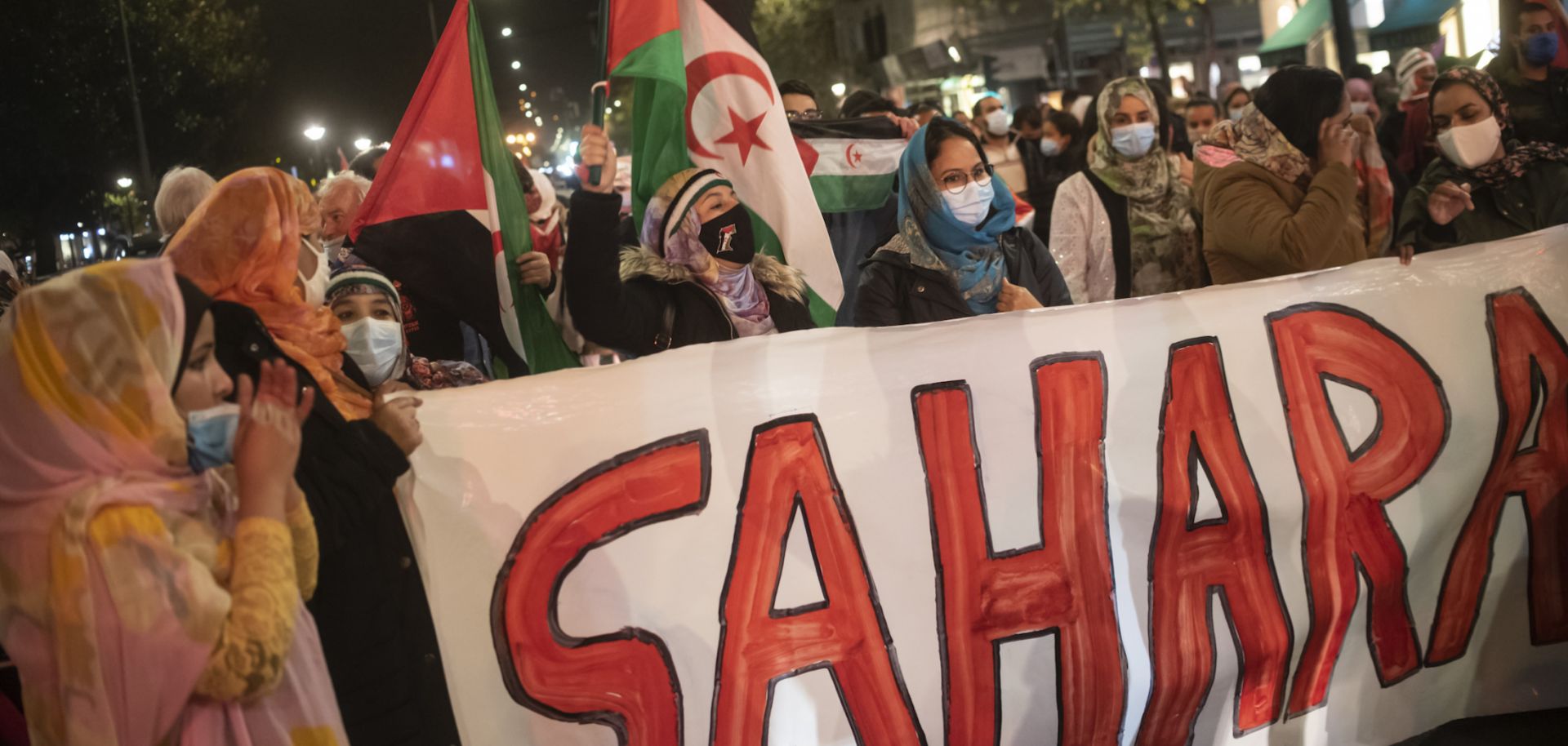
Women carrying Saharan flags take part in a demonstration in San Sebastian, Spain, to demand the end of Morocco's occupation in Western Sahara on Nov. 16, 2020.
Western Sahara may be inching toward another conflict, as the region’s Algerian-backed separatists retaliate against the growing international acceptance of Morocco’s sovereignty claims. On Nov. 17, the Polisario Front separatist movement officially withdrew from a 1991 U.N.-backed cease-fire agreement with Morocco after Rabat launched a military operation against pro-independence supporters for blocking traffic in the southern town of Guerguerat. In the near term, further demonstrations and/or military provocations by the pro-independence group will raise the risk for more commercial and security disruptions at already tense border crossings in the disputed resource-rich region.
The Sahrawi people and Polisario Front separatist movement are growing increasingly frustrated with continued delays to the U.N.-mediated referendum on independence for Western Sahara. On Oct. 30, the U.N. Security Council again voted to extend the timeline of the referendum (which was initially promised in 1991 as part of the cease-fire), further undermining Polisario Front’s trust in the United Nations while adding to its concerns that the agreement will never materialize. Such extensions will continue to anger pro-independence supporters in Western Sahara, especially younger generations who have only ever known such delays and uncertainty, raising the risk for future escalations.
- Backed by Algeria, the Polisario Front is an armed component of the Sahrawi Arab Democratic Republic (SADR) government, which promises locals a free and independent political system. The group operates mostly in exile out of the Algerian town of Algeria.
- To the Polisario Front and its supporters, recent statements from the United Nations, including that Secretary-General Antonio Guterres “remains committed to doing his utmost to avoid the collapse of the cease-fire,” underscore that the institution cares more about upholding peace in the region rather than its promise of political independence.
- In late October, pro-independence civilians took to the streets, lit tires on fire and blocked traffic along a critical Moroccan border post with neighboring Mauritania. The Moroccan military later cleared the demonstrators using force.
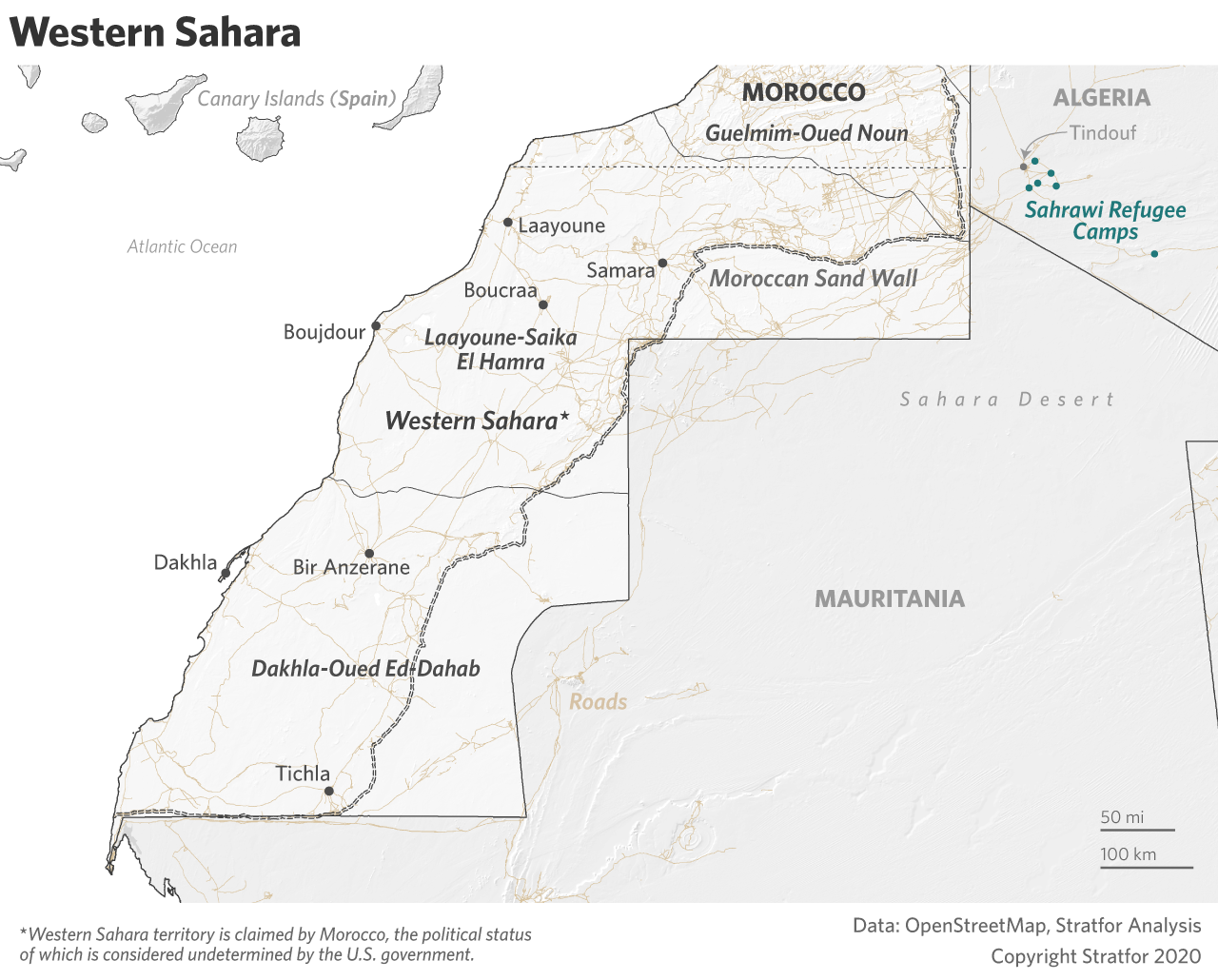
Morocco, meanwhile, will continue to do whatever it can to protect its investments in Western Sahara by maintaining control over its territory, making future tit-for-tat military escalations all the more likely. In 2007, Morocco debuted its “Autonomy Plan” for Western Sahara, which aims to make the area a semi-autonomous region under Moroccan diplomatic and defense control. Since then, this political mediation plan has continued to accrue more Western and regional support. But despite the plan promising Moroccan benefits and citizenship to indigenous Western Sahara residents, many locals living in the region — of which roughly four-fifths is under Moroccan control — still support the SADR’s rule.
- Despite the growing calls for independence, Morocco has maintained it will only grant autonomy to the Sahrawi people living in its claimed territory.
- For years, Morocco has increased monetary and commercial investment in its Western Sahara territory as part of its push to establish de facto control of the region, which is rich in fish and phosphates, and may also have untapped oil and gas reserves. In 2016, Morocco launched a $1.8 billion investment plan that included sizeable funding for new plants for the state-owned phosphate company OCP.
- In response to Moroccan pressure and promises of commercial benefits, 17 other African and Middle Eastern countries have so far either established or promised to establish a consulate in Western Sahara, with many only doing so in the last year. Such consulates help legitimize Morocco’s de facto sovereignty claims over the disputed territory.
Whether the situation in Western Sahara significantly escalates will largely depend on Algeria’s next move, given its role as the SADR and Polisario Front’s biggest backer. Algeria has so far mostly urged calm while calling for renewed global attention on the need for the independence referendum. Algeria has also largely avoided interfering in foreign conflicts since its own major domestic conflict in the 1990s forced it to turn inward. But Morocco’s continued military operations in the region against the Polisario Front may prompt Algiers to deepen its involvement in Western Sahara. While a military conflict between Morocco and the Polisario Front would be disruptive, such a conflict between Algeria and Morocco would be especially serious, given the arms build-up between the two countries in recent years. Developments that would suggest such a wider escalation is on the horizon include an increase in Algeria’s material support to the Polisario Front in terms of money or equipment, or an escalation in Algeria’s official rhetoric on the conflict.
