
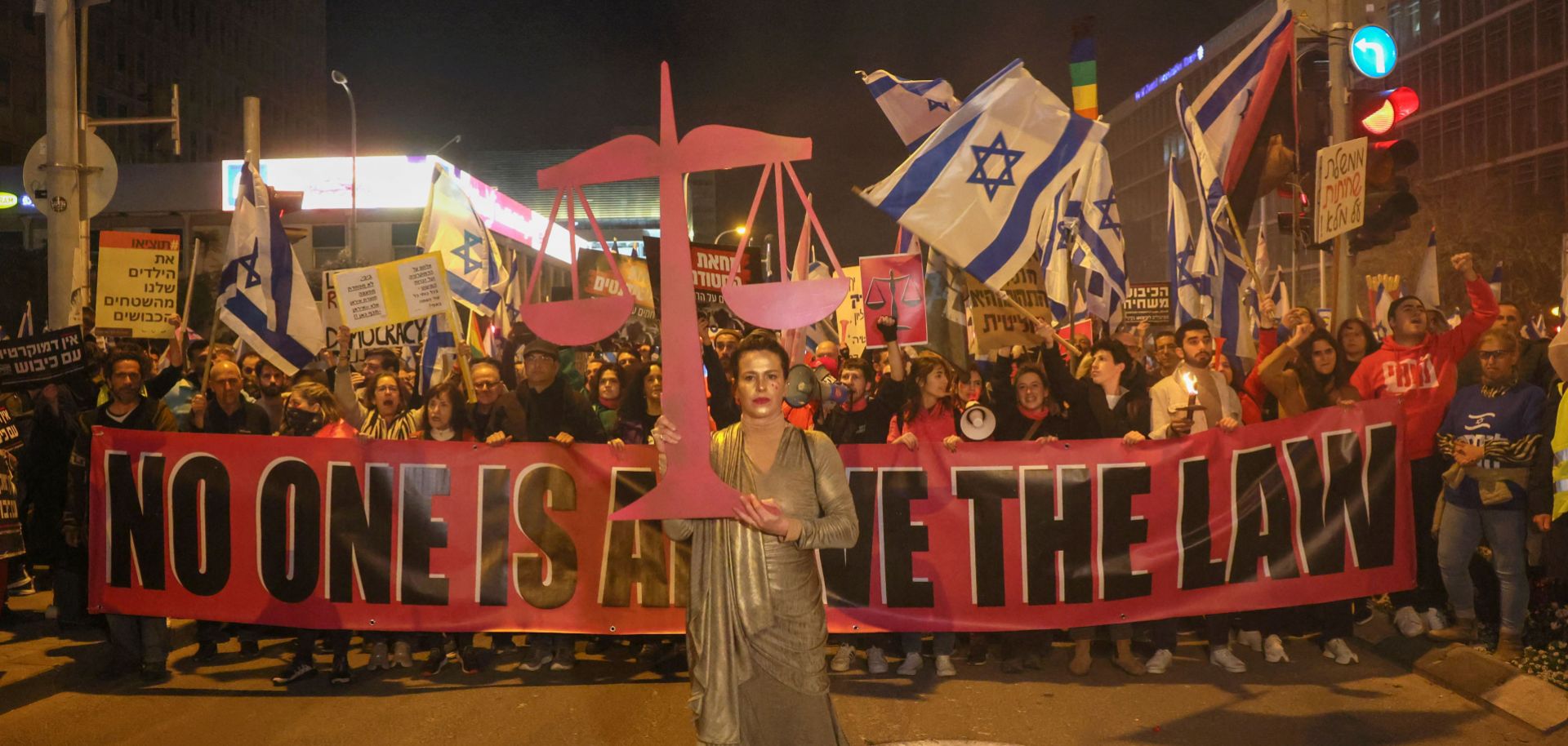
People march on a street in Tel Aviv, Israel, on Feb. 11, 2023, to protest against controversial judicial reforms being touted by the country's right-wing government.
Israel's controversial judicial reforms will likely cause only marginal near-term harm to some aspects of the country's investment attractiveness. Still, deeper economic problems will manifest over time if the government continues to enact far-right policies. Israel's central bank chief Amir Yaron and the Finance Ministry's chief economist Shira Greenberg reportedly told ministers on Feb. 23 that the government's push to overhaul the country's judicial system could quickly trigger an economic crisis. According to comments cited by The Times of Israel, Greenberg specifically said the reforms could create a ''snowball effect'' by being ''perceived by the market as damaging the strength and independence of state institutions and increas[ing] uncertainty in the investment environment.'' The remarks come as Israeli Prime Minister Benjamin Netanyahu's right-wing government is pursuing policy changes that would give the country's legislature the power to override Supreme Court decisions — fueling fears among tech, business and financial leaders over the potential economic fallout.
- Netanyahu's new government — which took office in December 2022 — first unveiled the judicial reforms in January. The changes would give the government full control over who is appointed to the Supreme Court (as opposed to the committee system that currently includes judges and judicial experts); block the Supreme Court from overturning the country's quasi-constitutional Basic Laws (Israel has no formal written constitution, so these are the most fundamental laws that themselves can be enacted by a majority vote in the Knesset); and enable the Knesset to override Supreme Court decisions with a majority vote.
- The government and its right-wing supporters claim the reforms are aimed at reining in a court system that they say acts too often in the interests of a narrow (and often left-leaning) segment of society against the will of Israeli voters. But critics have argued these changes would result in a populist or illiberal democracy, with the Knesset able to enact wide-ranging reforms without checks or balances.
- The first parts of the legislation have passed their initial readings; the Israeli government aims to have the reforms complete by the end of March before Passover.
Recent developments suggest some limited risks to Israel's near-term economic stability. The planned overhaul of the country's judicial system has spooked investors and business leaders in recent weeks, prompting a series of warnings from business leaders and financial institutions that the changes will put the country's economy at risk. The Israeli government has dismissed these concerns — pointing to the country's comparatively low debt, strong current accounts surplus and years of fiscal restraint — and has accused those sounding alarm bells of being biased against the current Netanyahu government. Amid the uproar over the reforms, the Israeli shekel's value against the U.S. dollar fell on Feb. 27 to its lowest point since 2020, when COVID-19 lockdowns raised questions about Israel's economic viability. In January, the credit ratings agency S&P also warned that the reforms could prompt it to downgrade to the country's otherwise AA- credit rating. If S&P did so and other agencies followed suit, it would deter investment in Isreal by increasing borrowing costs (at least marginally) at a time when the country's central bank is already raising interest rates to tamp down on inflation.
With Israel's government signaling it will enact unpopular judicial reforms, some investors, industries and workers might choose to do business elsewhere in the near term. It's possible that some of the judicial reforms are adjusted because of their general unpopularity outside of the government and its right-wing and far-right base. But the political conditions of Israel's current government, which relies on several far-right parties to remain in power, suggest that Prime Minister Netanyahu will enact the most far-reaching proposals. This will generate a perception that Israel's balance of power has shifted to favor the current right-wing and far-right government, and will undermine Israel's attractiveness as a place to work, invest and set up a business for secular, left-leaning or liberal Israelis. Those with dual citizenship could relocate, both as workers or as business owners, to Europe or the United States. Investors, meanwhile, might become more judicious in how they invest in Israel, particularly those who use ESG (Environmental, Social, and Governance) frameworks. This is most likely to impact the country's tech sector, where many jobs can be done remotely.
- Norway's sovereign wealth fund, KLP, which holds some $1.3 trillion in assets, is considering exiting Israeli holdings in response to the government's push to overhaul the country's judicial system, as well as expand Israeli settlements in the West Bank. The fund utilizes ESG as a framework for investing.
- Israel's bankers estimate that some $4 billion had been transferred to foreign banks since the judicial reforms were announced in January. That same month, a major Israeli start-up, Papaya Global, said that it was moving money out of Israel in reaction to the reforms.
- The tech sector employs about 10.4% of Israel's workforce. Some tech companies and workers in the country have been taking part in public protests and strikes against the judicial overhaul; some have also threatened to leave Israel because of the reforms.
But the immediate impact on business and investment is unlikely to significantly threaten Israel's macroeconomic situation, which remains generally favorable. The country enjoyed a relatively quick economic recovery from the COVID-19 pandemic, partially because of its early vaccine distribution and overall management of the virus, which enabled Israel to open back up its economy and resume normal business activities earlier than other countries. The Israeli economy grew 6.5% in 2022 and is expected to grow by 3% in 2023, despite slowdowns in the United States and Europe. Israel's relatively strong economic situation will likely still make workers and business leaders wary of leaving the country in response to the judicial reforms — especially as macroeconomic conditions are weakening in Europe and the United States in the face of high inflation, higher interest rates, the effects of Russia's ongoing war in Ukraine, supply chain disruptions, and lingering effects of the COVID-19 pandemic. This means that while some investment flows, workers and businesses may change behavior in response to the government's planned judicial overhaul, they're unlikely to do so at a scale that would spur a near-term macroeconomic challenge to Israel.
- Israel's 2022 debt-to-GDP ratio dropped to 59.2% from 66.2% in 2021, far below the Organization for Economic Cooperation and Development (OECD) average of 124% in 2021.
- Israel's exports hit a record $160 billion in 2022, a rise of 10% from 2021, about half of which came from the country's high-tech sector.
- Israel's population also grew by 2.2% last year amid a surge of immigration from former Soviet states.
In the long term, however, macroeconomic risks may emerge if the government continues to enact far-right policies, which could lead to diplomatic isolation, a talent exodus, religiously-influenced budgets, and/or flare-ups of violence with Palestinians. Many governments in Israel's history have not completed a full four year-term. But if the current Netanyahu cabinet and its right-wing partners are able to remain in power until 2026, their pursuit of sweeping systematic change is unlikely to stop at the judiciary — expanding to other right-wing and far-right agendas that could include restricting women's right to pray at the Temple Mount and segregating public places like transportation based on gender; increasing subsidies for religious studying and state spending for inefficient religious schools; enacting anti-LGBTQ, -Arab and -Palestinian measures; further expanding Israeli settlements and military crackdowns in Gaza and the West Bank; and enacting legal measures designed to shield Netanyahu from his corruption charges. Religiously-inspired social policies could spark a much wider exodus of secular Israelis over time, deter investment from ESG-utilizing institutions and investors on a bigger scale and lead to diplomatic isolation as the secular-dominated Diaspora in the United States and Europe change their voting habits to support politicians more critical of Israel. Additionally, if far-right policies lead to widescale violence with the Palestinians — including recurrent wars in Gaza or an uprising in the West Bank — it would harm the country's overall economy by leaving the security situation uncertain.
- Despite having strong records defending the country, multiple centrist and high-profile Jewish Diaspora writers and advocates of Israel have spoken out against the new Israeli government and the rise of Israel's far-right. Such individuals have long helped convince U.S. and European voters and governments that they should not isolate Israel, as advocated by the Boycott, Divestment, and Sanctions (BDS) movement, over its Palestinian policies.
- Another extended conflict with the Palestinians would likely cause damage to the country's economy. Israel's economy shrank by .01% at the height of the violence during the Second Intifada (2000-2005) as tourists stayed away, investors looked elsewhere and wealthy Israelis sought shelter from the fighting overseas. The country's economy did not start to recover until violence ebbed. The RAND Corporation has predicted that another uprising might cost Israel $45 billion over a year in direct costs and lost opportunities.
- The International Monetary Fund has repeatedly warned that Israel needs to direct state spending toward productive investments in infrastructure and education, where it lags behind other OECD peers. Of particular challenge is the role of state spending on religious subsidies and schools, which produce low-skilled and often unproductive workers who require wage and family subsidies to avoid poverty. While these challenges are slow-moving as Israel's religious community grows, there is concern that the Israeli government's religious parties will reinforce this trend by increasing spending on religious subsidies and schools.
