
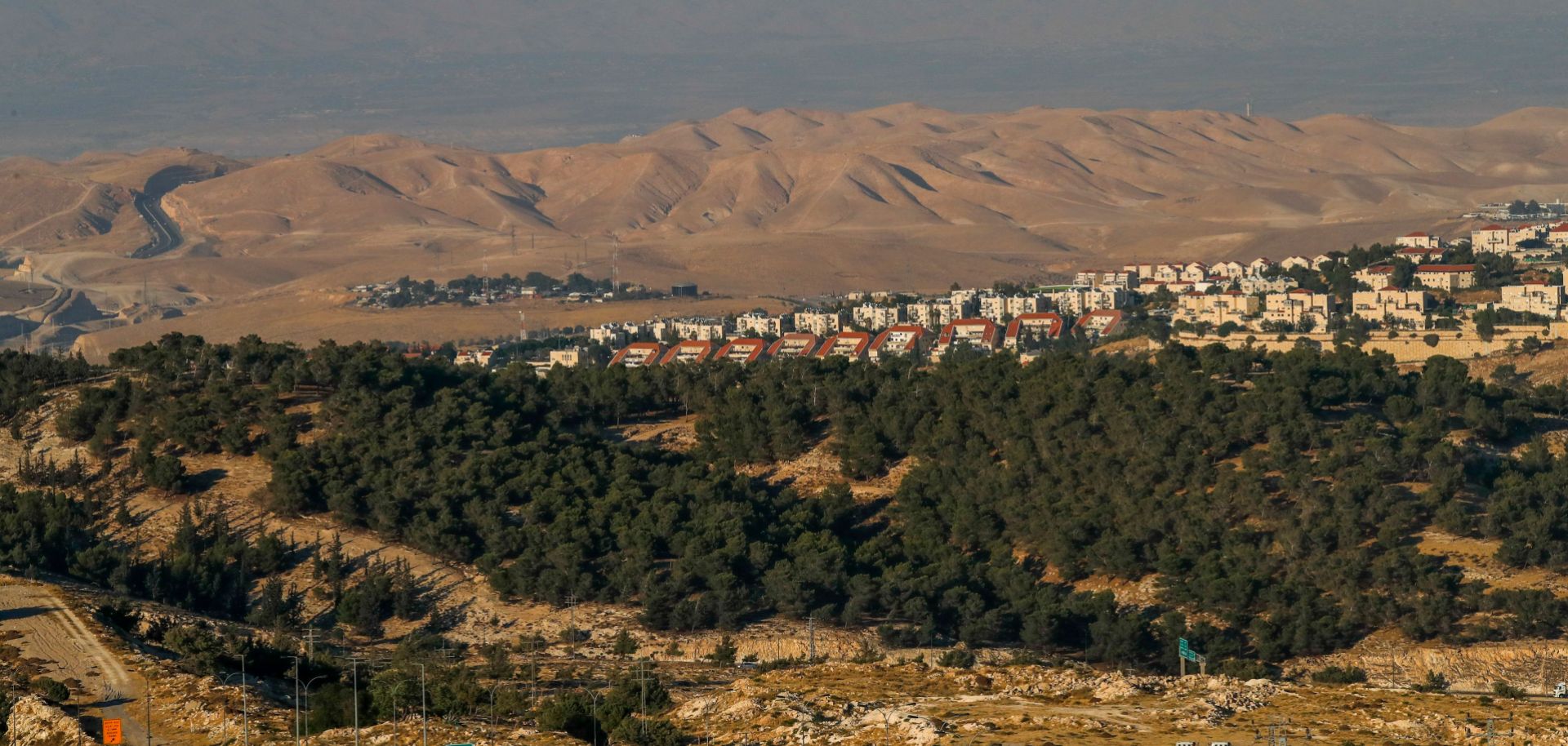
The Israeli settlement of Ma'ale Adumim is seen in the background of the photo of the West Bank’s E1 corridor taken on June 30, 2020.
The new Israeli government is pushing ahead with expansionist projects in the West Bank at the risk of provoking unrest among Palestinians and criticism from allies abroad. On July 15, the Israeli Defence Forces advanced plans to build 3,412 new apartments in the West Bank along the strategic E1 highway, which helps link East Jerusalem to the rest of the West Bank. The move allows the E1 settlement project to advance to Israel’s Higher Planning Committee, which could then greenlight the project and allow construction tenders to be issued.
- The E1 construction project had largely been stalled over the past 30 years as successive Israeli governments feared the international repercussions of building a settlement in the area. In more recent years, the government of former Prime Minister Benjamin Netanyahu had advanced plans to build in the region, buoyed by the support of former U.S. President Donald Trump’s administration. But with both a new U.S. president and new Israeli coalition in power, the project was once again temporarily frozen — until now.
Israeli Prime Minister Naftali Bennett’s government appears likely to build up these new E1 settlements, as well as others in the West Bank, despite criticism from both left-wing members in the coalition as well as the international community. Though left-wing and Islamist elements of Israel’s coalition government will protest settlement expansion, they have few ways to actually counter it. If they leave the coalition and force new elections, polls suggest a repeat of previous political paralysis or even the potential for the return of Netanyahu and the right-wing. The offices of the prime minister and defense minister are also ultimately in charge of approving settlements, which gives anti-settler elements of the coalition no political means to block construction. Bennett is himself a long-time advocate of settlement and even annexation in the West Bank, and his place in power depends on the continued support of the coalition’s large pro-settlement contingent.
Further settlement construction will anger Palestinians and could provoke unrest in the future. New Israeli settlements will contribute to anti-Israeli sentiment throughout the Palestinian territories, where grassroots activists continue to protest Israeli expansionism. This will, in turn, risk creating the conditions ripe for widespread unrest by triggering more clashes between Israeli forces and Palestinians.
In the long term, settlement construction will also risk emboldening Israel’s critics in the United States to reshape bilateral relations. With the exception of the Trump administration, U.S. governments have maintained the view that Israeli settlements in the West Bank are illegal. But despite decades of international criticism, Israeli settlement construction has yet to provide widespread sanctions or undermine its relations with the United States, as well as its other key allies in Europe and, more recently, the Arab Gulf. The May flare-up in Gaza, however, has since eroded public support for Israel around the world — especially in the United States, where 25% of Jews surveyed in a recent Jewish Telegraph Agency poll said they now view Israel as an “apartheid state.” In the context of this shifting U.S. sentiment toward Israel, constructing the new E1 settlement in the West Bank will only further contribute to generating the political conditions needed for critics of Israel to try to affect U.S. policy.
- On July 8, the Israeli military demolished the home of a Palestinian man linked to a May 2021 killing of an Israeli settler. The U.S. embassy in Jerusalem quickly condemned the move, saying that “the home of an entire family should not be demolished for the actions of one individual.”
- The United Arab Emirates, which normalized ties with Israel in 2020, has kept its criticism of settlement construction muted as it builds up diplomatic and economic ties with the country.
