
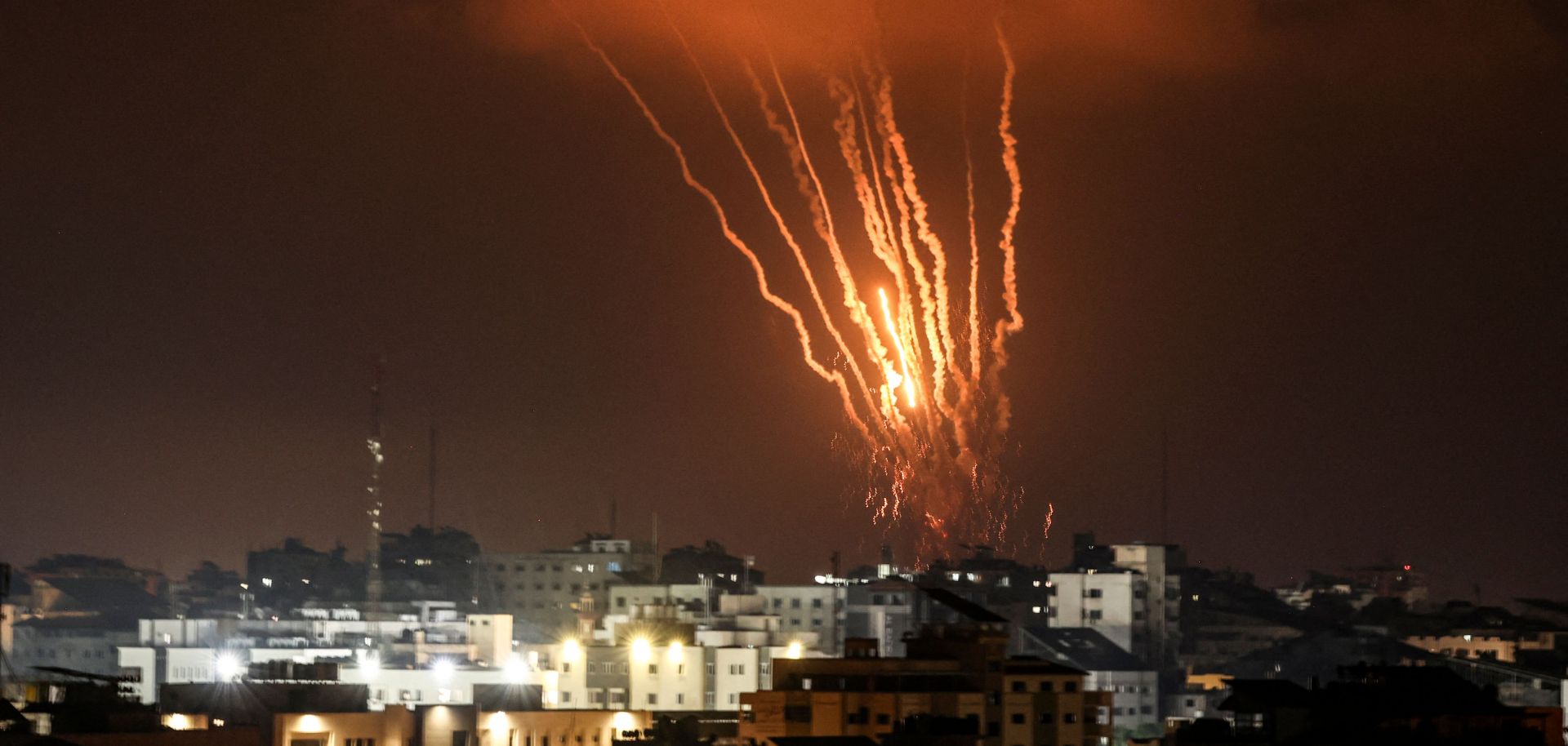
A picture taken on Aug. 5, 2022, shows Palestinian rockets being fired from Gaza City in response to earlier Israeli airstrikes.
In the most recent conflict with Israel, Gaza's militant Hamas rulers showed a higher threshold for escalation than the smaller Palestinian Islamic Jihad (PIJ) group. But more Israeli attacks against the coastal enclave could eventually force Hamas to come to PIJ's aid, possibly sparking a greater war in the Gaza Strip akin to that seen last year. On Aug. 6, Israel began a pre-emptive military campaign against the Palestinian militant group PIJ in the Gaza Strip, after Israeli Defense Forces (IDF) became convinced that PIJ fighters were plotting an imminent attack in retaliation for the IDF's capture of the group's high ranking leader in the West Bank earlier in the month. In the ensuing three-day conflict, PIJ claimed to fire around 1,100 rockets toward Israel, though a substantial number of them failed to reach Israeli airspace and most were intercepted by Israel's Iron Dome air defense system. The conflict ended with an Egyptian-mediated cease-fire, which went into effect on Aug. 7. The fighting notably did not include Hamas, the larger Palestinian militant group that governs the Gaza Strip, despite at least two Hamas members being killed in the latest round of Israeli airstrikes.
- PIJ is smaller than Hamas but also more radical, and has often fired rockets at Israel even during Hamas-Israeli cease-fires. PIJ appears to have also played a role in inspiring the spate of deadly, long-actor terrorist attacks that rattled Israel in the spring of 2022. The terror wave, which killed over a dozen Israelis between March and April, caused an IDF crackdown in the West Bank that led to the arrest of the PIJ commander.
- In 2021, Israel and Hamas fought a much larger 11-day war that killed at least 256 in Gaza and 14 in Israel. That exchange saw Hamas utilize its much-larger rocket and missile arsenal to hit targets as far away as Tel Aviv and Jerusalem. The damage to the Gaza Strip from that war has still not been fully repaired.
Hamas stayed out of the latest round of fighting because it wasn't directly targeted, and because attacking Israel would have threatened Hamas' access to foreign aid that it depends on to maintain its legitimacy as Gaza's leader. Shortly after launching its latest military campaign in Gaza, Israel signaled the operation was specifically targeted at PIJ leaders and assets, not Hamas, which undercut the immediate pressure for Hamas to join the escalation. Additionally, Hamas officials have admitted that the Gaza Strip is experiencing a financial crisis, with banks in the region running low on funds. Reports have indicated that cash-strapped Gaza militants are also struggling to secure critical imports of food and fuel, which have become unaffordable due to the global price shocks brought on by the ongoing Russo-Ukrainian war. For Hamas leaders, Gaza's growing economic troubles have increased the political importance of keeping the peace with Israel, which enables crucial aid from Qatar to flow into the Strip by ensuring Israel's military does not block points of entry.
- The functioning of Gaza's government and, by extension, the territory's war-torn economy (which is largely driven by state spending) is heavily reliant on the aid Hamas receives from its wealthy Arab Gulf partner, Qatar. Hamas seized control of the internationally-recognized Palestinian Authority (PA) in 2007, but remains barred from accessing PA funds due to its designation as a terrorist organization by the United States, Europe and Israel. This has left the militant group largely unable to fund crucial government services in the Strip and pay public sector wages without external support.
- In July, Hamas raised taxes on consumer goods to try to improve its finances, sparking public backlash and protests in the Strip. Political demonstrations in Gaza are rare, as Hamas typically does not tolerate public dissent against its rule. The fact that the tax hike prompted Palestinians to take to the streets thus highlights the level of desperation among Gazan residents amid the territory's deteriorating economic situation.
In the run-up to its national elections on Nov. 1, Israel's government will likely continue its crackdown on PIJ, including airstrikes on Gaza, while trying to avoid provoking another escalation by Hamas. After the collapse of its latest government, Israel is preparing to hold its fifth election in less than four years, where caretaker leader Yair Lapid is hoping to defeat former Prime Minister Benjamin Netanyahu. The handful of swing voters in the upcoming election are right-wing and tend to be hawkish on Gaza. This will incentivize Lapid's caretaker government to maintain its assertive strategy against Palestinian militants, in the hopes of winning over these voters and preventing another wave of terrorism inside Israel or attacks from the Gaza Strip ahead of the November ballot. While Israel will target any militants that pose a threat in the West Bank, Hamas is less likely to respond to crackdowns on its members in the region to ensure it retains access to financial aid, which is contingent on maintaining peace with Israel. In the immediate future, retaliatory attacks against Israeli operations in the West Bank are thus much more likely to come from PIJ, which does not bear Hamas' burden of governing Gaza and needing to maintain political legitimacy. Israel will, in turn, likely continue striking PIJ in the Gaza Strip to either prevent attacks or respond to such attacks.
- Swing right-wing voters have helped decide each of Israel's last four elections. Recent polls suggest these voters could once again decipher the outcome of the November ballot.
- Former Israeli Prime Minister Naftali Bennett's ideologically diverse government, which Lapid helped form, collapsed in June after the defections of several key Knesset members weakened the ruling coalition to the point where it could no longer pass legislation. Israel has been mired in successive political crises since November 2018, when the right-wing Yisrael Beiteinu party defected from former Prime Minister Netanyahu's government because it thought Netanyahu was too dovish on Gaza.
However, repeated attacks against the Gaza Strip will still anger Palestinians, who will eventually demand Hamas join PIJ to retaliate against Israel — raising the risk of another flare-up akin to the 2021 Gaza war, as well as another bout of inter-communal clashes inside Israel. Palestinians are currently more concerned with cost-of-living issues than the conflict with Israel. But that opinion will rapidly shift if Israel repeatedly attacks PIJ targets in Gaza in the coming weeks, as such strikes would likely fuel popular anger by causing collateral damage to civilians. If the public's mood in Gaza turns to demand retaliation against Israel, Hamas will likely bolster its coordination with PIJ and carry out complementary military operations. In response to such attacks, Israel could carry out widespread retaliation operations, with the country's caretaker leaders eager to win the November election — sparking a cycle of escalation that results in another full-scale war. If fighting between Palestinian militants and Israeli forces reaches the level seen during last year's conflict, tensions between Israeli Arabs and far-right provocateurs could also see more violent clashes break out on the streets of Isreal. This situation would cause politicians around the world to again openly criticize Israel's Palestinian policies — especially those in the United States, where some lawmakers are growing increasingly skeptical of U.S.-Israeli ties.
- Since the beginning of the year, far-right Israelis have repeatedly tried to provoke Israeli Arabs into violence at events like the ultranationalist Flag March in Jerusalem in May, in the hopes of stirring up unrest that would justify their demands to expel or limit the rights of the Israeli Arab community. In the event of another war with Hamas, far-right vigilantes would likely target Israeli Arabs again.
- The United States has toned down its criticism of Israel after the 2021 Gaza War, with President Joe Biden's Democratic Party seeking to win pro-Israel swing voters in November's midterm elections. But a new military escalation would anger Israel skeptics in the party's base and potentially cause Democratic Congressional candidates to run on a more overly anti-Israel platform.
