
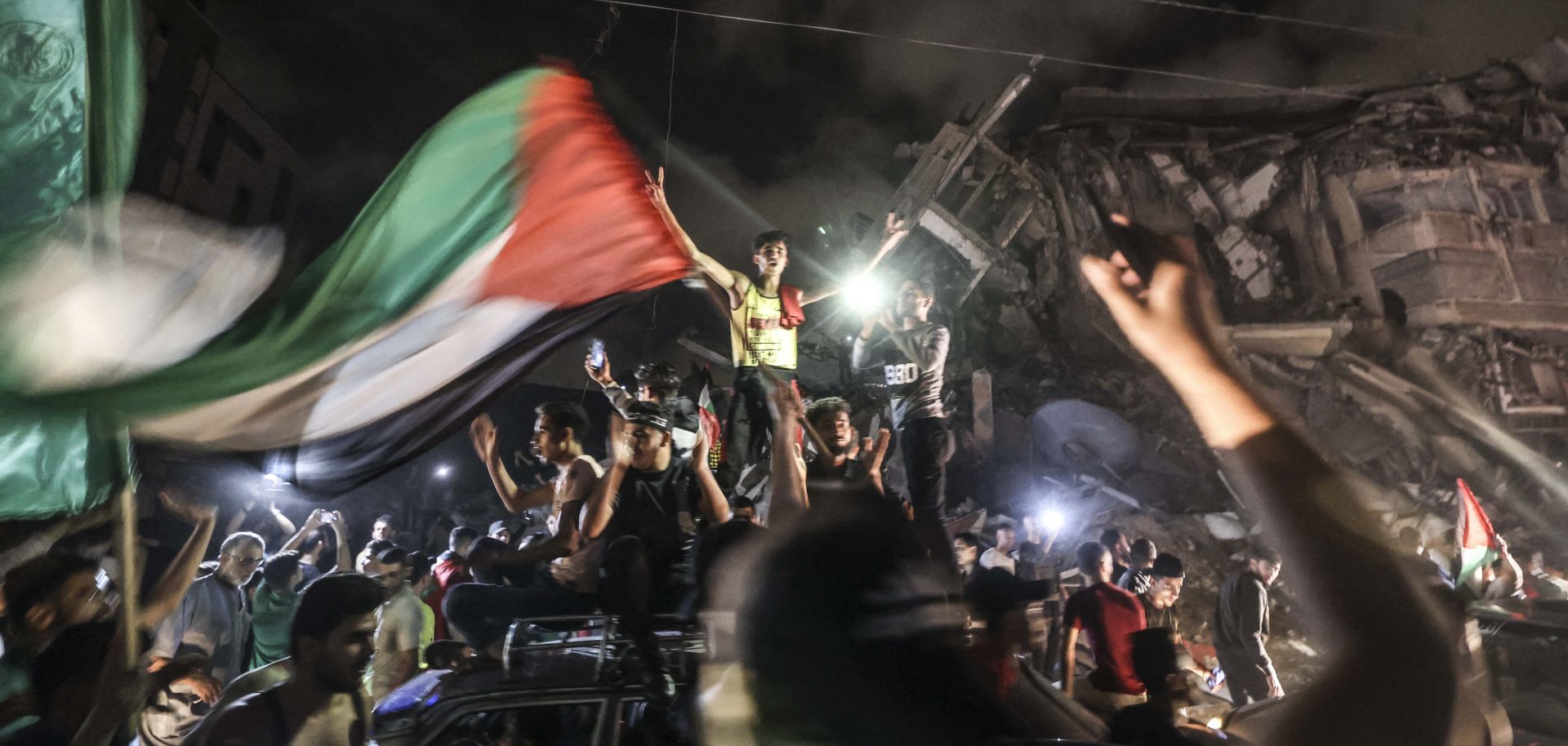
People in Gaza City wave the Palestinian flag in celebration of the cease-fire reached between Israel and Hamas on May 21, 2021.
The May 2021 Gaza conflict drew from and energized a burgeoning grassroots movement among younger Palestinians frustrated with the pace of progress under the territories’ two main political parties, Hamas and Fatah. While unlikely to become a well-organized force, this new brand of Palestinian activism will increasingly collide with right-leaning Israeli politics, guaranteeing more conflict and unrest in the region.
- Israel and Hamas struck a cease-fire in the early hours of May 21, ending 11 days of violence between the Israeli Defense Forces and Gazan militants that marked the worst military escalation across the border since 2014. A total of 243 Palestinians and 12 Israelis were killed in the latest flare-up, which saw thousands of rockets launched from Gaza and hundreds of Israeli airstrikes.
The increased international focus on and sympathy for the Palestinian cause following the latest Gaza conflict has reenergized stagnant Palestinian politics, especially its youth-driven activist community. Hamas and Fatah will attempt to use the surge in global attention on Palestinians’ push for statehood to their own political benefit. But the unrest seen in Israel and the Palestinian territories over the past two weeks was unique in that it was primarily grassroots-driven, which reflects how Palestinian political energy is now outpacing the two parties’ projects and goals.
- For the first time in decades, Palestinians participated in strikes on May 18 across Israel and the Palestinian Territories, attempting to use their economic leverage to bring to their demands to end Israeli expansionism. Neither Hamas nor Fatah organized the strike.
- Organized grassroots demonstrations in Jerusalem, as well as participation in more spontaneous and sporadic demonstrations, were major drivers to the current escalation. Hamas and other Gazan militants launched the rockets on May 10 that ultimately triggered the latest flare-up, but only in response to unrest stirred after individuals began rallies and demonstrations in Jerusalem.
- The Palestinian diaspora and activist network has long shown signs of simmering grassroots sentiment that rejects both Fatah and Hamas.
Both Hamas and Fatah will struggle to address or effectively channel this new rise of grassroots opposition, which will likely deepen the paralysis between them. This will make the two parties even less appealing to the newly energized Palestinian electorate, opening the door for a new political strand in the Palestinian territories over time. The gridlock between Fatah and Hamas was most recently underscored by canceled elections due to internal politicking and the former’s fear of being overtaken by the latter. 93% of Palestinians had registered for the elections by February 2021, a signal of a potential high turnout for the legislative election previously scheduled for May 22. The eruption of the latest conflict itself has also underscored Hamas and Fatah’s failure to advance the quest for statehood in a way that protects Palestinians from expansionist Israeli politics, further fueling grassroots popular anger.
- Hamas has won some political clout from this latest round of fighting with Israel. But the conflict has also set the party back from a tactical offensive standpoint, which will make it difficult for Hamas to use armed force again in the near term, as well as act on any newly acquired political power. Although Hamas established itself as the defender of Jerusalem at Fatah’s expense, it did so at great cost in terms of damage to the infrastructure it uses to carry out its main goal of “opposition” to Israel.
- Fatah was largely silent during the latest flare-up, which many Palestinians have perceived as acquiescence to Israel’s expansionist policies. Palestinian Authority President and Fatah leader Mahmoud Abbas has also faced increased scrutiny for staying in office without holding necessary elections.
Because this grassroots energy will be difficult for Hamas and Fatah to control, there is a high risk of it turning into destabilizing unrest in the Palestinian territories and Israel in the near term. Related implications include:
- Sporadic anti-government violence and demonstrations in the Palestinian territories and in Palestinian-heavy areas of Israel, as the Palestinian political scene fractures further and domestic dissatisfaction with Hamas and Fatah persists.
- Another uprising against Israel, as grassroots energy remains high and anti-Israel anger remains potent. This could happen without Hamas or Fatah initially driving it, and could turn into something similar to the first and second intifadas. Such an uprising would pose serious security risks for Israel, since it would be directly targeted at forcing Israeli policy to change.
- Further Israeli isolation of Gaza and expansions into the West Bank, as Israel takes advantage of the deepened political paralysis in the Palestinian territories. Regardless of Hamas and Fatah’s official actions, some Palestinians are guaranteed to push back against any new West Bank settlements, raising the risk of triggering another conflict with Israel.
- The emergence of new leaders within Hamas and Fatah, as the parties push to appeal to the newly energized electorate. Fresh faces could help boost the two parties’ appeal to younger Palestinians. But this would also further solidify Hamas and Fatah’s rivalry — portending more disputes over how to hold elections and approach negotiations with Israel, among other political impasses.
- A disorganized resistance movement. Because this grassroots energy is largely leaderless, its organization as an opposition force will be stop-and-go and easily hit barriers to efficiency, including falling apart on the weight of its own plurality. To protect their own positions in power, Hamas and Fatah may separately try to take advantage of the nascent movement’s organizational weakness by trying to either co-opt or crack down on it.
