
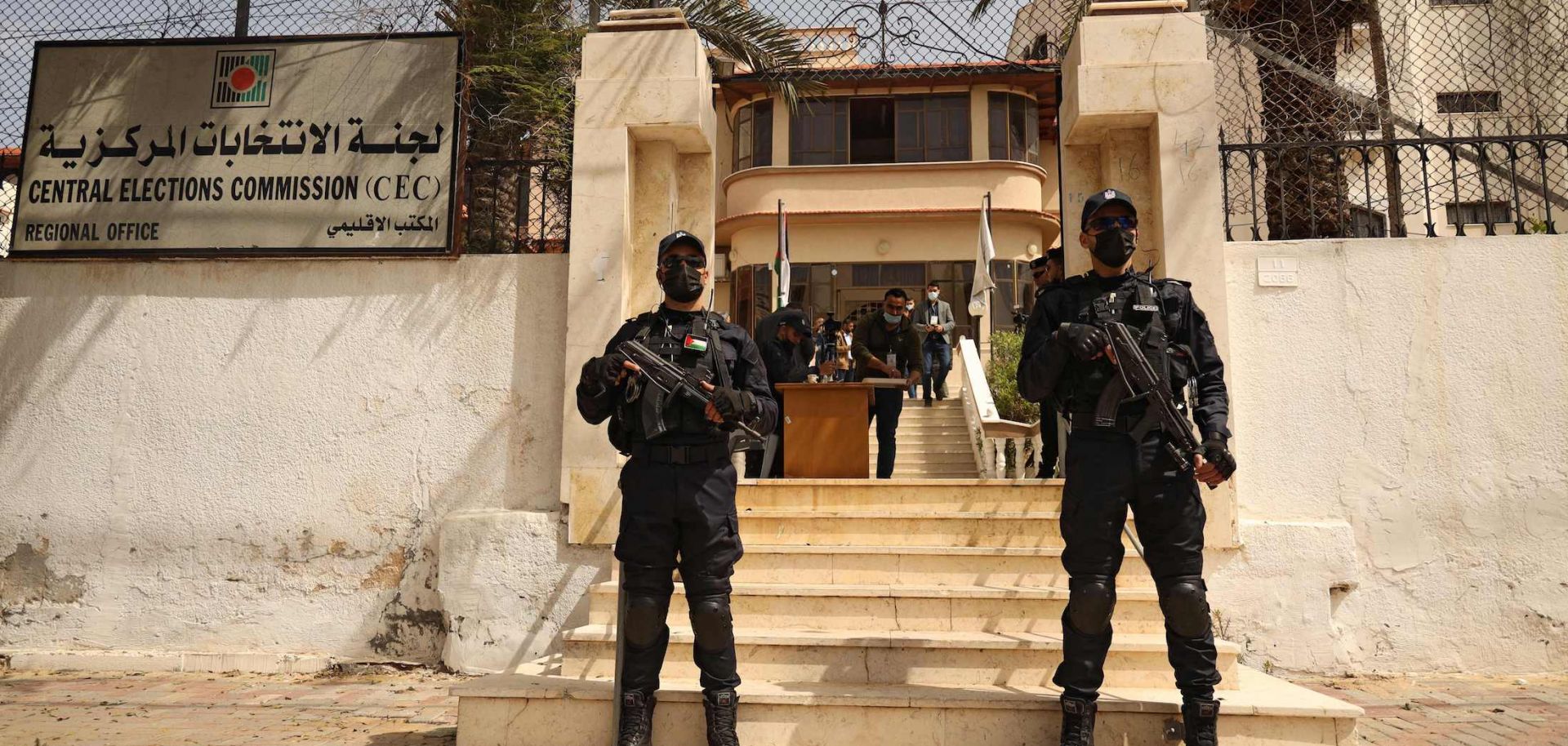
Police officers stand guard March 20, 2021, outside the Central Elections Commission office in Gaza City at the start of the registration period for the May parliamentary election.
Hamas and Fatah are promising elections to improve their legitimacy after years of political stalemate, but may not be able to deliver — which would deepen the Palestinian territories' economic, political and social crises and add to its international isolation. On Jan. 15, Palestinian Authority President Mahmoud Abbas decreed a series of elections for the West Bank and Gaza, which would be the first national Palestinian elections since 2005. Legislative elections are set for May 22, presidential elections for July 31 and Palestinian National Council elections for the Palestinian Liberation Organization for Aug. 31. Palestinian political parties feel pressure to hold long-delayed elections because economic strain, political paralysis, and the Palestinians' failing diplomatic isolation campaign against Israel are wearing down both Hamas' and Fatah's legitimacy among Palestinians in Gaza and the West Bank and with Arab allies in places like the United Arab Emirates, Saudi Arabia and Qatar. Elections will likely occur. But arguing about logistics for how to hold them has hampered election planning before, and could do so again, while complaints from either Hamas or Fatah regarding the other party's candidate lists could hamper them at the eleventh hour as they have before. Although elections won't solve the underlying issues dividing the polity, holding them would at least acknowledge Palestinian popular will, which party leaders hope will boost their standing among a beleaguered population and lead to compromises on bigger issues like pursuing statehood.
Economic frustration felt by Palestinians across the West Bank, Gaza Strip and in the diaspora has intensified popular anger at the paralysis within and between Fatah and Hamas, prompting the two factions to pursue cooperation. Facing united popular discontent, both parties increasingly seem to acknowledge that better economic coordination could yield political gains in terms of trust, popularity and domestic legitimacy for each party. Progress on planning the elections marks an improvement in the Palestinian Authority's typically fractured internal dynamic. The election decree came against the backdrop of political reconciliation talks between Hamas and Fatah in Istanbul and Cairo that began in late 2020 and that have continued through March 2021. While full reconciliation has not yet occurred, the talks were a sign that Palestine's political factions from Hamas and Palestinian Islamic Jihad to Fatah are more serious about cooperating ahead of the scheduled elections. If the talks fail, the elections are very unlikely to be held.
- The Palestinian territories have been politically paralyzed since 2006 after Hamas won the authority's legislative elections, taking 74 of 132 seats in the Palestinian Legislative Council. The resulting victory gave rise to a deadlock between President Mahmoud Abbas of Fatah and Hamas and to international sanctions against the Palestinian Authority designed to prevent Hamas, a U.S.-designated terrorist group, from taking power. The stalemate eventually precipitated a civil war in Gaza in 2006, with Hamas taking control of the strip.
- Overall Palestinian unemployment has reached 40%, a dismal rate even by regional standards, and the economy contracted by 8% in 2020 as the COVID-19 pandemic's economic effects were felt.
- The secretary-general of the Palestinian Authority on March 17 revealed that the 2021 draft budget, which will be difficult to pass because of the usual politicking and feuding, has a budget deficit of $1.2 billion. This implies that the Palestinian Authority will remain heavily dependent on foreign aid, something that could flow more freely from wealthy Western partners if democratic elections are held.
Additionally, Fatah is facing increasing pressure to find a viable successor for the aging President Mahmoud Abbas, now 85 years old. New presidential candidates will emerge to attempt to replace Abbas, whose legacy is at stake without a clear successor able to take up his record of diplomatic negotiations and championship of Fatah.
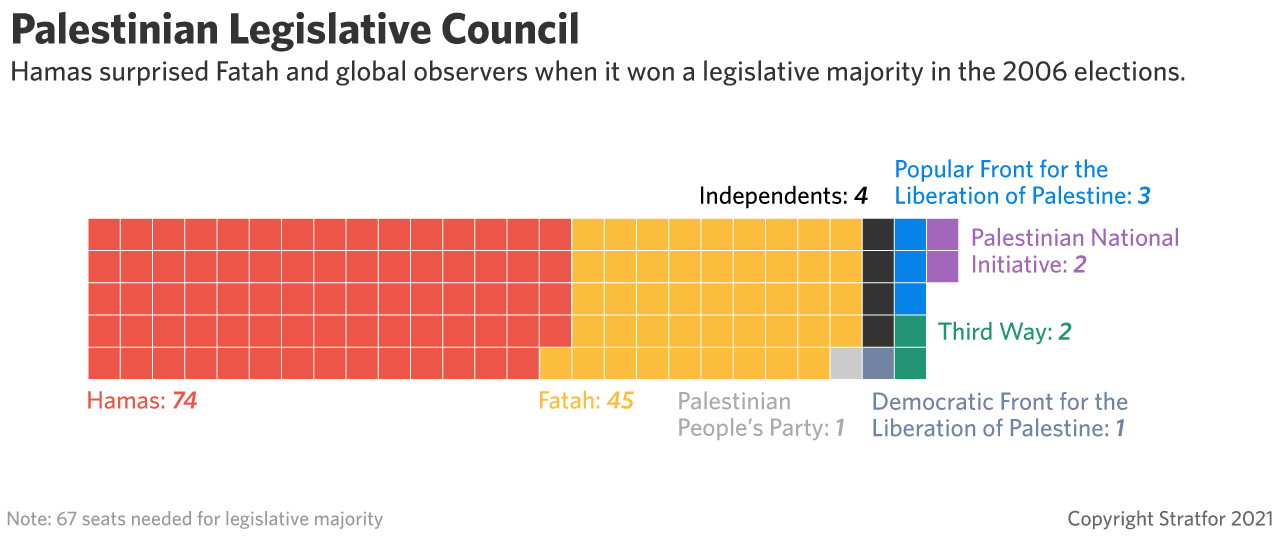
Hamas has held a plurality in the Palestinian Legislative Council since 2006. Fatah, however, holds most of the significant Palestinian political positions that interface with the outside world, including the presidency of the Palestinian Authority and the leadership of the Palestinian Liberation Organization. But Fatah has been riven with long-standing internal factionalism and disputes that partially explained its parliamentary-majority loss to Hamas in 2006. A fresh popular mandate could help the future leadership of Fatah keep the party intact and coordinate with Hamas and other parties.
- Abbas has held power despite his four-year term expiring in 2009, but repeated pledges to hold elections have fallen flat; support for Abbas has cratered, and he now has a disapproval rating of 65%.
- Fatah has agreed with Hamas leadership on how to sequence the elections, a critical issue that has prevented them from being held several times before, indicating resolve on the part of Fatah.
International developments like Arab-Israeli normalization and COVID-19 are pressuring Palestinian factions to compromise. Arab-Israeli normalization between the United Arab Emirates, Bahrain, Morocco and Sudan and Israel weakened Fatah's favored strategy of diplomatically isolating Israel. Normalization is likely to continue as Muslim global opinion continues to deprioritize the Palestinian issue and Muslim states increasingly seek access to Israel's technology sector and cutting-edge defense exports. Meanwhile, the Palestinians' already-struggling economies will remain reliant on international aid in the wake of the pandemic, making Hamas' preferred use of militant confrontations less effective, as Israel uses its ability to hold up aid to the Gaza Strip as leverage to enforce cease-fires.
- Palestinian President Abbas reportedly called the Abraham Accords, which oversaw normalization between Israel, the United Arab Emirates and Bahrain, "high treason" against Palestine.
- The Palestinians remain heavily dependent on international financial aid, and Israel largely controls the flow of actual goods and equipment into the West Bank and Gaza Strip.
If Palestinian elections actually occur, it would signal a desire to make progress on these internal issues and to substantially improve the Palestinians’ diplomatic strategy to pressure Israel into recognizing an independent state. The key dividing issue between Fatah and Hamas is disagreement over how to build and maintain relationships with neighboring countries, including Israel and the Arab states, to pursue their shared goal of Palestinian statehood. Although Hamas will likely remain more confrontational to Israel than Fatah, agreeing on something as contentious as elections signals the possibility of compromise on other controversial issues, including the elephant in the room, Israel.
Failure to hold elections could precipitate another major crisis in the Palestinian territories and deepen the authority's international isolation. Reconciliation talks are not guaranteed to produce a workable framework for actual elections, potentially derailing the election process — particularly as Hamas will likely need substantial modifications to its charter that currently commit it to militancy if it is to be de-designated a terrorist organization by the United States. If Hamas or another militant group like Palestinian Islamic Jihad perform well in the legislative elections in May but have not signaled a willingness to abandon militancy, this could produce another international backlash to the elections. This would isolate the Palestinian Authority and spur Fatah to reject the election results, producing another political and even a security crisis in the West Bank and Gaza.
