
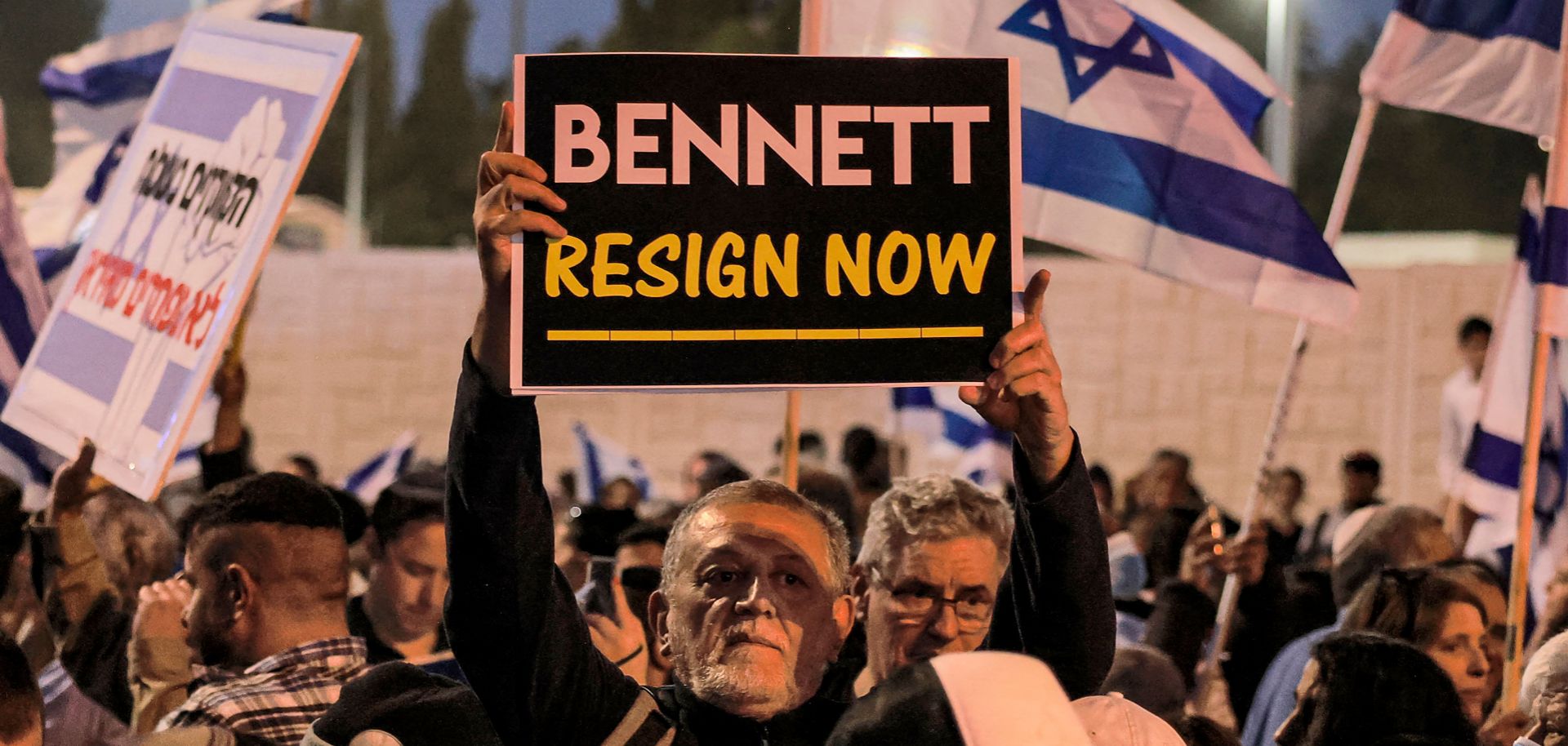
A man holds up a sign during an anti-government protest staged by Israeli right-wing supporters in Jerusalem, Israel, on April 6, 2022.
Following a key defection from the ruling coalition, Israel's right-wing opposition will use Jewish identity politics to peel off the final vote needed to force new elections, which could spur violence by emboldening radical groups. On April 6, Idit Silman — a lawmaker from Prime Minister Naftali Bennett's right-wing pro-settler Yamina party — defected to former Prime Minister Benjamin Netanyahu's opposition Likud party after she was reportedly promised the position of health minister if Netanyahu returns to power. Silman's departure has left Bennett's coalition without a legislative majority in the 120-seat Knesset, which is now split 60-60 between the government and the opposition. Bennett has held meetings with other Yamina lawmakers and coalition leaders to try to prevent any additional defections, which would collapse his government and trigger new elections in Israel for the fifth time in four years. But unless Bennett finds support from opposition lawmakers, his coalition will remain unable to pass legislation, portending further political paralysis.
- The political crisis caused by Silman's defection could last until Dec. 31, which is the deadline for the Knesset to pass the 2023 budget. According to Israeli law, if the Knesset fails to pass the budget before then (which requires a simple majority of at least 61 votes), early elections must take place. Bennett's coalition had originally aimed to vote on the 2023 budget next month, but Silman's recent defection now makes this very difficult.
- Bennett's so-called ''change government'' was formed in June 2021 and brings together settlers, nationalists, Islamists, leftists and centrists. This ideological diversity has since severely handicapped the coalition's cohesion and ability to pass legislation. Members from Bennett's own Yamina party have proven especially troublesome, with Yamina legislator Amichai Chikli refusing to vote to form the coalition last year because he opposed the inclusion of centrists and left-wing parties.
The opposition only needs to secure one more defection to dissolve the Knesset and trigger fresh elections. Several members of Israel's coalition government could defect in the coming days, including disaffected Yamina members, as well as members of the right-wing New Hope party and the centrist Blue and White party. Some right-wing members of Bennett's coalition dislike having to work with left-wing Meretz and the Islamist Ra'am party, but have supported the coalition because of mutual disdain for Netanyahu, who repeatedly broke promises and made political enemies among his own right-wing partners during his 12-year tenure as prime minister. But Netanyahu might be able to convince one or more lawmakers from parties in the ruling coalition to join the opposition by offering lucrative ministry posts in his prospective next government, which seemed to do the trick in winning over Silman. Anger over their policies not being passed, or simply the belief that an evenly split government is unsustainable and the country would be better served with fresh elections, could also prompt a member of the government to go rogue and defect on their own accord.
- Wholesale defections of the right-wing parties like Yisrael Beitenu and New Hope are possible but less likely. Their leaders have strong rivalries with Netanyahu and would be unlikely to be rewarded with the top posts they currently hold in another Netanyahu-led government.
Bennett may be able to find support on a case-by-case basis among lawmakers hesitant about Netanyahu's return to politics, which would enable the current Israeli government to remain in power — albeit in a constantly fragile position. There remains some discontent within the opposition for Netanyahu's leadership that could complicate his return to power. Netanyahu is currently on trial for corruption charges; a conviction might bar him from politics or drive down his popularity and politically affect Likud. He also promised to annex portions of the West Bank in 2020 but then failed to follow through, angering settlers and nationalists. One of these disgruntled settler or nationalist lawmakers might join with the Bennett government on certain items; rogue Yamina lawmaker Amichai Chikli might do the same. However, this would probably mean that the Bennett government would need to make concessions to the right that could alienate Meretz and Ra'am, like expanding settlements in the West Bank or promising Jewish identity policies.
The Netanyahu-led opposition will heavily emphasize Jewish identity politics to peel off another lawmaker, but in doing so, could embolden nationalist far-right groups to carry out violence against Palestinians, Israeli Arabs, and government officials. Part of Silman's rationale for leaving the coalition was that she felt the government did not emphasize Jewish identity well enough compared with Netanyahu's Likud party, which has long positioned itself as a champion of Israel's Jewish nationalism. Similar perceptions may lure other Yamina or New Hope Knesset members to join Likud. But as the opposition attempts to discredit the government as failing to uphold Jewish nationalist values, it could cause fringe radicals — like the Khanists of Otzma Yehudi — to carry out provocative marches, demonstrations and even riots against Palestinians, Arabs and members of the government. This would raise the specter of a wider security crisis as Bennett's coalition is already under public pressure to halt a surge of terror attacks inside Israel, and radical far-right groups might conclude that more violence would be enough to cause defections among wavering right-wingers in the Knesset.
