
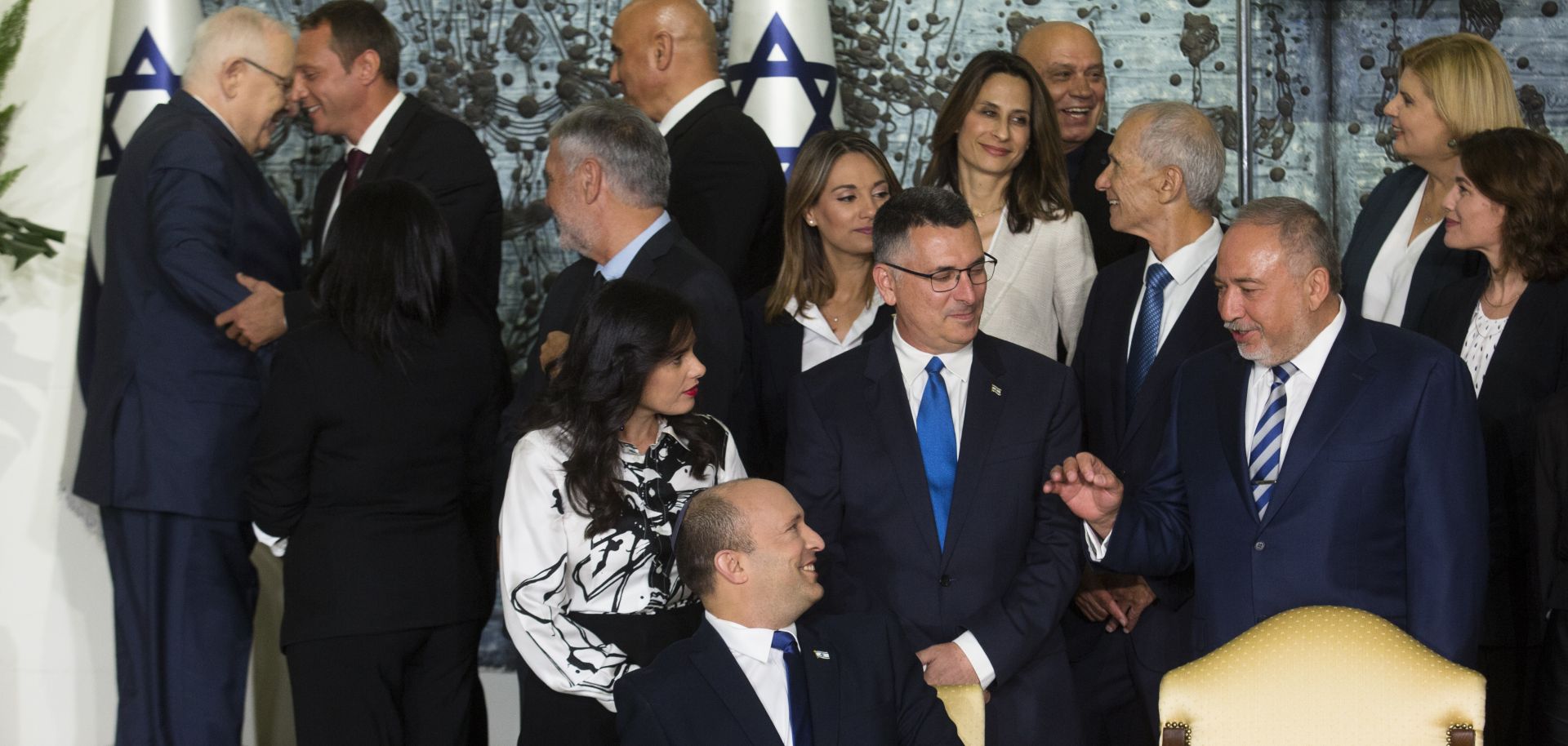
Israeli Prime Minster Naftali Bennett (bottom center) and members of his new coalition government chat with each other before posing for a group photo at the President's Residence in Jerusalem on June 14, 2021.
Israel’s government, one of the most politically diverse coalitions assembled in the country’s history, is engaging in policy disagreements that could weaken it to the point of collapse. On Dec. 28, right-wing members of Israel’s ruling coalition condemned Defense Minister Benny Gantz after he met with Palestinian Authority (PA) President Mahmoud Abbas and announced a series of measures designed to boost the economy in the West Bank. Then, on Jan. 1, the Islamist Ra’am party threatened to leave the coalition over an otherwise popular tree-planting project in the Negev desert, where a large part of Israel’s Arab Bedouin population lives. In both cases, coalition members negotiated backroom deals, avoiding their seven-month-old government’s immediate demise. Prime Minister Naftali Bennett assured right-wing lawmakers that Gantz’s meeting with Abbas would not see a return to the peace talks with the Palestinians. And the forestry project has also been paused until there’s a plan in place to ensure Bedouin communities aren’t displaced. Both incidents, however, highlight how the diverse political make-up of the eight-party coalition makes policymaking difficult, and how fractures may eventually lead to the government’s dissolution.
- With just 61 of the Knesset’s 120 seats, the current ruling coalition’s fragile majority makes the defection of even one lawmaker a critical matter.
Disagreements over the country’s Palestinian strategy and domestic forestry policies, as well as other issues, are likely to re-emerge in the future, sowing distrust between the coalition’s parties and lawmakers. The coalition’s right-wing parties, including Prime Minister Naftali Bennett’s pro-settler Yamina party, oppose a return to the peace talks with the Palestinians, preferring to leave such negotiations in stasis while continuing to expand Israeli settlements in the West Bank. However, other elements of the coalition — including Gantz’s more moderate Blue and White party and the centrist Yesh Atid party (whose leader Yair Lapid will replace Bennett as prime minister in 2023, per the coalition deal) — are more in favor of holding peace talks with the Palestinians and a two-state solution. This sets the stage for future clashes between the coalition’s right-wing parties and other members, especially when Lapid takes over as prime minister next year. The forestry issue will likely also continue to pit Ra’am against the rest of the coalition — especially Meretz, the left-wing environmentalist party pushing the Israeli government to adopt more climate change policies. Other issues that might emerge in the coming weeks or months include the construction of new Israeli settlements in the West Bank, which Meretz and Ra’am oppose but Bennett and the right-wing favor. Potential violence in the West Bank or Gaza Strip could create internal disputes as well, with right-wing members pushing a stronger military response as Ra’am and the coalition’s left-wing parties push for conciliation and concessions. And lastly, should corruption charges or the appointment of a new Likud party leader formally end former Prime Minister Benjamin Netanyahu’s long political career, it would also remove the key unifying force for the coalition, creating room for more discord.
- The parties in Israel’s current coalition are united in their opposition to the return of Netanyahu. Recent polls suggest his Likud party may still win a narrow majority in a fresh election, and the 72-year-old former prime minister is also currently on trial for corruption charges and is facing internal challenges from ambitious Likud members who want to replace Netanyahu as the party’s leader.
These disagreements will create opportunities for the opposition, now led by Netanyahu’s Likud party, to try to peel away lawmakers or even whole parties to bring down the government. Netanyahu reportedly offered to freeze the forestry project in exchange for Ra’am’s support during the 2021 coalition negotiations. The opposition might be tempted to lure Ra’am again or could focus on other right-wing parties and lawmakers to bring down the coalition. This becomes increasingly likely as the scheduled transfer of power from Bennett to Lapid looms and right-wing parties in the coalition grow nervous about being led by a centrist. Compared with Netanyahu and Gantz, the co-leaders of Israel’s last governing coalition, Lapid and Bennett have better personal relations. But they are nevertheless ideologically distinct on settlements and the peace process, which could cause some in Yamina to defect to prevent the transfer of power to Lapid. The removal of Netanyahu’s polarizing personality from the political equation, or a major crisis (like a fresh Palestinian war similar to the 2021 Gaza conflict) that exacerbates tensions between left and right, would increase the potential for Likud to retake power.
- The Likud-led opposition unsuccessfully lobbied a single Yamina right-wing lawmaker, Yomtob Kalfon, in 2021 to try to convince him to vote against the national budget and thereby bring down the government.
- Netanyahu and his rival Benny Gantz formed a unity government in 2020 with Gantz slated to take over as prime minister in 2021. But the agreement collapsed as it became clear Netanyahu had no intention of handing power to a political foe.
