
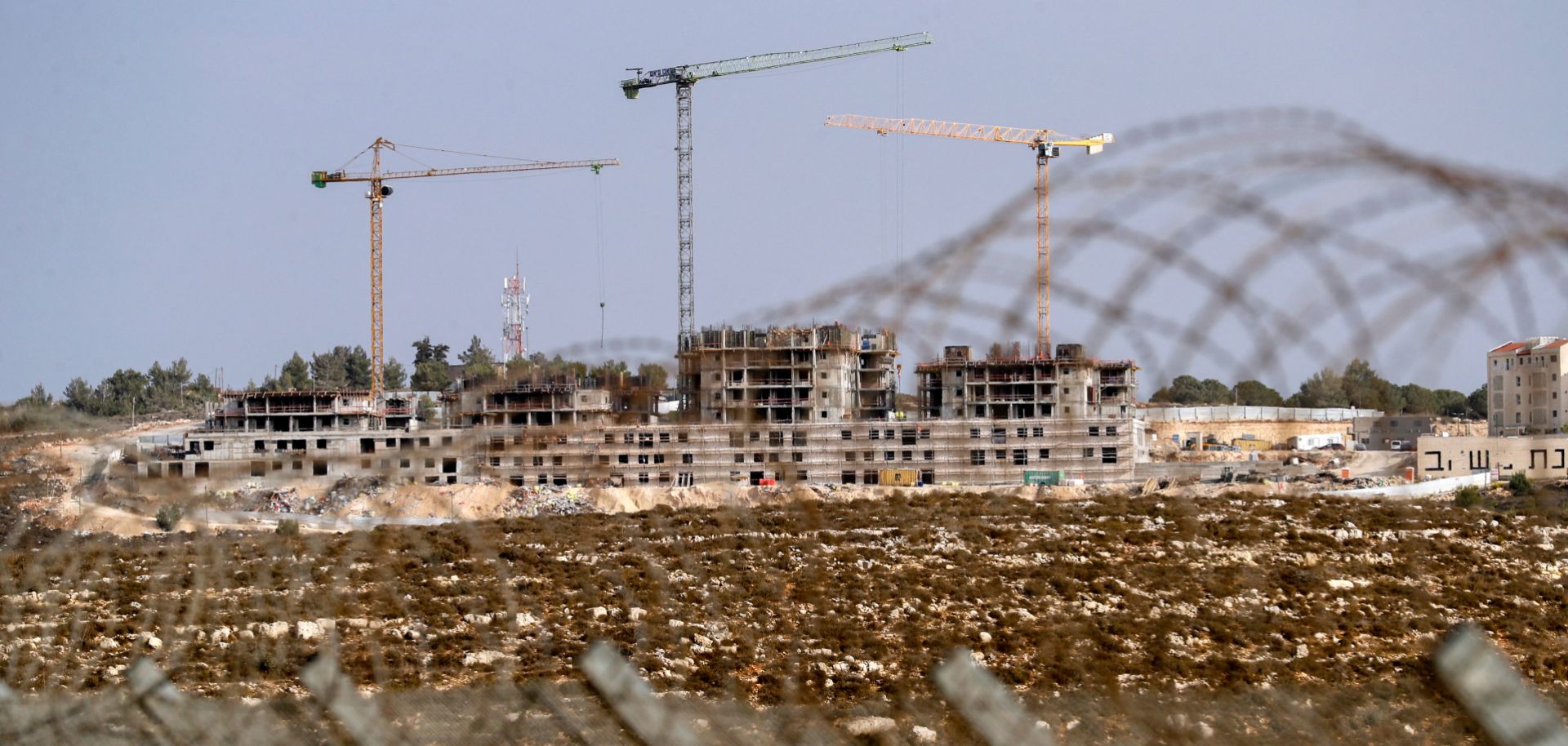
A photo taken on Oct. 28, 2021, shows ongoing construction work in an Israeli settlement near the Palestinian city of Ramallah in the West Bank.
New Israeli settlements will strengthen the conditions for future unrest in the West Bank, which could finally push the United States to turn its words into action and reshape its relationship with Israel. On Oct. 28, the Israeli government advanced plans to build 3,130 new homes across the occupied West Bank, marking the first such move since Israeli Prime Minister Naftali Bennett took office in June. The U.S. State Department quickly criticized the announcement, with spokesman Ned Price saying Washington “strongly” opposed the expansion of Israeli settlements. The left-wing members of Bennett’s ruling coalition also condemned the move, with leftist party Meretz calling it a “slap in the face” of the anti-settlement supporters who helped bring his government to power.
For now, internal disputes over settlements are unlikely to collapse the current Israeli government. A right-wing nationalist, Bennett has made it clear he would pursue policies to expand Israeli settlements in the West Bank, despite his reliance on Islamist and left-wing parties to maintain power. These anti-settlement parties, however, will likely remain in Bennett’s coalition so long as there is a threat of former Prime Minister Benjamin Netanyahu returning to the helm in a fresh election. Islamist and left-wing parties fear they’d again be shut out of power under another right-wing government led by Netanyahu. But the Israeli government is preparing legislation that may remove this unifying force by blocking Netanyahu from running for another term — in which case, ideological splits within Bennett’s coalition over settlements could weaken trust enough to eventually collapse the government.
The new Israeli settlements will, however, further anger Palestinians and raise the risk of violence in the West Bank by undermining the territorial viability of a future Palestinian state. Some of the homes slated to be built under the new plan are in a sensitive corridor that would cut East Jerusalem — the hoped-for future capital of a Palestinian state — off from key transportation routes connecting it to the rest of the West Bank. The completion of the new construction would thus pose a major obstacle to the formation of a viable Palestinian state. While the Palestinian Authority has worked with Israel to tamp down on unrest, its own legitimacy is increasingly in question, and its ability to prevent grassroots violence from escalating into another major uprising is uncertain in the face of new settlements.
This is likely to engender stronger U.S. criticism of Israeli policies that Washington sees as linked to driving unrest, such as settlement expansion. During his final weeks in office in 2016, former U.S. President Barack Obama made the unprecedented move of openly criticizing Israeli settlement expansion. This has since emboldened progressive members of his Democratic Party to be more forthright in their critiques of the close U.S.-Israeli relationship. The bloody Gaza War between Israeli forces and Palestinian militants in May has only fueled such criticisms in recent months, as well as calls for the United States to use its leverage over Israel to get it to halt West Bank settlements, hold off on military action against Palestinians and support the formation of a Palestinian state. Within this context, any unrest triggered by Israel’s continued settlement expansion could push the United States to finally take action on its rhetorical condemnation of Israel’s aggressive behavior toward Palestinians. Future developments that would indicate worsening Israeli-U.S. relations include:
- New U.S. condemnations of settlement constructions.
- New U.S. legislation designed to block aid to Israel or condemn settlement construction.
- U.S. media coverage of Israeli settlement policies takes on an increasingly critical tone.
- Progressive candidates running on more pro-Palestine planks in the U.S. midterm elections in 2022.
