
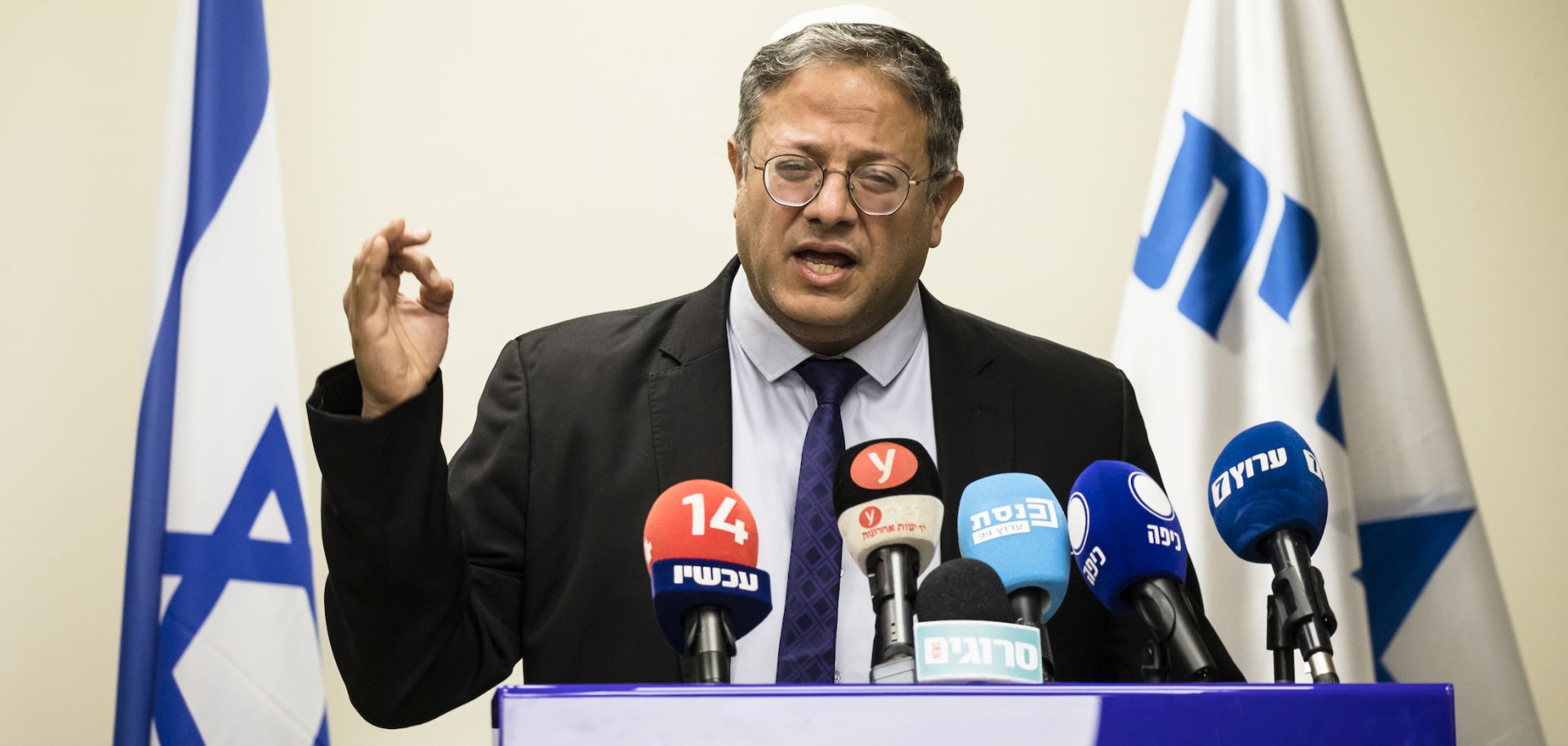
Itamar Ben Gvir, the leader of Israel’s far-right Oztma Yehudit party, holds a press conference on Nov. 28, 2022, in Jerusalem.
Israel’s ascendent far-right will use its recent electoral success to push its nationalist and ultra-Orthodox agenda. But despite likely criticism, the country’s U.S., European and Middle Eastern allies are unlikely to substantially alter their policy toward Israel to preserve their strategic ties with the country. Israel’s far-right Religious Zionism party — which includes smaller extremist parties like Oztma Yehudit (“Jewish Power”) and the anti-LGBTQ Neom party — won the third largest share of Knesset seats in the country’s Nov. 1 legislative election, giving it significant leverage in negotiations with former Prime Minister Benjamin Netanyahu to appoint a coalition government.
- Netanyahu is set to return to office after his bloc of right-wing and religious parties secured a majority of seats in the Israeli Knesset in the last election. The former prime minister’s Likud party is currently in talks with far-right and ultra-Orthodox parties to form a new coalition government.
- The Nov. 1 election was Israel’s fifth election in four years. The outgoing government coalition led by Prime Minister Yair Lapid brought together a varied assortment of liberal, centrist and Arab parties into a fragile coalition.
Religious Zionism will use its strong presence in the Knesset to try to reshape Israel’s political system and foreign policies in favor of its supremacist ideology, even as Israel’s allies abroad (like the United States and the United Arab Emirates) and politicians at home (like outgoing Prime Minister Yair Lapid) warn against doing so. In its negotiations with Netanyahu’s Likud party, Religious Zionism has reportedly been trying to extract promises for the next Israeli government to expand the country’s control in the West Bank, weaken the Supreme Court (which the party sees as a bulwark on religious law), and strengthen gender separation rights for the ultra-Orthodox in public spaces. The party has also been pushing for control of top cabinet positions, including defense minister or finance minister for Religious Zionism leader Bezalel Smotrich, as well as a newly-created national security minister (which would oversee Israel’s police, prisons, and border security) for Otzma Yehudit leader Itamar Ben Gvir. But the U.S. government and prominent American pro-Israel Jewish lobbies, along with officials from the United Arab Emirates, have warned against appointing such polarizing figures to these positions. On Nov. 17, the U.S. ambassador to Israel, Tom Nides, warned Netanyahu directly not to include Religions Zionism leaders in his prospective new cabinet. U.S. Union for Reform Judaism chief Rabbi Rick Jacobs also recently said that giving Ben Gvir the police post would be akin to handing the U.S. attorney general office over to the United States’ far-right Ku Klux Klan.
- Much of the concern about Religious Zionism stems from its ideological affiliation with the far-right Kahanist movement, which supports expelling Arabs from Israel, expanding the country’s borders through the West Bank and Gaza, and imposing radical rabbinical law in everyday life across Israel.
Israel’s First Major Far-Right Party
Far-right ideologies have existed in Israel since the country’s foundation in 1948. But Israel’s first major far-right party didn’t emerge until 1971, with the formation of radical Rabbi Meir Kahane’s Kach Party. The Kach Party wanted to strip Israeli Arabs of citizenship, impose automatic death penalties for Arab terrorism, introduce Jewish ultranationalism to school curricula, annex the West Bank and Gaza Strip, and have unrestrained military suppression of Palestinian militants. The party won one Knesset seat in the 1984 elections and was then banned for inciting racial hatred in 1988. In 1990, its founder Kahane was assassinated in New York City, and in 1994 both the Kach Party and another offshoot, Kahane Chai, were banned in Israel. Otzma Yehudit leader Itamar Ben Gvir joined the movement in the 1990s, though Gavir claims he’s since moderated some of his beliefs.
The far-right’s probable inclusion in Israel’s next government will formalize its influence over domestic and foreign policy. Netanyahu's next cabinet is poised to be the most far-right in modern Israeli history. Short of the Defense Ministry, far-right politicians might take less prominent posts or accept policy promises to come to an agreement on a new coalition government. Other components of the cabinet — including the ultra-Orthodox Shas and United Torah Judaism parties — will also be dominated by politicians who want to strengthen Jewish nationalism and rabbinical influence in the country. The policy priorities of these new government officials will include weakening Israel’s Supreme Court so it cannot easily block Knesset legislation, outlawing public displays of sympathy for Palestinian militants and Palestinian symbols like flags, weakening protections for Israeli LGBTQ individuals and marriage, strengthening exemptions for the ultra-Orthodox in education and military service, and imposing Israeli civil (rather than military) law on West Bank settlements and outposts.
- Israeli politics have been drifting further to the right for years. In an August 2022 survey conducted by the Israeli Democracy Institute, 62% of the country’s Jewish voters described themselves as right-wing — a notable jump from the 46% who did so in April 2019. A 2020 joint poll conducted by the Palestinian Center for Policy and Survey Research and Tel Aviv University also found that 51% of Israeli Jews supported the Vision for Peace plan proposed by then-U.S. President Donald Trump, which encouraged Israeli expansionism without guaranteeing a Palestinian state.
- The far-right’s ultimate goal is to take full control of territory in the West Bank under Israeli civilian law. Currently, the West Bank is governed under the Oslo Accords, which leaves one portion (Area A) under Palestinian security and political control, another portion (Area B) under joint Israeli-Palestinian control, and a final section (Area C) under Israeli military authority. Religious Zionism aims to transfer Area C to Israeli civilian law, which outgoing Defense Minister Benny Gantz has claimed would be tantamount to annexation.
- Both the far-right and the ultra-Orthodox parties aim to push back against secular and nationalist accusations that religious Israelis contribute too little to the country’s economy and military because of their educational and conscription exemptions that allow them to run religious schools and avoid military service. The outgoing Lapid-Bennett government attempted to push conscription for the ultra-Orthodox and introduce more secular education to religious schools.
While Israel’s regional and global partners will criticize the new government’s far-right and ultra-religious policies, they are unlikely to actively boycott it because of the importance of their strategic alliances with Israel. Regardless of its composition, Israel’s next government will likely earn diplomatic criticism from the United States, European powers, Turkey and the Arab Gulf. Israelis are highly sensitive to the threat of international isolation (such as that proposed by the Boycott, Divestment, and Sanctions movement). This is especially true when it comes to the United States, which is Israel’s main defense and economic partner. More moderate right-wing parties in the opposition, like A New Hope, will play into these fears by using any U.S. condemnation of the new Israeli government as evidence that right-wing voters should stop supporting such radical parties. Secular, opposition, Arab, and left-wing Israelis will likely criticize the new government’s policies, as well as carry out strikes and protests, in an effort to convince right-wing voters that the country’s ideological drift to extremes could cause international isolation. But this tactic could backfire when such isolation does not manifest, as Israel’s strategic value to its regional and global partners will deter most governments from actually imposing sanctions or cutting ties with the country in response to any controversial new policies. Indeed, the 2021 Gaza War and the bloody clashes that broke out between Arab and Jewish Israelis on the streets initially sparked wide-scale international and domestic criticism of the Israeli far-right. But despite this, Religious Zionism’s support has grown at home and Israel’s foreign relations with countries like Turkey have improved over the past year. International condemnation of the new Israeli government will thus likely again remain largely rhetorical, which could further convince right-wing Israelis that the far-right is not a diplomatic liability and strengthen public support for their positions across an increasingly nationalist electorate.
- The United States still needs Israel to balance Iranian activity in the region, and there remains a bipartisan supermajority in Congress that supports current Israeli-U.S. relations. In 2021, the U.S. House of Representatives passed fresh aid to Israel to resupply its Iron Dome system in a blowout 420-9 vote, despite sustained media and international criticism of Israeli policies during the Gaza War earlier that year.
- Turkish President Recep Tayyip Erdogan has said the expected return of a Netanyahu government is unlikely to change his country’s relations with Israel, which have recently improved after years of animosity amid the Turkish government’s push to bolster trade ties with former regional rivals.
- The Palestinian issue has also become less salient among Arab Gulf populations, which has enabled countries like the United Arab Emirates and Bahrain to ramp up their security cooperation with Israel in response to growing Iranian aggression and other regional threats.
