
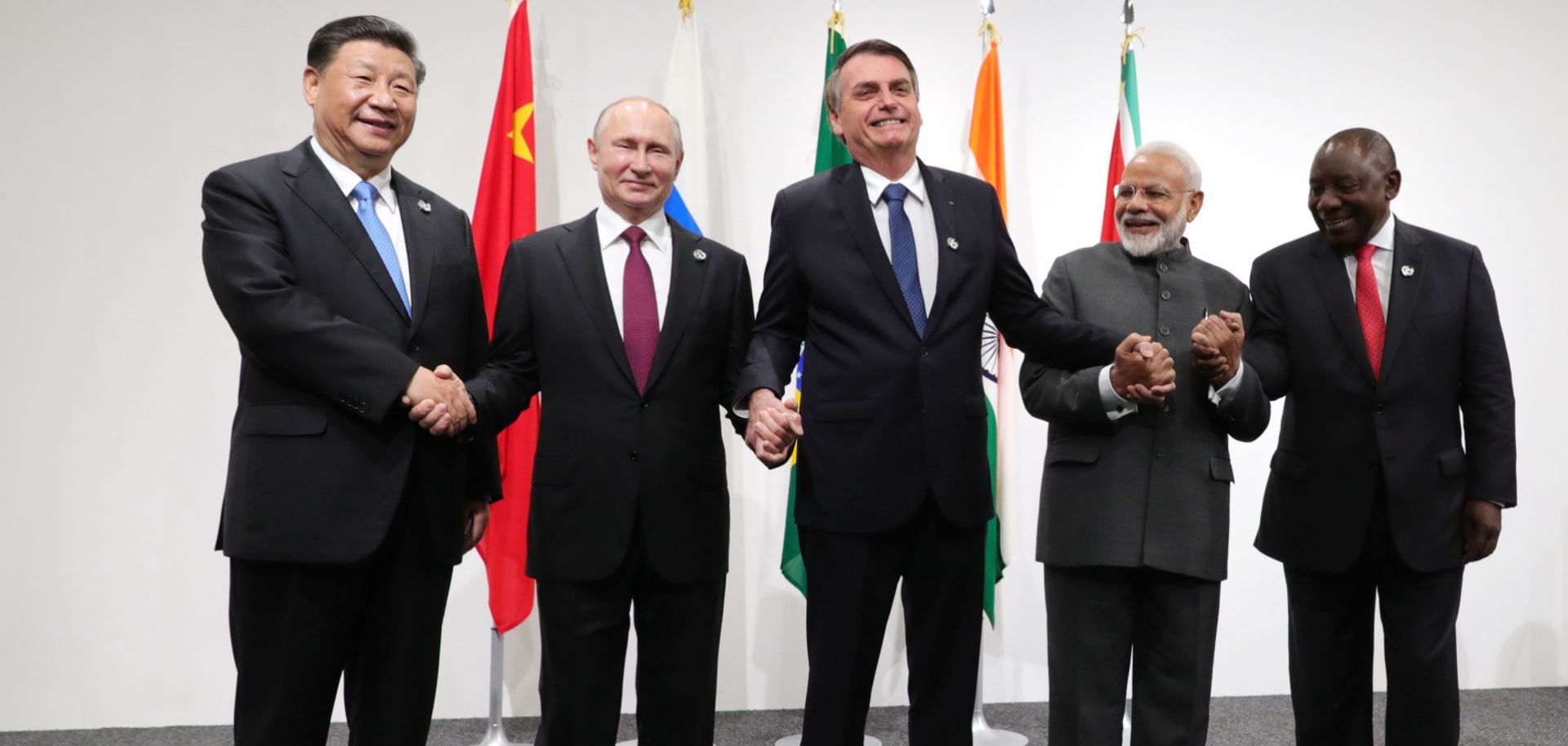
(From left) Chinese President Xi Jinping, Russian President Vladimir Putin, then-Brazilian President Jair Bolsonaro, Indian Prime Minister Narendra Modi and South African President Cyril Ramaphosa pose for a photo during the G-20 summit in Osaka, Japan, on June 28, 2019.
The true believer can be the hardest to believe. When a person, let alone a state, promises radical policies, the initial reaction of the seasoned analyst is usually incredulity. At RANE, we start our analysis with the rational actor model: leaders and states are self-interested, and self-interested politicians accept constraints and trade-offs, knowing that such measured approaches to strategy and policy are most likely to succeed at the least risk to themselves. But ideology throws a wrench in the rational actor model because ideologues do not always accept constraints — some even seek to break past them. As the post-Cold War assumption that democratic capitalism was the inevitable future continues to weaken, we're witnessing the assertion of alternative ideologies that prioritize neither democracy nor capitalism.
These modern ideologies are grounded in older traditions, but they are rarely pure revanchism that seeks to resurrect the past without modification. For example, Russian nationalism is grounded in Russian history but retains its post-Soviet capitalist flavor; so too does Chinese nationalism, which does not seek to return to the command economy of Maoism. For its part, Turkish Islamo-nationalism brings Islamist ideas into policy but is not about to return to a system that functions under a sultan or caliphate. Meanwhile, Israeli religious nationalists seek to erode the country's checks and balances, but they do not seek a return to the monarchies of pre-Roman Israel.
What unites these alternative ideologies is that they are willing to trade off democracy and/or capitalist ideals in pursuit of their goals without explicitly seeking to overthrow the democratic-capitalist world order. If Russia could conquer Ukraine and still trade with the West, Moscow would do so, as opposed to the Soviet Union, which saw trade ties with democratic capitalists as generally ideologically unacceptable. But if conquering Ukraine means losing access to the West's markets, the current Kremlin believes that such a cost is worth bearing for the sake of its emphasis on Russian nationalism.
This is a more subtle approach to ideology than in previous historical eras, like the Cold War and World War II. It makes it difficult to always accurately assess when a state is prioritizing an emerging or resurging ideology versus when it retains its drift toward the old democratic and/or capitalist world order.
How Geopolitics Views Ideology
Ideology sits above all seven pillars of geopolitics (geography, politics, economics, security, society, history and technology), acting as a set of organizing principles by which a state approaches these facets of power. Different ideologies might assign them different levels of priority in state policy. For example, expansionist fascists will focus heavily on geography and history, even at the expense of security. This was the case of World War II's Nazi Germany, which endlessly fought aggressive wars based on its ideological view that its thousand-year Reich had a historic destiny to dominate Europe. Democratic capitalists, on the other hand, prioritize political and economic policies over historical ones; the United States has a long history of resuming ties with former adversaries when enough trade is at stake.
Ideologies can anchor a state's geopolitical worldview, and therefore make forecasting easier. A revanchist, expansionist state can be expected to be aggressive against its historical rivals; a theocratic state can be expected to utilize its religion to inform its policies; a communist state can be expected to suppress business and free enterprise; and a capitalist state is expected to do the opposite. In this situation, ideology serves as the forecaster's helper — we can reasonably expect the Islamist Taliban to prioritize its restrictive social policies even at the expense of trade links that would benefit Afghanistan's economy, just as we can reasonably expect Franco-British capitalists to maintain working trade relations despite their ancient historical rivalry.
The Growing Difficulty of Spotting Ideologies
Ideologies do not exist in stasis; they evolve, splinter and collapse. Sometimes, ideological change is overt, such as when revolutions and elections bring to power clear shifts in policy, driven by the underlying ideologies of the new regimes. This again can serve as a forecaster's aid. For example, when a communist revolution broke out in the Cold War, it was reasonable to assume that the new regime would be anti-U.S. and anti-Western.
But in the post-Cold War era, ideology is both harder to describe and harder to see change. In World War II and the Cold War, doctrine-grounded, reasonably well-understood ideological geopolitical blocs existed: fascism, communism and democratic capitalism. Each served as a foil to the others. When fascism believed in ethnic supremacy, then democratic capitalism and communism at least nominally believed in ethnic equality; if fascism and communism believed in a command economy, then democratic capitalism believed in a free one. But the end of the Cold War muddled the ideological waters even though Francis Fukuyama's 1992 The End of History and the Last Man famously predicted the end of ideological competition. The world is no longer dominated by opposing factions with such diametrically opposite views of the world.
Nominally, the world has embraced capitalism, though not wholly democracy. Most autocrats go by the democratic title of ''president,'' as opposed to leader or general secretary, and many of them even go through the routine of elections, rigged though they are. There are few formal command economies left, as even anti-Western states like Venezuela, Iran and Syria would welcome trade agreements with Europe and the United States. And there are no nation-states that back aggressive, globe-dominating strategies, like the USSR and Axis powers once did. These trappings and nuances can obscure a state's true ideological inclinations.
Sometimes, ideological change is hard to assess, as it can subtly change on the grassroots level, catching observers off-guard. This is what happened with the candidacy of former U.S. President Donald Trump in 2015-2016; even he at times seemed surprised to discover that the base of the Republican Party had quietly shifted ideologically to align with his America First worldview that de-emphasized globalization and business-friendly policies in favor of culturally divisive ones. Ideological change might also happen behind closed doors at the state level, as it did in Saudi Arabia when the ascension of Crown Prince Mohammed bin Salman in 2015-2016 brought a secular, nationalist ideology that rapidly shunted aside the kingdom's decades-long religious worldview. In both cases, consequential ideological change was hard to foresee based on the data available at the time.
When Do the True Believers Mean It?
Even when a new ideology has seemingly taken over a state, it's not always easy to ascertain how determined this ideology is in the face of geopolitical constraints. Famously, Adolf Hitler made it very clear that he wanted a new order in Europe imposed by German arms. Still, until after the Munich conference in 1938, both France and the United Kingdom assumed that Berlin understood that another European war would be a disaster for all involved and believed that Germany would assert itself in ways that would not trigger another general war.
But for every one Nazi Germany, there is a North Korea, which so routinely threatens to launch all-out attacks on South Korea that we at RANE don't produce a Situation Report after every threat. North Korea knows that to follow through with its long-held ideological goal of forced unification with the south would result in a disastrous war it cannot win; in this case, constraints balance out ideology. And North Korea is hardly the only example: Iran threatens to destroy Israel as a matter of routine, but it knows to do so would probably also result in the destruction of Iran in turn (either by Israel's nuclear arsenal or by an international coalition's counterattack). And there is Israel, too, which in 2020 threatened to annex the West Bank and then backed down at the last minute, deterred by the diplomatic pushback of the United States and Gulf Arab states and distracted by the COVID-19 crisis.
In the Israeli case, the trickiness of assessing ideology in state behavior can be further complicated by leadership personalities. Israel's Prime Minister Benjamin Netanyahu is a master politician, long able to say many different things to many different people, including promising to annex the West Bank to win over right-wing voters. But while we have reporting that suggests he did mean what he said in 2020, we also have plenty of evidence of his restraint, from avoiding major military escalations with Iran to calculated campaigns in Gaza. The West Bank annexation in the summer of 2020 is a forecast we missed because we gave too much weight to ideology. However, we also have given ideology too little weight in other forecasts, including the February 2022 Russian invasion of Ukraine.
How Ideology Animates States
What is clear is that new ideological drivers beyond democracy and/or capitalism have greater weight in states than they did in past decades. The U.S.-led unipolar moment is finished, and a multipolar global environment enables such ideological expressions to bubble up to the surface in state behavior without pushback by the once-dominant democratic capitalism ideology of the West. And there is no shortage of alternative ideologies these days.
Most recently and prominently, a seismic and disruptive ideological expression emerged with Russia's invasion of Ukraine. There, the Kremlin decided its prior priorities for capitalist tenets, like free trade and economic growth, were outweighed by its nationalist and historical ideals; in this worldview, to rebuild the Russian Empire, economic sanctions and isolation are a worthwhile tradeoff.
Turkey, too, has borne the economic cost of ideology as it keeps interest rates artificially low in the pursuit of Islamo-nationalism principles, seeing interest rates as un-Islamic usury; it has also undercut its democratic institutions in a bid to keep the steward of this ideology, the Justice and Development Party (AKP), in power. Israel, now under the sway of a nationalist-religious far-right government, is in the midst of a judicial reform that even its own central bank head warns could harm its credit ratings and its opposition says will damage the country's democracy. And China's growing nationalist tendencies have kept it on a collision course with its key trade partners, the United States and Europe, over its view that Taiwan must be re-integrated with the mainland.
Even the United States, the champion of democratic capitalism, is not immune to this trend. Some of its grassroots voters are agitating against the traditionally peaceful political process, and still other voters are shifting away from voting on the economy and instead vote on culture, as evidenced by the results of the midterms in which issues like abortion and the state of democracy were noted on exit polls as major priorities, despite high inflation. Abroad, the United States is forced to choose between free trade and the global security architecture it helped build as Russia and China become more aggressive. In this last case, it is not so much that the United States is abandoning its emphasis on economics as guided by capitalism, but rather that it is being forced to re-emphasize security in the face of great power competition, even if that comes at the expense of economics.
There is a price to this trend, sometimes in economic terms, sometimes in the security realm and sometimes in the social sphere, as ideologies try to push past geopolitical constraints. But constraints are going nowhere, regardless of how hard an ideologue and their supporters believe in their tenets. For every radical, ideologically-driven push, there will be pushback. And such pushbacks can actually manifest into ideological changes themselves: lost elections, coups or revolutions, civil wars, or subtle regime shifts away from ideologies that impose too great a cost on a state. That, too, complicates the role of ideology in geopolitical forecasting, as once a state's ideology is well-understood, constraints may impose such costs that the state shifts away from it, forcing analysts to revisit their assumptions once more. This not only makes the forecaster's job harder, but also creates an expectation of more frequent policy and even larger strategic shifts in this more fluid emerging world order.
