
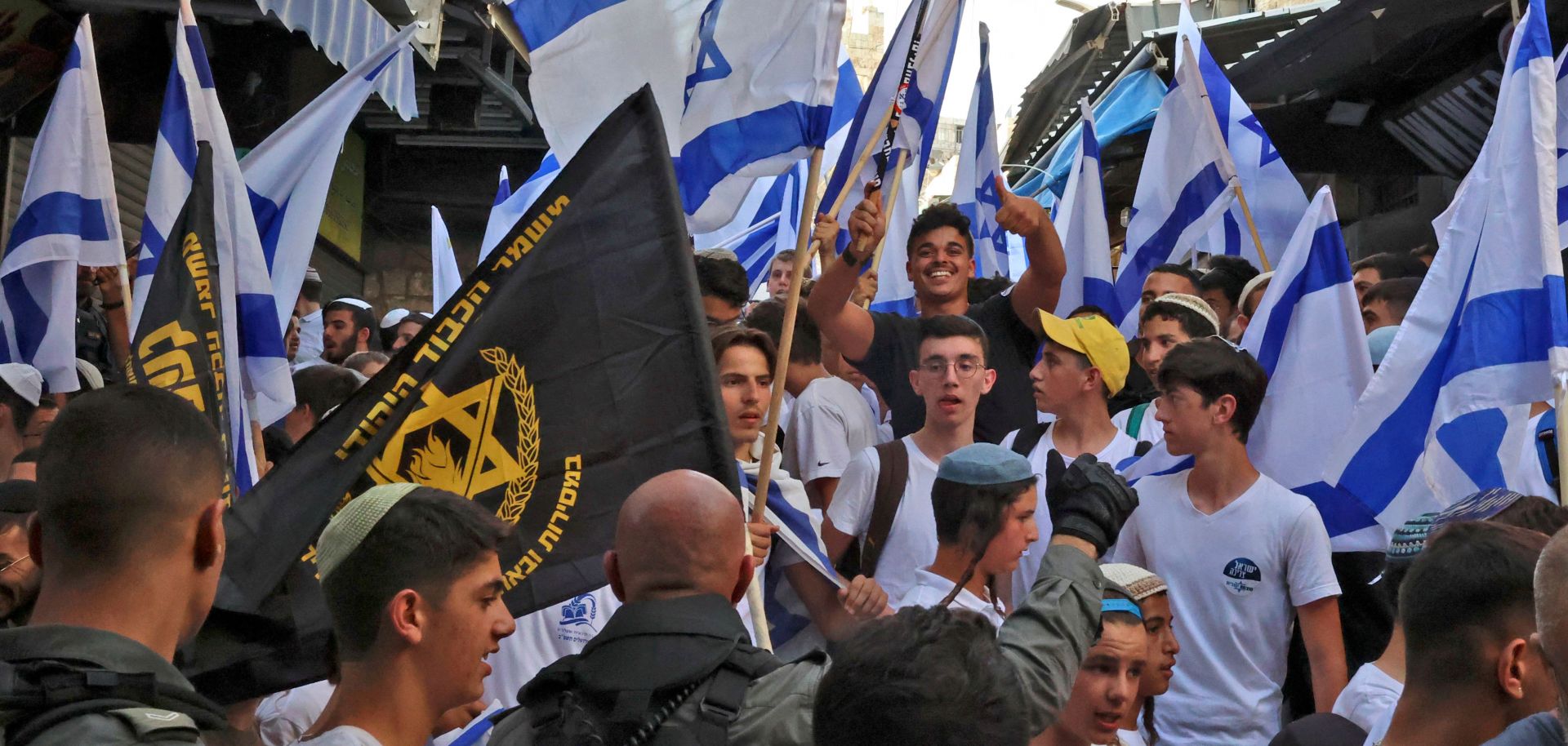
Demonstrators wave the Israeli flag and the banner of the far-right Jewish group "Lehava" (Flame) gather for the "Flag March" on May 29, 2022, marking "Jerusalem Day" in the Old City of Jerusalem.
Editor's Note: We continue to monitor simmering unrest in Israel and the Palestinian territories from multiple angles. As part of our coverage, we are examining the growing influence and impact of right-wing Israeli political forces. Next month, we will examine Palestinian militant groups in the West Bank. Neither of these (nor any other assessment) is meant to attribute responsibility for ongoing violence, but rather to provide a window into the different actors involved in the complex and multifaceted conflict.
Palestinian attacks and Israeli nationalist rhetoric appear to be increasing Israelis' support for far-right narratives and policies, with notable implications for Israel's national security. A study published Aug. 30 by the Israel Democracy Institute found that support in Israel for right-wing politics has increased considerably in recent years, with 62% of the 3,855 survey respondents identifying as right-wing ahead of the November legislative election, a significant increase from 46% in April 2019. Notably, Israeli support for far-right political parties — including those which were previously considered outliers — has also increased; for example, support has grown for Otzma Yehudit, a far-right political party led by ultranationalist member of the Knesset Itamar Ben Gvir, which is considered the ideological successor of the historical right-wing extremist Kach party. The increasing acceptability of and support for the far right has driven center-right and right-wing parties further to the fringes: Likud in particular has recognized the ascendance of the far-right and sought to shape its election campaign around far-right grievances and narratives. These trends do not necessarily suggest that the far right will enjoy a resounding victory, as recent polls continue to project a close race in which neither former Prime Minister Benjamin Netanyahu's right-wing bloc nor current Prime Minister Yair Lapid's center-left bloc would have the 61-seat majority needed to form a new government.
- A poll by Israeli Channel 13 News published Oct. 2 has the far-right Religious Zionism alliance — which includes Otzma Yehudit and the anti-LGBT Noam party — gaining 14 seats, more than double its current six seats, highlighting the growth in support for the far right.
- Likud is seeking to attract support from far-right voters by proposing aggressive policies vis-a-vis Palestinians and Arab Israelis and expressing sympathy with far-right grievances. In an interview with Israeli news outlet Zman Yisrael in May, Likud member of the Knesset Miki Zohar claimed that "Arabs are taking over the country. We see it every day. They abuse Jews. They do what they want. They go to violent demonstrations that sometimes lead to lynchings. They trample Israeli flags .... This will be the hot topic in the elections and the public will be with us."
- The rise of Otzma Yehudit demonstrates the increasing acceptability of far-right parties in recent years. The party owes much of its ideology to the extreme-right Kach party, which was established in 1971 and advocated for what effectively amounted to the expulsion of most Arabs and the imposition of Jewish religious law and sovereignty over Israel, the West Bank and Gaza. Kach was disqualified from running in elections in the mid-1980s for inciting racism and denying Israel's democratic character. Kach and a later splinter faction, Kahane Chai, were eventually outlawed following their support for Baruch Goldstein and his 1994 massacre of Palestinians at the Cave of the Patriarchs in the West Bank city of Hebron.
- Continued disagreement within the political right over Netanyahu's future role amid his corruption scandal has been a key constraint preventing the formation of a strong and unified right-wing coalition needed to build a majority government.
Historically, right-wing political action and violence often have emerged from right-wing politicians speaking of threats to Israel, its Jewish character and the expansion and solidification of Israel's control over the occupied Palestinian territories. Right-wing politicians have often said such existential threats exist because of declines in right-wing political power. In addition to galvanizing legitimate political action, some extreme right-wing elements have carried out violent attacks after this sort of political discourse, believing the state cannot or will not pursue policies they deem necessary to counter the alleged existential threats. Hard-line right-wing politicians and groups have often used specific narratives to connect current events to these alleged eventualities. First, they have accused Palestinians of being disinterested in peace and thus inherently violent, and Arab Israelis in particular of being untrustworthy and disloyal to the state. And second, they have accused Israeli political figures — typically centrist and left-wing politicians, but especially anyone on the political right — who engage or express willingness to work with Palestinians and Arab Israelis of treachery. Among the most prominent events to bolster both these narratives was the Second Intifada from 2000-2005, during which unrest and a wave of Palestinian suicide bombings prompted many Israelis to perceive Palestinians as intrinsically violent and disinterested in peace, a perception that far-right figures have widely promoted. That some Arab Israeli leaders expressed support for the unrest and violence at the time only reinforced many Israelis' distrust of Palestinians, but particularly Arab Israelis, bolstering the view — which far-right leaders have spread — that they were an "internal enemy." Israel's subsequent unilateral disengagement and withdrawal of settlements from Gaza in 2005 — led by Prime Minister Ariel Sharon, a member of Likud and a prominent supporter of the settlement movement — only drove further grievances among hard-line members of the political right and the settlement movement, who accused Sharon of treachery and of capitulating to Palestinian terrorism. Intra-Israeli tensions were so high in the run-up to the disengagement that many observers expressed concern about the potential for violence, with some even worrying about the potential for civil war. Though the disengagement eventually went as planned, Hamas' eventual rise to power in Gaza solidified the perceived credibility of right-wing narratives, seemingly proving that concessions to Palestinians inevitably lead to the formation of terrorist states that threaten Israel's national security.
- The Second Intifada and Israel's subsequent unilateral disengagement from Gaza were primary drivers for the development of Hilltop Youth, a label given to a group of predominantly young extremist Israeli settlers in the West Bank who still establish illegal outposts on hills and attack (or threaten attacks against) local Palestinians. Despite targeting Palestinians, their so-called price-tag attacks are also intended to provoke instability in the West Bank to deter the Israeli government from withdrawing.
- The right-wing opposition to Prime Minister Yitzhak Rabin and the Oslo Accords in the 1990s notoriously accused Rabin of treachery. Some believe the accusations, often leveled by incensed protesters at political rallies, helped prompt far-right extremist Yigal Amir — who perceived the Oslo Accords as an existential threat to a Jewish Israeli state — to assassinate Rabin in 1995.
- Younger Israelis' experiences witnessing the collapse of various Israeli-Palestinian peace processes, the violence of the Second Intifada and various Gaza Wars have driven strong support for the political right among Israeli millennials. The country's rising ultra-Orthodox population, which typically votes for religious parties on the political right, has also contributed. A 2018 study by the Israel Democracy Institute showed that "approximately 64 percent of Israeli Jews aged 18-34 identify as right wing, compared to 47 percent of those 35 and older."
Some right-wing Israeli politicians have used these narratives to frame recent spates of Palestinian rocket barrages, extremist attacks and intercommunal violence for their political advantage. Right-wing parties generally champion more assertive security policies, particularly amid escalations in Israeli-Palestinian violence. This seemingly has been effective in increasing Israelis' support for the political right, as academic studies have shown such support increases amid rocket barrages and Palestinian extremist attacks, in part because Israelis perceive the right as more effective in dealing with security issues. Recent violence has driven the latest surge in support for the right, especially its notable intensity and increased geographic scope, both of which have intensified feelings of insecurity and vulnerability among Israelis. The severity of barrages and violence during the May 2021 Gaza War, for example, was widely seen as the worst since the 2014 Gaza War, and subsequent escalations have occurred. Recent barrages from militants in Gaza have also more frequently targeted cities beyond those located in the south — which must contend with rocket attacks more regularly — likely increasing such feelings. But the recent events that likely prompted the greatest surge in support were the particularly intense eruption of intercommunal violence in May 2021 and the spate of Palestinian extremist attacks in the spring of 2022, both of which affected cities throughout the country. The May 2021 violent clashes in mixed Jewish-Arab towns — many of which were not accustomed to such clashes and whose communities had existed in relative peace — increased distrust of Arab Israelis. That there was a spate of Palestinian and Arab Israeli extremist attacks that killed at least 17 people and wounded at least 24 others about a year later — carried out in less prominent cities such as Hadera along with larger cities such as Tel Aviv — only hardened Israeli views against Palestinians and increased perceptions of vulnerability. Right-wing Israeli politicians and commentators have seized upon these incidents and framed them for political gain, fitting them into their long-standing narratives accusing Palestinians of being inherently violent and Arab Israelis of being treacherous and disloyal.
- The far-right Otzma Yehudit and its politicians have been known to label Arab Israelis and left-wing politicians as enemies of the state. A party billboard in Ramat Gan city bears the slogan "May our enemies be banished," along with the faces of three members of the left-wing Hadash party and Arab Ta'al party. A senior member of Otzma Yehudit, Baruch Marzel, has said he considers "a majority" of Arab Israelis to be enemies of the state.
- Demonstrating a dramatic growth in perceived insecurity during the spate of violent extremist attacks in the spring of 2022, Israel's Firearms Licensing Committee revealed in May that gun license applications for Israelis have increased 600% since the spate of attacks that began in late March.
- During the outbreak of intercommunal violence in May 2021, Israel National Police Commissioner Yaakov Shabtai noted that "we are witnessing a situation we have not seen before in mixed cities," and that it was the worst intercommunal violence in Israel in decades.
Amid the violence, the political right has delegitimized those involved in the recent diverse government by accusing them of treachery and facilitating (if not themselves driving) threats to Israel's national security. Former Prime Minister Naftali Bennett, who took over from Netanyahu in June 2021 and served until June 2022, is widely known for his hard-line nationalist views and long-standing support for Jewish settlement in the West Bank. It was thus a surprise to many — and particularly those on the far right — that he would at least temporarily set aside many of his hard-line policy positions to form the diverse governing coalition that would eventually unseat Netanyahu and for the first time usher in an Arab political party, Ra'am, into a ruling coalition. That other right-wing political figures — most notably Interior Minister Ayelet Shaked, an expansionist nationalist — also joined a coalition that included centrist and left-wing parties only increased concern among parts of the right that some politicians were willing to prioritize personal interest or a commitment to unseat Netanyahu over their ideological interests. Netanyahu warned shortly before the formation of the coalition that a "left-wing government" would endanger "Israel's security and future," and he has subsequently led the political opposition that has portrayed Bennett and other right-wing members who participated in the coalition as treacherous. This campaign has managed to undercut many of the participating politicians, including Shaked, whose Jewish Home party is poised not to meet the electoral threshold in the upcoming election.
- Prime Minister Yair Lapid's Sept. 22 speech to the U.N. General Assembly — in which he made headlines by calling for a two-state solution to the Israeli-Palestinian conflict — triggered immediate criticism from many opposition, and even some allied, politicians. Justice Minister and leader of the right-wing National Unity Party Gideon Sa'ar, for example, tweeted that "establishing a terror state in Judea and Samaria [the West Bank] will endanger Israel's security." Meanwhile, Netanyahu claimed that the speech was "full of weakness, defeat, and bowing of the head" and that "Lapid endangers our future and existence both on the Palestinian issue and on the Iranian issue."
- Netanyahu has also pointed to the former government's unwillingness to support the Israeli settlement movement as a key piece of evidence for its supposed threat to Israel's national security. Eventually, disagreement over the extension of a law granting Israeli settlers the same rights as citizens in Israel — which had historically been renewed on a regular basis — ultimately led to the collapse of the diverse coalition.
- Right-wing extremists have threatened Bennett on several occasions for his perceived treachery. In one notable incident, police opened an investigation in May 2021 after images circulated of Bennett in an Arab headdress, or "keffiyeh," along with a caption labeling him "the liar," evoking a similar image that circulated of Rabin prior to his 1995 assassination.
- In response to such threats and political pushback, some members of the former coalition have changed tack and sought to rekindle support from right-wing voters in the run-up to the new election. Shaked in particular has in recent interviews claimed she made "mistakes," appearing to express regret for supporting the diverse coalition and serving in the government.
Should the Israeli right successfully regain its majority in the November legislative election, the coalition would likely pursue more assertive legal and security policies vis-a-vis Palestinians and Arab Israelis, which could cause a violent backlash. Among other things, a potential ruling coalition made up of right and far-right parties would likely emphasize that Palestinians and Arab Israelis cannot be trusted, and that Israel and its Jewish character need to be protected. Some right-wing parties have already pledged to pass policies responding to these concerns. For example, amid recent spates of Palestinian extremist violence and the ascendence of the far right, Likud politicians have expressed the intent to draft legislation criminalizing flying the Palestinian flag or burning the Israeli flag, revoking the citizenship of those who protest during times of war, and deporting the families of alleged violent extremists who hold Israeli citizenship. The pursuit of some right-wing political priorities, particularly new or expanded Israeli settlement activity, would be especially risky. This is something many right-wing parties have long advocated in part because they believe settlements improve Israeli national security, but that would also likely drive retaliatory Palestinian violence. A right-wing government would also likely support more frequent and assertive security operations against Palestinians. This could include more preemptive security operations in the West Bank, where the Israel Defense Forces' use of unmanned aerial vehicles for targeted strikes was recently approved, as well as in Gaza. But although more assertive or preemptive security operations would probably benefit Israeli security to some extent, they would simultaneously increase risks of civilian casualties, worsen Israeli-Palestinian tensions and likely drive retaliatory Palestinian violence.
- Violent clashes between Israeli security forces and Palestinians in the West Bank have continued to increase in frequency and intensity since the IDF began security operations there following the spate of Palestinian and Arab Israeli violent extremist attacks this past spring. Some reportedly new or previously unseen Palestinian armed groups have contributed to this increase in violence — including Lion's Den, which primarily operates in the West Bank city of Nablus and whose attacks against Israeli forces have triggered recent IDF operations targeting the group. Intensifying clashes have helped make this year the deadliest in the West Bank since 2015, and Israeli officials have reportedly been concerned that continued escalation could prompt a broader Palestinian uprising there.
- Despite ongoing IDF operations in the West Bank, Netanyahu has continued to accuse the current government of being inadequately assertive and thus ineffective in countering Palestinian violent extremism. On Oct. 11, for example, Netanyahu tweeted in Hebrew that "Four Israelis were murdered this month in terrorist attacks. Lapid and Gantz refuse to impose a blockade on [the West Bank]. That's not how you defeat terrorism. Only a strong hand can defeat terrorism."
- Even if a legislative coalition that includes the far right does not implement more aggressive legal and security policies, it is all but certain not to revive moribund peace talks, and sporadic extremist attacks and bouts of intercommunal violence will persist.
Should the Israeli right fail to achieve a majority, some of their supporters may respond in the coming months with violence and vigilantism out of frustration with their perceived weak political influence, and/or what they call the caretaker government's unwillingness or inability to protect Israel's national security, Jewish character or the settlement movement. Clashes between Israeli far-right nationalists and Palestinians — for example, during the annual Flag March that takes place on Jerusalem Day — would likely be more intense, and far-right Israelis would probably engage in vigilante justice targeting Arab Israelis and Palestinians more frequently during intercommunal violence or after Palestinian extremist attacks. Far-right extremists would also likely use such violence to make a caretaker government look inept and to influence right-wing parties to take even more extreme positions. Similarly, extremist Israeli settlers (such as Hilltop Youth) would be more likely to threaten or engage in violence against Palestinians to fulfill the role of a state perceived as ineffective or unwilling to secure the settlements. As has historically been the case, such action would also likely be intended to revive any perceived waning relevance of the settlement movement and eventually force Israeli authorities to provide more security for the settlements. Finally, far-right violent extremists would also probably more frequently threaten — and could even attempt to attack — Israeli politicians who they perceive as treacherous and inadequately nationalist or right-wing.
- Following Israeli-Palestinian clashes at the Temple Mount that preceded the 2021 Gaza War, Israeli police altered the route of the far-right nationalist Flag March on May 10 in Jerusalem over concerns the march would prompt further violence. Organizers later canceled the event outright, though it was eventually rescheduled and allowed to proceed about a month later.
- Amid rising crime in the Negev that some attribute to the nomadic Arab Bedouin community, Almog Cohen, an activist and regional coordinator for Otzma Yehudit, established in March an armed militia called "Sayeret Barel" due to the alleged inadequacy of authorities and the claimed "absence of personal security." The group's website stated it would act independently of authorities, which it characterized as "political agents," and claimed the militia to be "closer to the individual citizen."
- Israeli media outlet Haaretz reported Oct. 21 that Israeli security officials have observed a steep increase in Israeli settler attacks in recent weeks, with more than 100 "Jewish nationalist crimes'' recorded over a recent 10-day period. Settler violence has primarily targeted Palestinians and their property, though some has also targeted Israeli troops. Haaretz reported that Israeli military officials assess settler leaders are using such attacks to promote instability and the perception that the IDF is losing control in the West Bank, particularly in the run-up to Israel's November election.
- The United Nations reported in late 2021 that the level of Israeli settler violence against Palestinians that year was the highest in recent years, and that reported incidents were increasingly severe. The U.N. Office for the Coordination of Humanitarian Affairs reported 410 settler attacks in the first 10 months of 2021, compared to 358 such attacks for all of 2020, and 335 such attacks in 2019.
- Illustrating recent threats to Israeli politicians, a death threat and live bullet were addressed to Bennett, then the prime minister, and his family in April. A month later, police arrested a suspect who reportedly supported Netanyahu and who had called Bennett a murderer, traitor and swindler on social media.
