
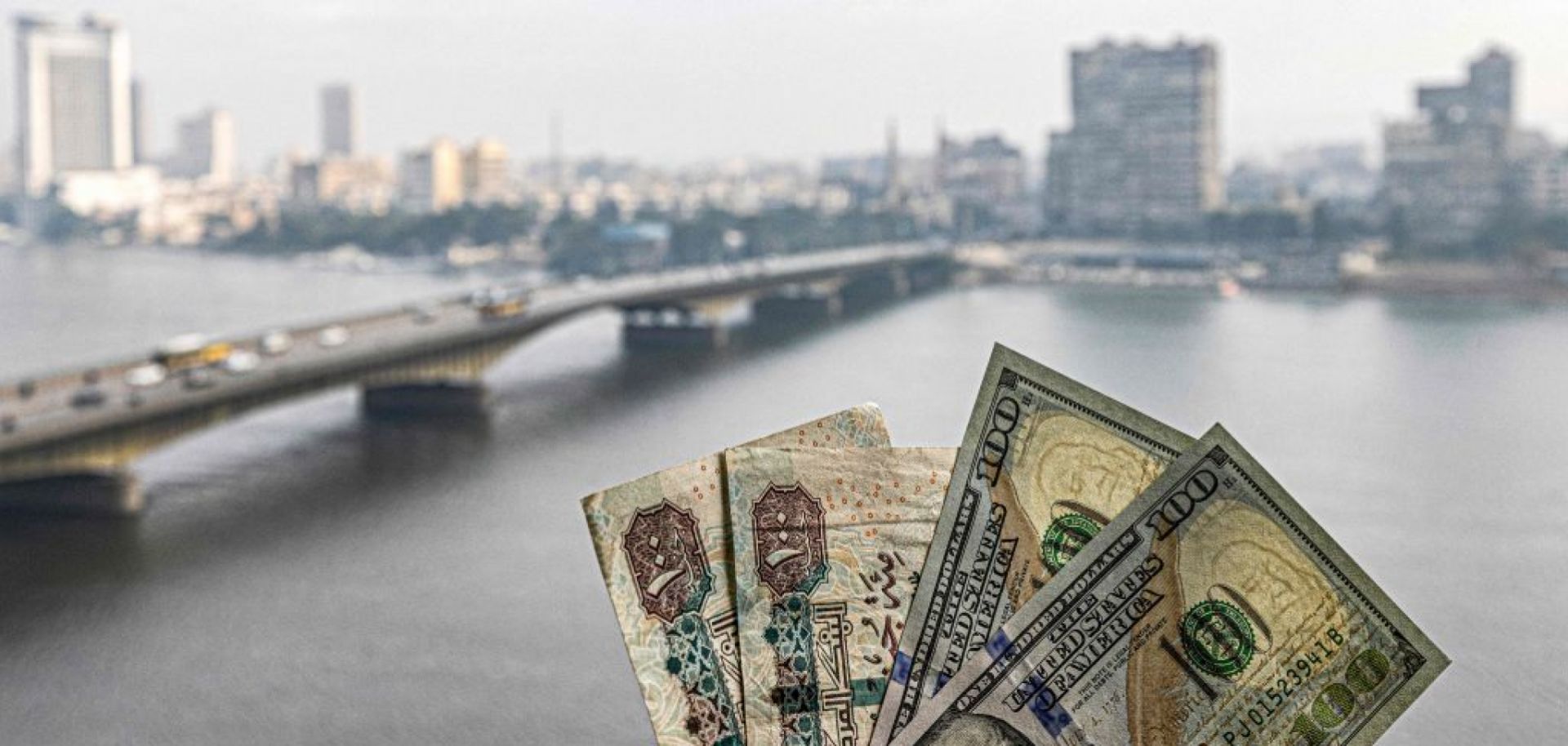
Two pairs of U.S. hundred dollar bills and Egyptian hundred pound notes are held before a window showing the skyline of Egypt's capital Cairo and the Nile River on Jan. 16, 2023.
Amid a worsening economic crisis, Egypt will balance economic austerity with the need to maintain social and political stability. Recent data has raised concerns about Egypt's near- and long-term financial stability, with the country experiencing slower-than-expected economic growth in July. Central Bank data released last week also showed that net foreign assets held by Egypt's commercial banks reached a record deficit in June amid a lack of foreign currency inflows. The shortages of hard currency highlight the severe balance of payments issues that the country faces, including a large foreign debt burden, high inflation and a depreciating currency despite costly interventions by the Central Bank. Moreover, Egypt is currently grappling with severe electricity shortages amid a record heat wave that has led to rolling blackouts. By adding to the overall economic malaise felt by the population, the energy crisis has sparked discontent, as evidenced by the growing number of Egyptians who have taken to social media in recent weeks to voice their anger and frustration with the government.
- A July 10-18 Reuters poll of 13 economists predicted that Egypt's economy will grow 4.2% in the 2023 fiscal year (July 1-June 30). This number is down slightly from an April forecast of 4.5%.
Egypt's economic situation worsened significantly in 2022, driving the government to seek external financing from the International Monetary Fund (IMF), and 2023's outlook is not improving. Egypt has devalued its currency three times over the last year to attempt to stabilize the pound's exchange rate, but this effort has largely failed, enabling the pound's volatility to continue draining Egypt's foreign exchange reserves. In turn, these limited reserves put more downward pressure on the pound and make it difficult for Egypt to purchase imports. This is particularly true for grain, as the Russia-Ukraine war has severely disrupted Russian and Ukrainian grain exports and raised global grain prices. Since Egypt was the number-one importer of grain from both countries in 2021, the year before the war began, Cairo has been especially hard hit by these shortages and is increasingly battling the looming threat of food insecurity. These struggles have lowered investor confidence and led to foreign and domestic capital flight, especially as global inflation rates continue to rise. Since many drivers of Egypt's economic crisis are outside of the country's control, particularly the Russia-Ukraine war and global inflation, Egypt's economy will likely remain volatile as long as global economic headwinds persist. To cushion its economy from the effects of this volatility, Egypt reached a staff-level agreement with the IMF on a 46-month, $3 billion loan program in December 2022.
- Egypt experienced some $20 billion in capital flight just after Russia invaded Ukraine in February 2022, and Egypt has yet to recapture much of that foreign capital.
- Meanwhile, Egypt's annual inflation hit a record high of 36.5% in July, up from 35.7% the previous month.
However, the IMF has delayed the disbursement of the second tranche of funds for several months due to Egypt's resistance to implementing unpopular reforms. Among the IMF's desired reforms are likely additional devaluations of the Egyptian pound, which would enable the government to pay its external debt liabilities and attract foreign investment. However, such exchange rate adjustments would make imports even more expensive, reduce the value of Egyptians' savings and lower households' purchasing power. In addition, the IMF is pushing the government to lower fuel, utility and food subsidies, as well as raise taxes, to help shore up the government's fiscal margins. The Central Bank could also introduce higher interest rates, which would slow domestic demand and imports, increase foreign currency inflows and improve investor sentiment. However, this move would depress some local business activity and capital investments. In this way, fulfilling the IMF's demands would make life significantly more expensive for Egyptians in the short term, which would raise anti-government sentiment.
- The Egyptian pound currently trades at 30.9 pounds per dollar at banks (in August 2022, it traded at 18-19 pounds per dollar), and at about 38 pounds per dollar on the black market. This discrepancy indicates that the pound has not reached its real value, despite three devaluations over the last year.
- Egypt's external debt liabilities quadrupled between 2015 and 2022 to just over $160 billion, or a third of Egypt's gross domestic product.
In order to avoid protests and unrest, Egypt will likely implement reforms that are just significant enough to unlock IMF aid. For example, Egypt will likely introduce new taxes that help generate revenue, but avoid lowering subsidies on socially sensitive goods (including bread) and making steep devaluations to its currency. This cherry-picking strategy could create tension with the International Monetary Fund, but it would be unlikely to derail the agreement. For Egypt's economy, the slow and selective implementation of reforms would create a painful, drawn-out period of adjustment that limits economic growth, does little to inspire investor confidence, and keeps markets vulnerable to renewed external shocks. However, even gradual reforms would likely help Egypt avoid a balance of payments crisis. While some social unrest would likely occur as a result of austerity measures, their gradual implementation would keep the risk of mass unrest low, and anti-government sentiment will mostly be aired on social media rather than in the streets.
- In addition to reforms, Egypt will also likely continue to sell off (non-military) state-owned assets to generate revenue, increase investment opportunities and raise labor participation in the private sector.
- Additionally, Egypt will continue to court other sources of bilateral funding, especially from the Arab Gulf states, which have historically supported Egypt.
In a less likely scenario, Egypt-IMF negotiations could collapse because Cairo refuses to implement economic reforms due to political and social risks. This scenario would cause a sharp increase in macroeconomic uncertainty, a decrease in foreign currency reserves, and a collapse in foreign and domestic investor sentiment. And without IMF financing, Egypt could also default on its debt. In the near term, the risk of social unrest would be low due to the maintenance of subsidies and government spending on benefits, but this risk would rise over the long term due to the worsening economic crisis.
- Egypt must pay $47 billion on its debt in 2023 but had only $34 billion in foreign currency reserves in December 2022.
The least likely scenario is Egypt's total compliance with IMF demands. In this scenario, the government would quickly roll out large reforms — including significant currency devaluations, new taxes and major subsidy reform — that enable Cairo to service its external debt and grow the economy. Egypt would also likely be able to acquire more funds from other lenders, which would speed the county's economic recovery even more. While these measures would sharply raise the cost of living for Egyptians, making the risk of anti-government protests high, the government would only choose this path if it viewed the political and social risk of implementing reforms as negligible and/or easily suppressible through force.
