
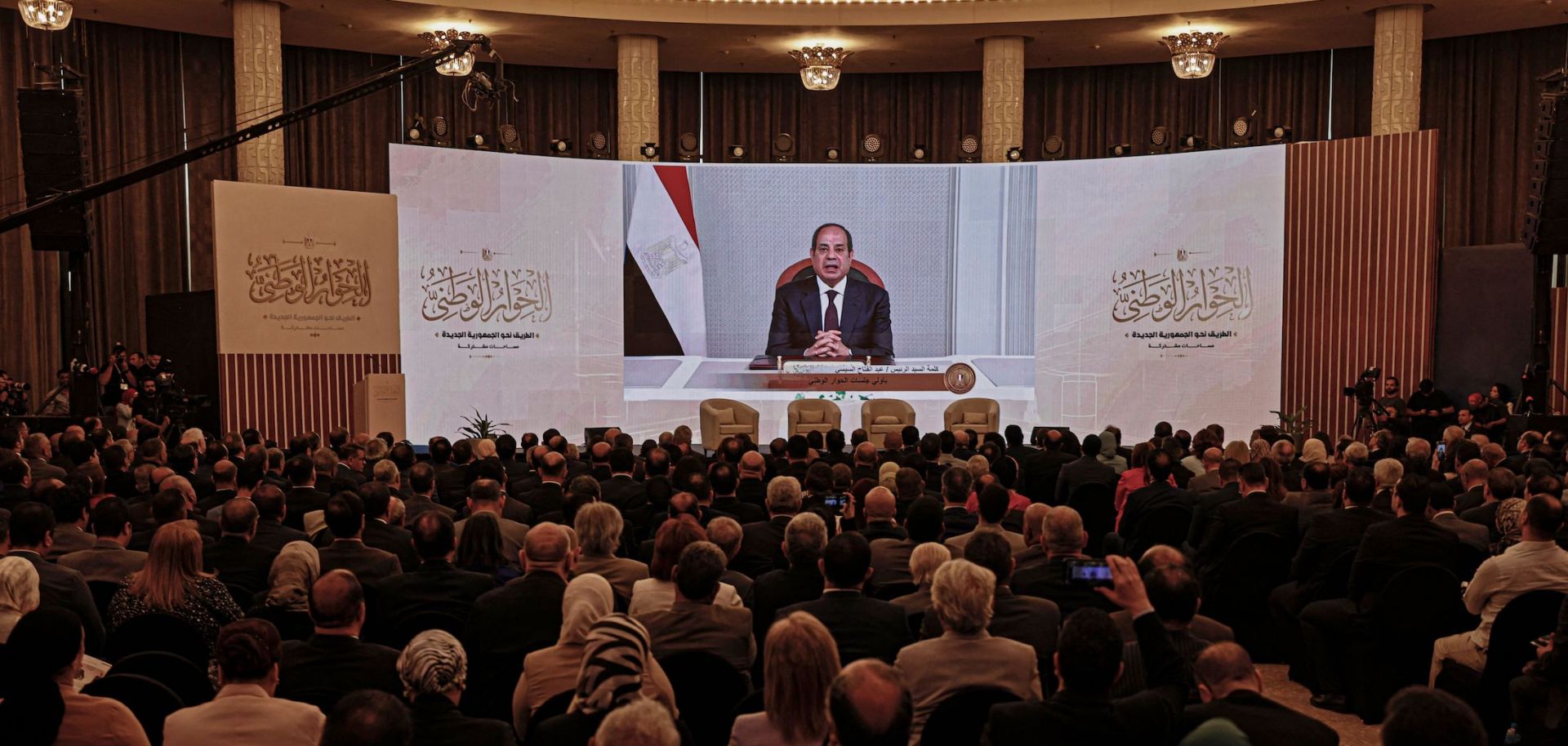
Egyptian President Abdel Fattah al-Sisi addresses those participating in his government's national dialogue via video conference on May 3, 2023.
The Egyptian government's tightly-controlled national dialogue may leave room for minor economic reforms, but it's unlikely to generate the serious political changes that people are increasingly demanding. On May 3, the Egyptian government kicked off a multiday national political dialogue to brainstorm solutions to problems and generate ideas for reform. The summit, which will last a few weeks, features subcommittees that are allegedly discussing over 100 wide-ranging topics, including elections, education, national identity and the economy. But on the first day of the event, the organizers made clear certain subjects would be strictly off-limits, including any issues broadly related to Egypt's foreign policy, national security and constitution. Government officials have also pledged President Abdel Fattah al-Sisi will take any recommendations presented by the subcommittees under serious consideration, though the decision to implement such proposals lies firmly in his hands.
- Al-Sisi announced the political dialogue in April 2022 as Egypt's economy began feeling the effects of the global fallout from Russia's Ukraine invasion two months earlier. Event organizers have said in the dialogue seeks to pave the way to a ''new republic'' and ''change many of the current situations'' in the country.
The dialogue's strict format and vetted attendee list will severely reduce its potential to foster groundbreaking or revolutionary ideas that could significantly alter Egypt's trajectory. Egypt has faced a notable increase in political and media repression since al-Sisi took office in 2014. Civil society organizations, as well as foreign NGOs, have reported levels of repression not seen in the country since before the Arab Spring in 2010-2011. Within this context, political discussion has become extremely rare in Egypt. In recent years, civil society groups and political parties that still operate within the government's accepted margins (i.e. by not directly criticizing the presidency or the military and/or by not demanding new elections or dramatic reforms) have started to cautiously call for dialogue. But while the current summit will be one of the closest things that the Egyptian government has come to true political dialogue in years, the logistics of the event and its format highlight the powerful hold that President al-Sisi now has on the country's political system. For one, the attendee list was strictly vetted to ensure only vocal pro-government supporters and uncontroversial political opposition groups participated in the summit; the Islamist Muslim Brotherhood, for example, was specifically excluded from attending. The exclusion of key cohorts of Egyptian society, combined with the aforementioned tight controls on what can be discussed, will limit the representative nature of the meeting and the diversity of ideas that the subcommittees might generate, making it largely a ''national dialogue'' in name only.
- Egypt's military re-asserted control in 2013 by helping install al-Sisi as president after the tumult of the Arab Spring led to the popular election of an Islamist president in 2012. Since then, political demonstrations have been largely outlawed, Islamist-linked political parties have been shut down, and press freedoms have been limited. Turnout in elections has also declined, likely due to Egyptians' belief that their votes are unlikely to result in real change to the daily issues they face.
- According to some of the secular parties participating in the dialogue, releasing political prisoners will be one of the top discussion points. But the issue is unlikely to be actually discussed in depth at the tightly-controlled event, with news outlets reporting that the Egyptian government detained new political prisoners the day the dialogue began. On May 3, a spokesman for the Civil Democratic Movement — a liberal alliance of 12 opposition parties that is participating in the dialogue with government approval — said the arrests created ''serious doubts'' regarding Cairo's commitment to reform.
Instead, the summit will likely only result in small moves to revive Egypt's sluggish economy in the hopes of mitigating the risk of anti-government dissent. Egypt's economic conditions have continued to worsen in recent years, as evidenced by skyrocketing inflation (which reached a near-all-time high of 32.7% in March) and other grim indicators, including billions of dollars in capital flight. Al-Sisi's move to announce the national dialogue was likely motivated by a growing concern that the country's deteriorating economy could start to fuel rare public backlash at his government. To mitigate this threat, the government is likely hoping the summit will yield tangible ideas it can implement to improve Egyptians' lives and help appease their anger. Dialogue participants will thus probably be able to debate small but tangible ideas about how to support the private sector, promote entrepreneurship and structure new taxes and government cash transfers for those in need. But the numerous delays to the summit (which was originally supposed to be held last year), along with the government's tight controls over who can attend and what topics they can discuss, also suggest the al-Sisi administration wants to keep the event from turning into a forum for public anger over the economy that could backfire by growing into actual physical demonstrations and greater dissent.
- Russia's invasion of Ukraine in February 2022 hit Egypt's economy particularly hard due to its dependence on Russian and Ukrainian imports and tourists. The loss of those key revenue flows has steadily eroded foreign investor sentiment in the Egyptian market over the past year.
- Egypt signed a $3 billion loan agreement with the International Monetary Fund (IMF) in December 2022. But Egypt has yet to receive its second tranche of funding, likely due to the government's slow progress in implementing the IMF's recommended reforms, which include introducing new taxes and lifting some government subsidies.
But without an outlet for people to express their frustration over key political and economic issues, al-Sisi's firm grasp on power could eventually come under threat. While Egypt's top-down system of governance can provide policy continuity and predictability, it also leaves little room for dissent, which is necessary for a flexible and adaptable system. This exposes al-Sisi's regime to inherent risks during times of hardship by effectively creating a pressure cooker where public outrage can build up and eventually explode, as seen during the Arab Spring. Egyptian civil society organizations and opposition parties (like those within the Civil Democratic Movement) argue that a more democratic system could absorb anti-government sentiment through means such as fair elections and authentic dialogue that, over time, lead to policy adjustments. But in Egypt's current repressive environment, once such dissent rears its head, it risks going past the point where the government can quickly nip it in the bud without imposing a drastic crackdown that would only risk further angering people. This means that if Cairo continues to let Egyptians' frustration fester without providing an outlet for release (by, for example, fostering authentic dialogue), anti-government sentiment may eventually reach a tipping point — at which time, the al-Sisi regime may prove too brittle to handle the resulting public uproar.
- On May 8, the National Dialogue's Board of Trustees issued a statement calling on participants to help prepare a ''democratic atmosphere for multi-candidate presidential elections,'' which are scheduled in mid-2024. Such statements from the event's government-linked leaders indicate al-Sisi's regime is aware of Egyptians' growing desire for a more democratic environment.
