
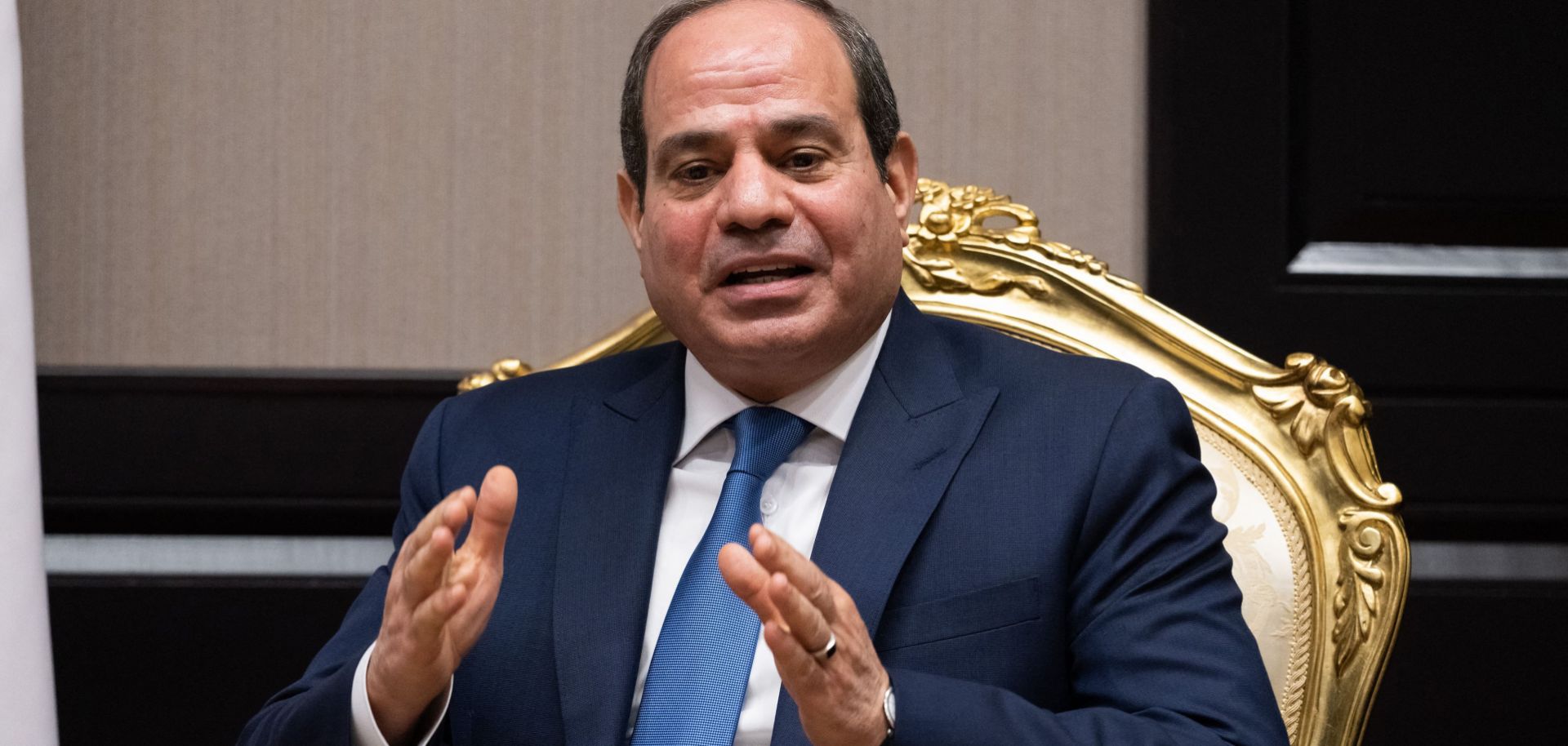
Egyptian President Abdel Fattah al-Sisi is seen on the sidelines of the COP27 summit on Nov. 11, 2022.
Egypt's push to preserve its close ties with Russia amid Moscow's growing international isolation will expose Cairo to U.S. and international retaliation that could further weaken the Egyptian economy. According to leaked U.S. intelligence documents obtained by The Washington Post, Egyptian President Abdel Fattah al-Sissi proposed a plan in February to supply Russia with up to 40,000 rockets, as well as gunpowder and artillery. The top-secret Pentagon documents — which are dated Feb. 17 and were reported by The Washington Post on April 10 — also showed that al-Sisi had instructed his subordinates to keep the scheme a secret ''to avoid problems with the West,'' and to tell factory workers that they were building rockets for the Egyptian army (and not Russian troops fighting in Ukraine). On April 17, The Washington Post then published another set of leaked documents that showed al-Sisi ultimately abandoned the plan in early March after holding talks with senior U.S. officials, and agreed to send artillery rounds to Ukraine instead. U.S. officials have since confirmed that the Egypt-Russia weapon transfer never took place. But the fact that al-Sisi proposed such a plan in the first place — and sought to keep it quiet, only to later scrap the project amid U.S. pressure — nonetheless highlights the tricky balancing act Egypt finds itself in, as it tries to reduce its reliance on the United States by diversifying its foreign partnerships, without exposing itself to sanctions that could jeopardize the billions of dollars of U.S. aid that the Egyptian economy still heavily depends on.
For decades, Egypt has sought to offset its deep reliance on the United States by also maintaining close ties with Russia and other U.S. adversaries. But the scrapped weapons transfer shows how this balance is becoming increasingly difficult. Egypt has historically been a geopolitical power in the Arab world, Middle East, Mediterranean and Africa. But the economic and security challenges it has faced in the 20th and 21st centuries have left Cairo partially dependent on stronger external powers for aid and security support. In recent decades, the United States has served as Egypt's primary patron, annually providing the North African country with approximately $1.3 billion worth of aid. But over the years, Cairo has also cultivated strong relationships with Russia and, more recently, China — the United States' top two strategic rivals. This balancing act has enabled Egypt to maintain its strategic autonomy by keeping it from becoming too reliant on any one foreign partner. It has also enabled Cairo to maximize the economic benefits it can enjoy through aid, investment and trade cooperation from a wide array of powerful partners. Compared with the United States, Russia grants Egypt access to investment and support with fewer human rights and governance conditions as well, and additionally serves as a key source of wheat and energy exports. But as evidenced by al-Sisi's scrapped plan to supply Russia weapons, Egypt's traditional balancing act between the United States and Russia has become particularly risky amid Moscow's growing international isolation following its invasion of Ukraine last year, and the West's consequent sanctions campaign against the Kremlin and its supporters.
- Since Egypt became a sovereign state in 1952, Egypt has maintained close ties with both Eastern and Western powers — particularly Russia and the United States, at times very pointedly playing them off each other for Cairo's benefit. This was particularly evident during the Cold War, which saw the government of then-Egyptian President Gamal Abdul Nasser leverage his close relationships with the Soviet Union and the United Kingdom, and eventually the U.S. government.
- Egypt is the third-largest recipient of U.S. aid in the world. Since 1978, the United States has provided Egypt with over $50 billion in military assistance and $30 billion in economic assistance.
- Egypt imported 80% of its wheat from Russia and Ukraine prior to the war.
- China is also one of Egypt's key economic partners. Cairo and Beijing have recently been deepening their security ties as well, with the two countries working closely on industrial military projects.
The fact that al-Sisi was considering sending weapons to Russia indicates he believed that even if such a plan was made public, the United States would not cut off aid to Egypt for fear of destabilizing the Middle East. In addition to solidifying its political ties with Russia, al-Sisi's proposed weapons transfer was likely aimed at bolstering his country's economy by bringing new business to Egypt's defense sector. Egypt's macroeconomic fundamentals have been shaky over the past year; the Egyptian pound has steadily deteriorated, despite two devaluations seeking to stem the currency's decline, which has eaten into Egyptians' savings and has eroded their purchasing power. In a bid to access more foreign currency that can help Cairo prop up the pound and reduce its dependence on external debt, al-Sisi was likely trying to boost military equipment exports by producing rockets for Russia. The Egyptian president's desire to keep the scheme a secret (including from even those making the rockets) shows he was aware of its potential to roil ties with Washington. But his desire to propose the plan regardless also indicates he didn't think the United States would go so far as to cut off aid to Egypt in retaliation. This calculation was likely based on the fact that the aid Cairo receives from Washington is, according to the U.S. State Department, related to maintaining the two countries' ''mutual interests in Middle East peace and stability,'' which creates a strong imperative among U.S. leaders to continue sending cash to Egypt, even if Egypt periodically engages in controversial action at home and abroad. Indeed, the United States has yet to cut off most aid flows to Egypt, despite growing calls from lawmakers in Congress to do so amid the al-Sisi government's growing ties with Russia and domestic human rights violations.
- Egypt provides stability in the Middle East by maintaining the longest peace accord with Israel of any regional state, and by remaining neutral in most regional conflicts. Egypt also works closely with the U.S. military in counterterrorism missions. In recent years, the United States has only withheld small tranches of economic aid to Egypt over human rights violations.
But Egypt's desire to maintain ties with Russia nonetheless exposes it to greater risks at an especially precarious time for the Egyptian economy. In Washington, al-Sisi's proposal to manufacture and send rockets to Russian troops fighting against U.S.-armed troops in Ukraine is being perceived as a betrayal of U.S. national security interests. This will risk intensifying existing U.S. congressional pressure to cut aid to Egypt, especially in the wake of Cairo's recent moves to purchase Russian weapons. Most of Egypt's military arsenal is from the U.S. and other Western sources, including France. But under al-Sisi, Egypt has sought out larger purchases of higher-tech Russian equipment — including Sukhoi Su-35 aircraft — despite warnings from U.S. officials that this could lead to sanctions or cutoffs of U.S. military aid. Even though the Su-35 deal has run aground (in part due to fears of triggering U.S. retaliation), Cairo's desire to diversify its military suppliers — and foreign relationships more broadly — remains. And that desire will continue to expose Egypt to potential sanctions from both the United States and its allies, as European countries could also view the revelations about al-Sisi's aborted plan to give rockets to Russia as enough justification to scrutinize the economic aid they also provide to Egypt.
