
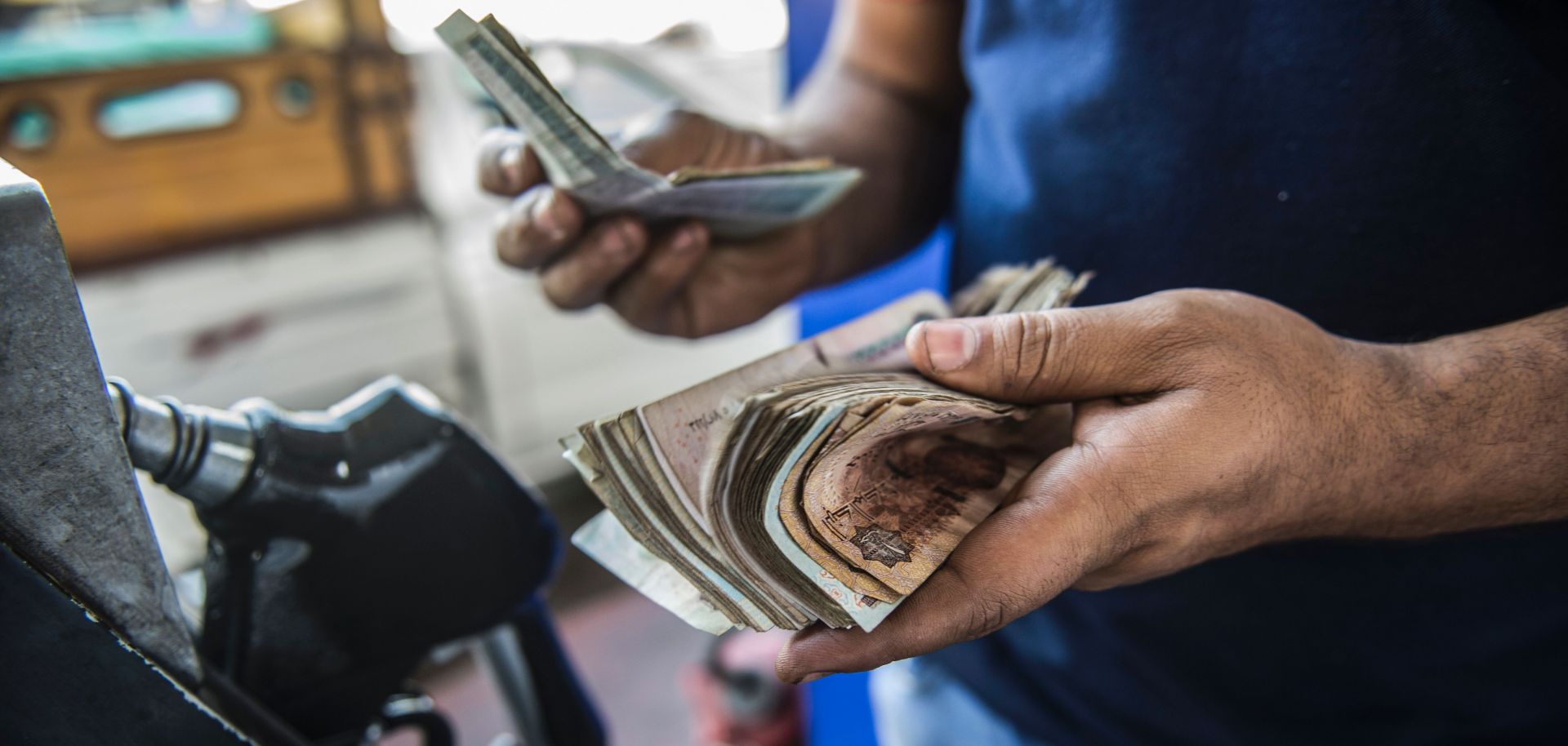
A gas station worker counts cash collected from customers in Cairo on June 29, 2017, after Egypt’s government slashed fuel subsidies.
Egypt’s government will seek to reform its subsidies scheme in 2022 to reduce state spending amid rising inflation, which other countries in the region could emulate. While protests are possible, widespread social unrest in Egypt is unlikely due to the security apparatus’ firm control of the country. Macroeconomic reform will be a high priority for Egypt in 2022 as it continues the reform process that President Abdel Fattah al-Sisi’s administration started when it took office in 2014. In particular, rising inflation is incentivizing the government to reduce subsidies that weigh on state finances. Changes to government subsidies are particularly impactful in Egypt, where nearly 30% of its 100 million people live below the poverty line. Annual inflation rose to 6.2% in November 2021 and is anticipated to rise further in early 2022 due to global price increases in products like energy and food — all of which will have an impact on Egyptians’ pocketbooks, as well as their government’s budget.
- After coming into power in 2014, the al-Sisi administration began a series of macroeconomic reforms that included reducing some government subsidies and taking out a massive loan from the International Monetary Fund (IMF) with accompanying austerity measures. By stabilizing Egypt’s economy, these reforms have since enabled Cairo to increase investments in the country’s health and education systems, as well as infrastructure in rural regions. In the 2020-2021 fiscal year, Egypt’s national budget was expected to overperform its primary surplus target, despite the effects of the COVID-19 pandemic.
- Egypt is home to the largest population in the Arab world. In December 2020, Egypt’s statistics authority revealed that the country’s poverty rate had declined for the first time in two decades, but at 29.5%, the rate is still high by regional and global standards.
The Egyptian government’s recent success in reducing fuel subsidies has given Cairo confidence that it can change other, more controversial subsidies. Egypt’s government has been tinkering with fuel subsidies over the last few years by progressively raising the prices of gasoline, diesel and kerosene since 2014. Based in part on its success scaling back government assistance on fuel, Cairo has also eying changes to other subsidies, including those for bread, water and electricity. Compared with fuel, however, price increases for such basic services and food items would be more socially destabilizing due to the broader impact on Egyptian society. Not all Egyptians have cars or even depend on motorized vehicles to get to work, but every Egyptian needs food, electricity and water.
- In 2014, the Egyptian government raised the price of gasoline by 78%, diesel by 64%, and kerosene by 64%. At the time, fuel subsidies cost the government a full fifth of the budget, more than health and education spending combined. This created an expensive burden that Cairo wanted to alleviate so that it could increase spending on the economy and cash transfer programs for low-income households. From 2016 to 2021, state spending on fuel subsidies declined from 128 billion Egyptian pounds to 18 billion pounds (roughly $1 billion).
- Since 1988, about two-thirds of Egypt’s population has been able to buy subsidized bread loaves for just 5 Egyptian piasters (or about a third of a U.S. cent). This costs the government 48 billion Egyptian pounds (or roughly $3 billion) a year.
While many Egyptians will oppose the reforms, widespread unrest is unlikely because of the strong control Egyptian authorities have over people’s ability to protest. Since Egypt’s historic Arab Spring protests led to the resignation of longtime president Hosni Mubarak in 2011, the country’s government, backed by its military, has instituted tighter controls on public gatherings and unauthorized demonstrations. While Egyptians still frequently air anti-government sentiment online, these measures have minimized protest activity in the streets over the past decade. The Arabic hashtag “Leave Sisi,” for example, recently trended on Twitter but did not result in actual demonstrations.
- Firm military backing for the Egyptian presidency and Cairo’s centralized political system has made Egypt one of the most politically stable countries in the Middle East and North Africa, despite the clear existence of political dissent on social media and other online forums. The improvement of Egypt’s economy since 2014 has also buoyed the government’s popularity, especially among the country’s upper- and middle-classes.
- The Egyptian military continues to have the strong backing of key defense partners like the United States, which authorized a $2.5 billion arms sale to Egypt on Jan. 25.
The Egyptian government will mitigate the impact of subsidy reforms by adjusting other social safety net programs accordingly. In October 2019, after putting in place one of the last steps of its fuel subsidy adjustment scheme, Cairo announced it had added 1.8 million people to the ration system that enables Egyptians to receive food and household goods at subsidized prices. Cairo’s rare move to raise public and private wages last month could thus indicate it’s taking a similar approach in preparation for any potential backlash against changes to other subsidies.
If successful, Egypt’s subsidy reforms and fiscal consolidation efforts could provide a blueprint for other countries in the region facing similar issues. Egypt’s experience with its IMF program, which resulted in notable structural reforms that helped stabilize the economy even during the COVID-19 pandemic, is often cited in the Middle East as a success. To aid their flagging debt-ridden economies, nearby Tunisia and Lebanon are currently considering IMF agreements this year that would require fiscal consolidation measures similar to the ones Egypt has been implementing for years. However, Tunisia and Lebanon do not have the same type of centralized government as Egypt, which could make it harder for them to emulate Cairo’s actions. They also lack the same kind of efficient security apparatus that would keep social unrest within tolerable margins.
- The $12 billion IMF loan Egypt received in 2016 was, up until that point, the largest such loan the Middle East region had seen. The IMF program — which entailed austerity measures including tax increases and reduced subsidies — has largely been hailed as a success by both Egyptian and World Bank authorities in terms of how it helped boost macroeconomic growth, reduce government expenditures, and usher in more foreign investment.
