
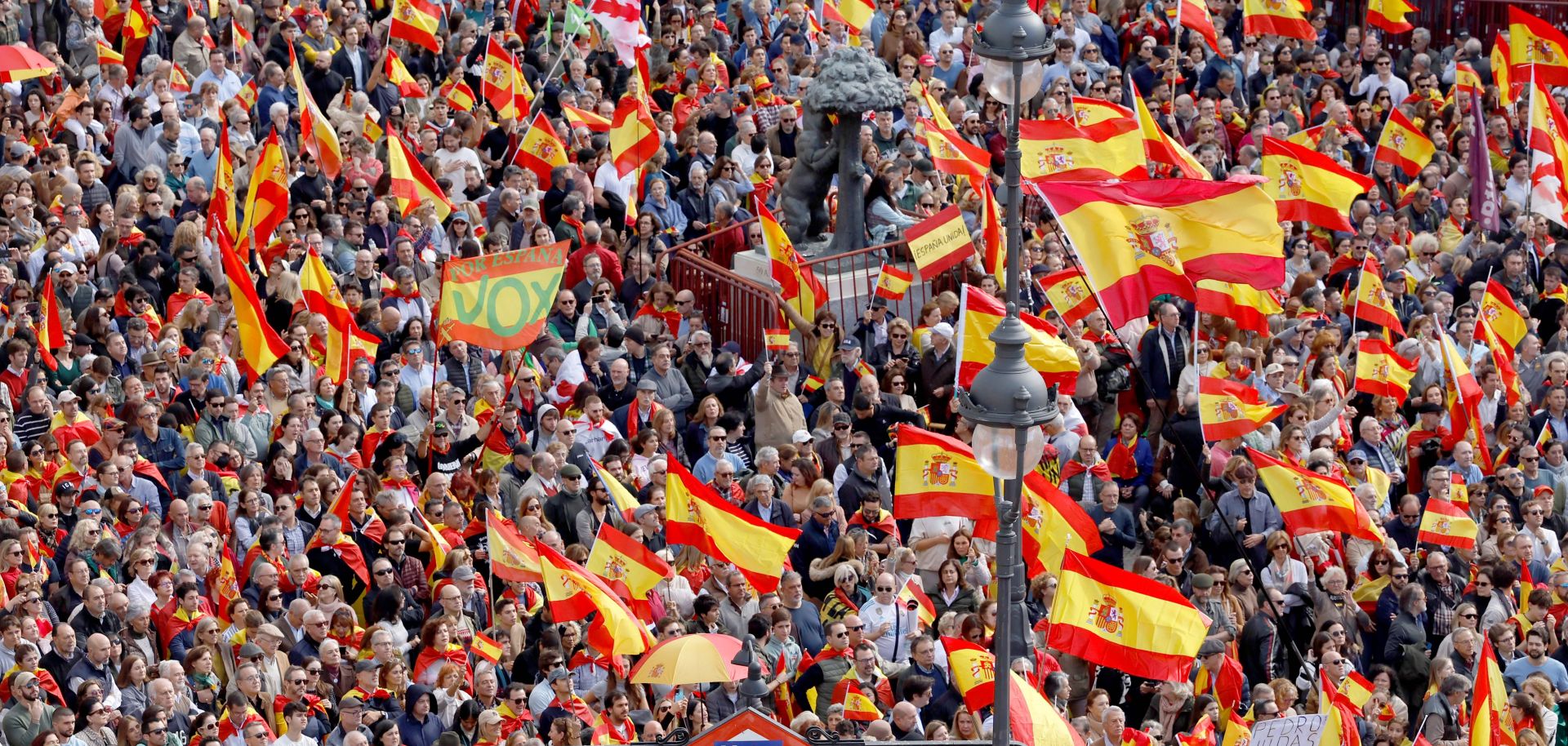
Far-right parties are again on the rise across Europe, driven by a sense of identity loss and popular backlash against rising migration levels and costly climate policies, among other factors. Meanwhile, the steady erosion of a traditional political practice in Europe known as the cordon sanitaire — in which mainstream political parties isolate and marginalize extremist forces — has enabled those far-right parties to increasingly enter coalition governments across the Continent. Material constraints have so far forced far-right parties to moderate their most radical proposals upon taking power, while the center-right is still largely expected to hold across most countries, as well as in the European Parliament. And yet, Europe is still poised to see significant policy shifts in areas such as climate, migration and EU enlargement, as moderate parties try to compete with rising far-right parties by co-opting them in coalition governments and incorporating their proposals into their own platforms.
A Trend Decades in the Making
While support for far-right parties in Europe has been on the rise for years, the trend first became evident during the 2008-09 global financial crisis, which saw many European governments impose austerity measures that severely undermined trust in mainstream political parties and institutions, creating fertile ground for populist parties across the ideological spectrum. The 2014-16 migration crisis then accelerated that trend, with many Europeans perceiving the surge of refugee flows from North Africa and the Middle East as a threat to national identity and public safety. This trend is now gathering further pace on the back of a popular backlash against rising levels of migration, a sense of identity loss amid rapidly changing demographics in Europe, a perceived cultural hegemony from the liberal left, rising costs of living, and growing costs for households and businesses associated with the green energy transition.
Against this backdrop, far-right parties once pushed to the margins of the political landscape have begun entering governments across Europe — either at the head of ruling coalitions (as is the case in Italy) or as junior partners (as is the case in Finland and Sweden). And while far-right parties in Spain, Denmark and Poland failed to garner enough support in recent elections to enter their countries' governments, they still performed strongly in those ballots — a trend set to only accelerate in 2024.
High-Stake Elections
Several key elections are set to take place in Europe in 2024. In June, the European Union's 27 member states will elect their representatives in the European Parliament. And according to the latest polls, far-right parties are slated to secure control of nearly 25% of the supranational legislature, for a total of 169 seats in the 705-seat body.
The far-right eurosceptic Identity and Democracy group is projected to win 87 seats in the European Parliament, boosted by the rising popularity of its national members, which include the Alternative for Germany party, France's National Rally party, and the Netherlands' Party for Freedom (which recently won the Dutch general election). And the like-minded European Conservatives and Reformists parliamentary group — which includes the Brothers of Italy party, Poland's Law and Justice Party, and Spain's Vox party — is also projected to win 82 seats.
At the national level, far-right parties are polling strongly in the EU countries scheduled to hold national elections next year, which include Austria, Belgium, Portugal and Romania. Austria's Freedom Party and Belgium's Flemish Interest party are currently polling in first place with 30% and 23% support, respectively, while Romania's Alliance for the Unity of Romanians and Portugal's Chega party are currently polling in second and third place at 20% and 15%, respectively.
In Austria, the far-right Freedom Party is on course to emerge from the country's fall 2024 election as the leader of a new coalition government. In Belgium, Portugal and Romania, establishment parties have so far been able to prevent fringe parties from taking power by refusing to work with them. But with far-right parties continuing to gain widespread support, it's unclear whether decades-old cordon sanitaires will continue to hold after the three countries' elections in June, March, and late 2024, respectively.
In fact, the old European taboo of joining forces with the far-right is evaporating across several countries, as declining support for centrist parties makes it increasingly difficult to cobble together multi-party coalitions to keep the far-right out of government. Finally, Alternative for Germany — which is currently the second-largest party in the country, with 21% support among German voters — is currently polling in first place in the eastern states of Saxony (32.5%), Thuringia (34%) and Brandenburg (32%) that will hold elections next September.
Ideology Meets Reality
Because of Europe's highly diverse historical experiences and political traditions, being far right means something different from country to country, which complicates drawing general conclusions on what a far-right resurgence may imply for the whole region. While sharing commonalities like anti-immigration views and a level of mistrust toward supranational institutions like the European Union, not all European far-right parties share the same ideas.
In northern Europe, for example, far-right parties tend to be more libertarian and fiscally conservative, while in the south they often support more protectionist policies and oppose the spending limits posed by EU fiscal rules. Moreover, depending on their country's unique history or geography, far-right parties may be staunchly pro-NATO or favor more positive relations with Russia. Besides resulting in potentially very different policy outcomes at the national level, this heterogeneity makes it difficult for different far-right parties across Europe to coordinate action and form a coherent policy platform at the EU level — especially given that their ideology is typically rooted in nationalism, which inherently clashes with the concept of a supranational body like the European Union that demands compromise and collective decision-making.
What appears more evident is that far-right parties tend to temper many of their most radical ideas once they take power. In Italy, for example, geopolitical and economic constraints have forced Prime Minister Giorgia Meloni's far-right government to embrace a more pragmatic approach and abandon the more radical, Eurosceptic stances and economically unsustainable proposals that led to her Brothers of Italy party's victory in the October 2022 election.
Something similar will likely happen in the Netherlands, where the far-right Party for Freedom is slated to enter the next coalition government after winning the country's November 2023 election. To secure the backing of more moderate coalition partners, the party will probably have to water down many of its radical views, including its proposal for a Dutch referendum to exit the European Union.
So while far-right parties will fare well in upcoming elections across Europe and many will strengthen their role in ruling coalitions, economic, legal, institutional and geopolitical constraints will continue to somewhat temper their political agendas. Moreover, the center is largely expected to hold across much of the Continent as center-right parties will continue to play important roles in governments, either by acting as a moderating force within coalitions with the far-right, or by maintaining the cordon sanitaire through alliances with other moderate parties across the ideological spectrum to keep far-right parties out of power.
Looking Ahead
And yet, even if far-right parties will not completely take over Europe, their rise will still impact European politics and EU policies. While the necessity to compromise with more moderate parties to form governing majorities will force far-right parties to abandon some of their most radical policy proposals — including exiting the European Union, ending asylum for refugees or completely abandoning climate change mitigation policies — their electoral success will contribute to pushing the debate over pressing issues, such as immigration and climate change, further to the right. To compete with increasingly popular far-right ideas, mainstream political parties will thus increasingly integrate some elements of the far-right's agenda into their platforms. This means governments across Europe will likely take a tougher stance on migration, which could see some tighten asylum procedures and reduce financial support for refugees, as well as implement stricter immigration regulations and border controls. European governments may also pursue less ambitious climate targets, which could see them potentially delay or scale down renewable energy investments, as well as water down emissions reduction targets. Moreover, mainstream political parties might integrate nationalist rhetoric within their economic policy, perhaps by implementing welfare programs aimed at specific voter demographics that would increase social inequalities, or by promoting protectionist industrial policies that would make it more difficult for European governments to strike compromises on shared EU projects.
To some extent, the same is true at the EU level. The June elections will likely produce a more conservative, yet still largely moderate European Parliament and a like-minded European Commission. According to the polls, far-right Eurosceptic forces are expected to make significant gains, but not to gain control of key EU institutions. And still, while the new European Commission will not differ substantially in terms of approach and policy priorities, it will have to work with a likely more protectionist and less environmentally ambitious European Parliament that will be more skeptical of climate legislation and any policy proposals that could negatively impact traditional industrial, manufacturing and agricultural sectors. On top of this, the growing influence of far-right parties across some member states' governments will complicate finding EU consensus on issues such as enlargement, immigration, climate change and support for Ukraine.
