
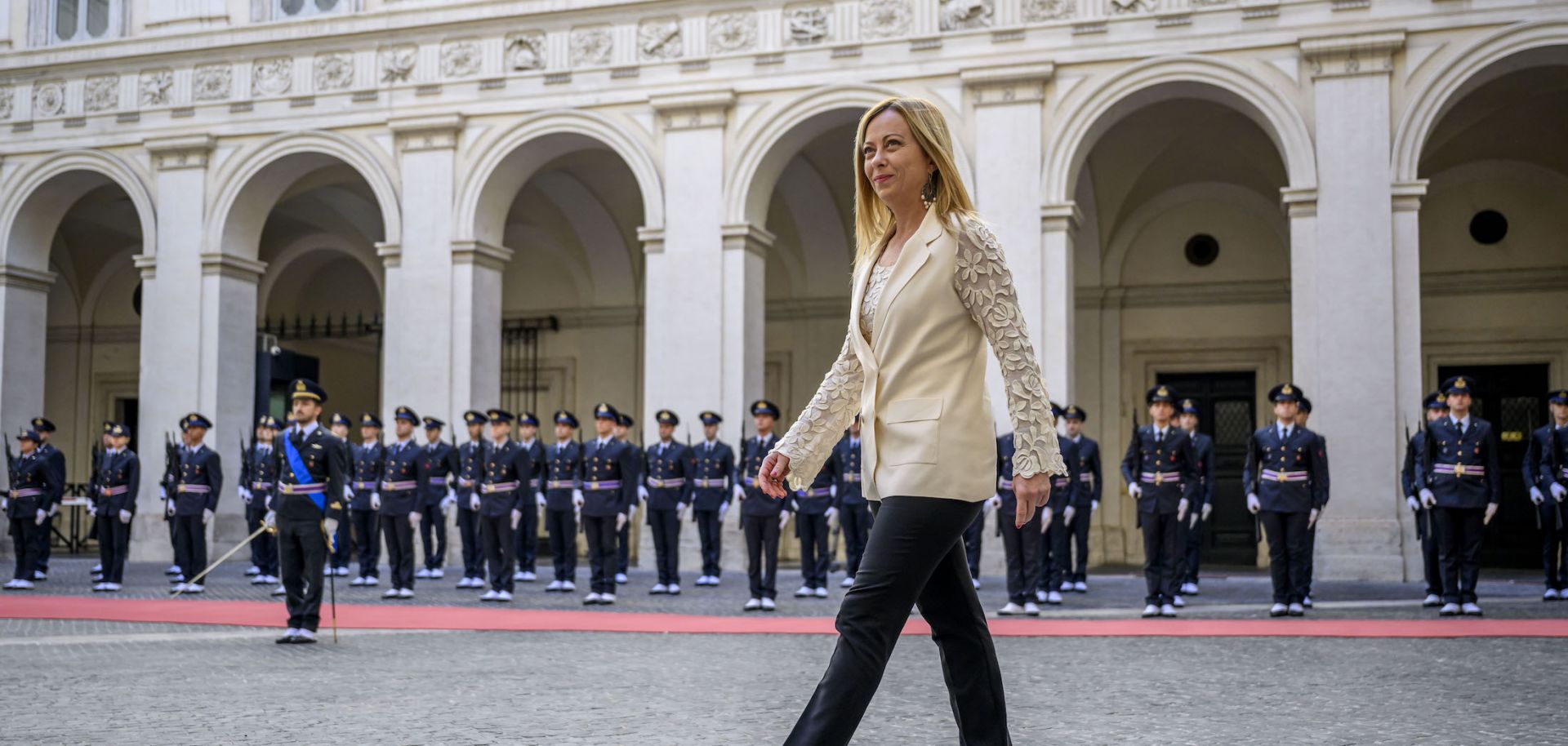
When Prime Minister Giorgia Meloni took office on Oct. 22, 2022, at the head of the most right-wing government Italy has had since World War II, many feared Rome might embark on a path of Euroscepticism and economically unsustainable policies that would strain public finances. One year on, most of these concerns have not materialized, as geopolitical and economic constraints forced the coalition to embrace a pragmatic approach and abandon some of the more radical stances that contributed to its rise. In fact, Meloni largely remained on the path set by her predecessor Mario Draghi's unity government, keeping a largely conservative fiscal policy, pursuing post-pandemic economic reforms, maintaining Rome closely aligned with NATO and supportive of Ukraine, and seeking collaboration with the European Union even in politically sensitive areas like migration. The government then sought to please its electorate by pursuing a conservative agenda in areas where external pressures were lower, such as on civil rights, protectionist policies, and climate issues, yet always trying to prevent a clash with Brussels by avoiding excessively veering off established European norms.
Foreign Policy: An Ambivalent Approach to Europe
On the international stage, Meloni has sought to reaffirm Italy's place within NATO despite known pro-Russia sympathies within her coalition. This was evident in her commitment to maintaining political and military support for Ukraine in its war against Russia, her alignment with other Western leaders in backing Israel after Hamas's surprise attack last month, and her announcement that Italy will exit China's Belt and Road Initiative (BRI), which the country joined in March 2019 under former Prime Minister Giuseppe Conte, becoming the only G-7 country to be part of the initiative. Within the European context, Meloni has maintained a more nuanced approach. She has avoided major disputes with the European Commission, maintained a constructive engagement in European forums and expressed a commitment to European integration. At the same time, however, she has maintained her party's formal political alliance with eurosceptic forces like Spain's Vox party, Poland's Law and Justice (PiS) party, and Hungary's Fidesz party. Meanwhile, Rome has sought to reboot its role as a regional power in the Mediterranean and beyond, pursuing a policy of engagement in North Africa based on energy cooperation and establishing strategic partnerships in the Middle East and the Indo-Pacific through economic and investment deals and defense cooperation agreements.
Economic Policy: Fiscal Prudence With Greater Interventionism
During her first year in office, Meloni faced a complex economic landscape marked by high energy costs, surging inflation and rising interest rates, all of which are pushing Italy's economy toward a return to the low growth rates of previous decades as the post-pandemic recovery momentum wanes. Against this backdrop, her government's fiscal policy has reflected a balancing act between addressing pressing economic challenges and navigating fiscal constraints, while also trying to deliver some of its electoral promises. Although Meloni inherited a 2023 budget plan that had already been largely defined by the previous government, her government's 2024 budget made its economic policies more apparent. Key measures in the new budget include limited tax cuts, public sector pay rises and pension increases, which were partially balanced off by shelving signature policies of previous administrations, such as Conte's so-called ''citizens' income'' social welfare system and ''110% Superbonus'' tax credit scheme for home renovations. However, as growth slowed and borrowing costs soared, Italy had to raise its deficit targets for 2023 and 2024. Still, an only modest rise in the country's 10-year government bond yields compared with Germany's (a key benchmark of sovereign risk in the eurozone) indicates markets have so far remained somewhat confident in Meloni's government. In parallel, the government has pursued a markedly interventionist and protectionist policy on the industrial front, promoting national champions in various sectors such as energy and luxury, and launching a sovereign wealth fund to finance them. Under Meloni, Rome has also implemented measures to enhance its control and support for strategic sectors, including expanding its powers to block technology transfers and scrutinize foreign investments.
Domestic Politics: Rare Government Stability in Rome
On the domestic front, Meloni's government has so far enjoyed remarkable stability, in contrast with Italy's notorious tradition of fragile and unstable governments. Over the past year, her coalition has maintained strong support among voters and has avoided significant internal turbulence. Meloni's Brothers of Italy party, in particular, continues to dominate the Italian political landscape with nearly 30% of voter support — well ahead of the two main opposition forces, the center-left Democratic Party (PD) and the left-wing populist 5-Star Movement, which are polling at 19% and 17%, respectively. Moreover, Meloni's party remains significantly more popular than its two junior coalition partners, Matteo Salvini's right-wing Lega party and Antonio Tajani's center-right Forza Italia party, which collectively garner less than 20% of support. Several political factors have worked in Meloni's favor. For one, the left-wing opposition remains divided and unable to mount an effective front against her government. Additionally, the June 2023 passing of former Prime Minister Silvio Berlusconi, who founded Forza Italia in 2013, left his center-right party without strong leadership. This has since made Forza Italia a significantly easier partner to manage for Meloni, particularly as the party now lacks future political prospects outside the scope of this majority, and has also expanded her appeal from the far-right to the center-right. Domestic politics is one of the few realms where Meloni's government has been able to act with a bit more free rein, with her coalition pursuing a conservative social policy agenda on issues such as parental rights and LGBTQ issues as a way to appease its electoral base.
Future Risks: Economic Fragility Giving Way to Political Instability
Overall, under Meloni's leadership, Italy has so far maintained a largely stable and predictable course that has kept Rome in positive relations with its allies, relatively trusted by markets and popular among Italian voters. Moving forward, however, the weakening of the country's debt-laden economy, as well as potential disagreements emerging within the ruling coalition, could increase political and economic risks in Italy.
Meloni inherited an economy burdened with a debt-to-GDP ratio of 144%. This ratio remains on a downward path thanks to some economic growth over the past year, along with a reduction in nominal debt aided by inflation. However, Italy's slowing economic activity, combined with the uncertain global economic environment, poses substantial risks for a country with such a high debt load. Rome's higher-than-anticipated fiscal deficit and high debt-to-GDP ratio thus remain a primary source of concern for investors, particularly given the uncertainty surrounding EU fiscal rules in 2024 amid ongoing difficult negotiations on reforming the European Union's Stability and Growth Pact (SGP). Last year, the European Central Bank (ECB) established a backstop mechanism that allows it to purchase sovereign bonds issued by countries facing sharp interest rate movements, which should help contain spreads to sustainable levels should Italian 10-year government bond yields come under market pressure. But, Rome will still need to maintain fiscal consolidation efforts and compliance with forthcoming EU rules to ensure it remains eligible for an eventual ECB intervention.
The resulting limited fiscal space, in turn, has the potential to weaken Meloni's government and rattle markets in the coming months by constraining Rome's ability to respond to future external shocks or finance competing policies from the three members of its ruling coalition. Moreover, Italy's economy will continue to depend on the European Union's pandemic-recovery funds, which are conditional on Rome pursuing structural economic reforms set forth by Meloni's predecessor in agreement with Brussels. All these constraints have so far reassured markets by limiting the Italian government's ability to change course for the country's economy. But they've also left Meloni with minimal flexibility to deal with eventual political or economic crises.
Against this backdrop, domestic politics may not turn out to be as stable in 2024 as they have been so far for Meloni, particularly as Lega party leader Salvini's continued discomfort with his secondary role in the coalition remains a lingering threat to her majority. One potential source of conflict between Meloni and Salvini comes from Italy's ongoing discussions with the European Union on key fiscal and economic issues, including the ratification of reforms to the eurozone's permanent bailout fund known as the European Stability Mechanism, which Rome is holding up in exchange for more flexible EU fiscal rules under the new SGP rule currently being negotiated. Intra-coalition disagreements may emerge as Meloni will likely seek a compromise with the European Commission, which may prompt Salvini to accuse the prime minister of capitulating to Brussels' demands as he sees a chance to distance himself from Meloni ahead of the June 2024 elections for the European Parliament and reverse years of falling approval ratings for his party by capturing votes from disenfranchised Eurosceptic Italians. More broadly, the three coalition parties' decision to run separate campaigns may exacerbate internal differences in the run-up to the vote. While Meloni has so far maintained solid popular support, her parliamentary majority still rests on Salvini's 66 seats in the Chamber of Deputies, so a split between the two may trigger a political crisis and ultimately topple the coalition, in tune with Italy's tradition of revolving-door governments.
