
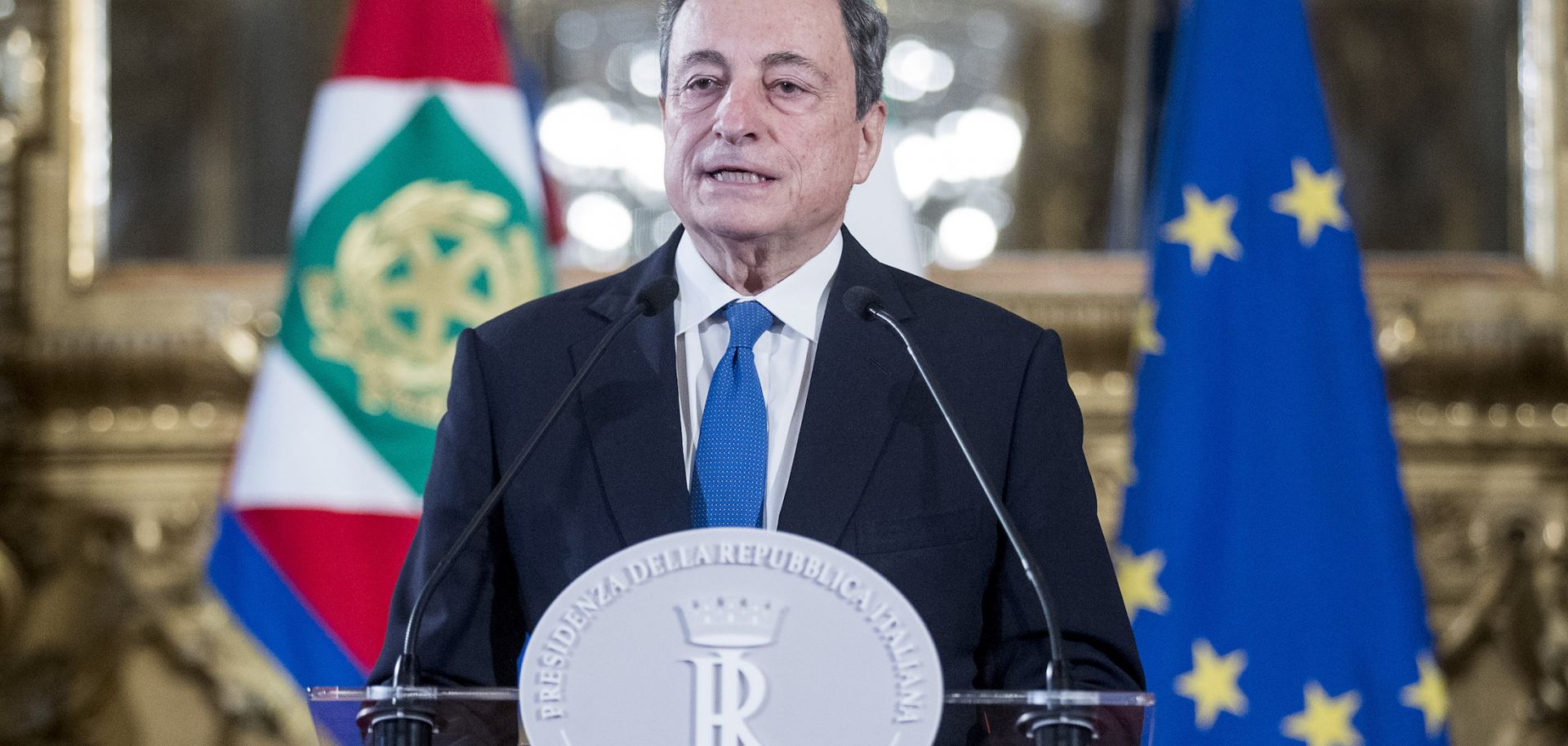
Italian Prime Minister Mario Draghi-designate speaks to the media on Feb. 3, 2021, in Rome.
The appointment of former European Central Bank President Mario Draghi as Italy's new prime minister will create temporary political stability in the country and unlock significant EU financial assistance to it. But a heterogeneous political coalition, COVID-19 and difficulty implementing economic structural reforms could create new instability in the medium to long term. In the coming hours, Draghi will present a list of Cabinet ministers and a government program. Then in the week of Feb. 15 he will probably win votes of confidence in the Italian Chamber of Deputies and Senate, where most parties have expressed their support for his premiership. This will put an end to the political crisis that started in mid-January when former Prime Minister Giuseppe Conte lost his majority in parliament and resigned. Draghi's appointment means that the prospect of a disruptive early general election in the middle of a pandemic has disappeared. Draghi's strong parliamentary majority also means that his government will be stable, at least in the immediate future.
- Italy's political crisis began Jan. 13, when the small centrist Italia Viva party withdrew its support for Conte's government, effectively leaving it without a majority in Parliament.
- Conte resigned on Jan. 26 hoping to be reappointed with a stronger majority, but he failed to obtain enough support in Parliament to lead another government. This prompted President Sergio Mattarella to ask Draghi, a very respected figure in Italy, to form a government.
- On Feb. 12 the members of Italy's anti-establishment Five Star Movement, the largest party in the Italian Parliament, voted in favor of supporting a Draghi government. This happened after other parties, including the center-left Democratic Party, the center-right Forza Italia and the right-wing League, all expressed their support for Draghi.
Draghi's immediate goal will be to accelerate the vaccination process in Italy, which is moving slower than expected due to logistical issues, and to progressively lift the lockdown measures so that economic activity can pick up. Draghi's main goal will be to spend the 209 billion (about $253 billion) euros in grants and loans that the European Union has allocated to Italy as a part of the COVID-19 Recovery Fund. Draghi is also expected to propose reforms in Italy's tax system, public administration, justice and education. At the European level, Draghi will probably push for deeper EU integration, including the creation of a common budget for the eurozone and the completion of the banking union.
- The European Commission has temporarily suspended EU rules on public debt and fiscal deficit, which means that Rome will not be under immediate pressure from Brussels to reduce its fiscal deficit, even if Italy will be asked to present proposals to reduce it in the long run.
- Brussels will also be interested in backing Draghi's domestic policies for political reasons, which means that Rome will not be under significant pressure to introduce unpopular austerity measures.
- The European Central Bank's asset-purchasing programs mean that Italy's borrowing costs are within tolerable margins in spite of having a debt-to-GDP ratio of around 160%, the second-highest in the eurozone after Greece.
Despite this short-term stability, Draghi's heterogeneous coalition and Italy's perennial struggles with structural reforms and the administration of EU funds could eventually threaten his government. While the coalition of parties that back Draghi is very big, it is also quite diverse, which means that parties can withdraw their support for the government as soon as the ideological discrepancies become evident. In addition, the Italian economy contracted by almost 9% in 2020, with growth of only 3.4% and 3.5% expected for 2021 and 2022, respectively, which means that Italy may not return to pre-pandemic GDP levels until 2023 and that the risk of social unrest will remain high. Finally, Italy has proven hard to reform in the past due to a combination of high bureaucracy, vested interests, corruption and a complex decision-making progress. This means that the current strong support from Draghi (both domestically and from financial markets) could erode if he fails to deliver on his reform proposals.
- Draghi is backed by left- and right-wing parties with very different ideologies. These discrepancies are likely to result in a complex policymaking process where some reform proposals are watered down to appease a heterogeneous parliament while others are scrapped.
- As the mid-2023 general election approaches, some parties may decide to exit the coalition to distance themselves from the government in the eyes of voters, threatening Draghi's majority.
- Italy has traditionally struggled to spend EU money. In the 2014-20 EU budget period, Italy managed to absorb only 43% of the money it was allocated, in part due to bureaucratic and administrative bottlenecks. This means that Rome may not be able to take full advantage of the Recovery Fund.
- A slower-than-expected vaccination campaign (which is connected to logistical problems in the production and distribution of vaccines) combined with the emergence of new variants of the virus that causes COVID-19 are forcing Italy and the rest of the European Union to extend lockdown measures. This, in turn, is delaying the economic recovery on the Continent and taking a particularly heavy toll on sectors such as tourism and hospitality, which represent a significant part of the Italian economy.
