
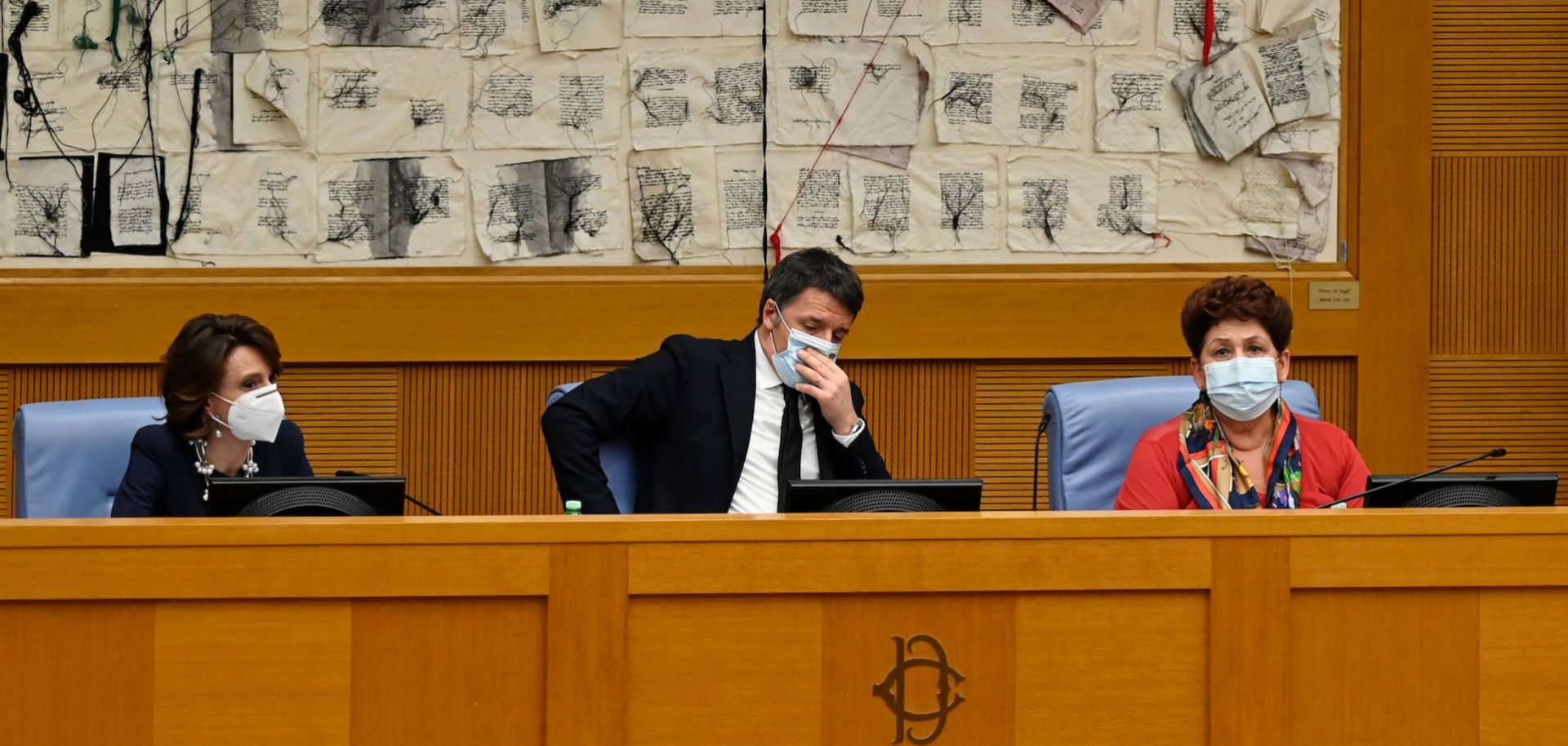
Italy’s former prime minister and current leader of the Italy Alive party, Matteo Renzi (center), holds a press conference with outgoing ministers Elena Bonetti (left) and Teresa Bellanova (right) on Jan. 13, 2021.
Italy is in a political crisis after a junior member of Prime Minister Giuseppe Conte’s coalition exited the government, effectively leaving it without a majority in Parliament. The most disruptive (but least likely) scenario would be an early general election, which would undermine Rome’s efforts to handle the health and economic repercussions of the COVID-19 pandemic. On Jan. 13, the small Italy Alive political party withdrew its ministers from Conte’s cabinet to protest his handling of the COVID-19 pandemic. This has left the senior members of the coalition — the anti-establishment Five Star Movement and the center-left Democratic Party — without a majority in Parliament.
- Without Italy Alive, Italy’s government still has a slim majority in the Chamber of Deputies. However, the coalition has lost control of the Senate. This means that, with the current distribution of seats, it would not win a vote of confidence.
- Conte is a former law professor with no political party of his own. He became Prime Minister in June 2018 with support from the Five Star Movement and the right-wing League Party. When the League left the government in August 2019, the Five Star Movement formed a new government with the Democratic Party, once more with Conte as prime minister.
Italian President Sergio Mattarella will likely pressure the political parties in Parliament to appoint a new government and avoid an early general election. Only the president has the power to dissolve Parliament and call an early general election. Mattarella is against holding an election in the middle of a pandemic, with lockdown measures in place and with infections on the rise.
The scenarios for the coming days include:
- A new majority for Conte. Conte could seek support from other political parties and unaffiliated lawmakers to remain in power. Members of the Democratic Party admitted on Jan. 14 that Conte is currently struggling to find these extra votes.
- A new government. Conte could resign, and Mattarella could ask Parliament to appoint a new government. The new government could be led by Conte himself or by another politician with enough support in Parliament. It could also be a technocratic government led by a non-politician.
- An early general election. If Conte resigns and Parliament is unable to appoint a new government, Mattarella would have no choice but to dissolve the legislature and call for an early general election. The right-wing League and Brothers of Italy parties have already expressed their support for this option.
An early vote would slow down the implementation of relief measures to handle Italy’s pandemic-induced economic crisis, including the use of billion euros in EU grants and loans. It would also undermine efforts to bring Italy’s deep fiscal deficit under control. An early general election would delay any efforts by Rome to reduce its fiscal deficit and public debt. It would also delay the implementation of programs to spend the roughly 209 billion euros from the EU Recovery Fund that has been allocated to Italy. In addition, an early general election could mean the return to power of the euroskeptic League party, which is currently in first place in opinion polls.
- According to the European Commission, the Italian economy contracted by around 10% in 2020, with only 4% growth expected for 2021.
- Italy’s fiscal deficit is well above 10% of GDP, while public debt is at around 160% of GDP.
- The Italian government is also handling issues, including the sale of the troubled Monte dei Paschi bank to Unicredit, the restructuring of the bankrupt Alitalia air carrier, and the purchase of troubled road operator Autostrade per l’Italia.
