
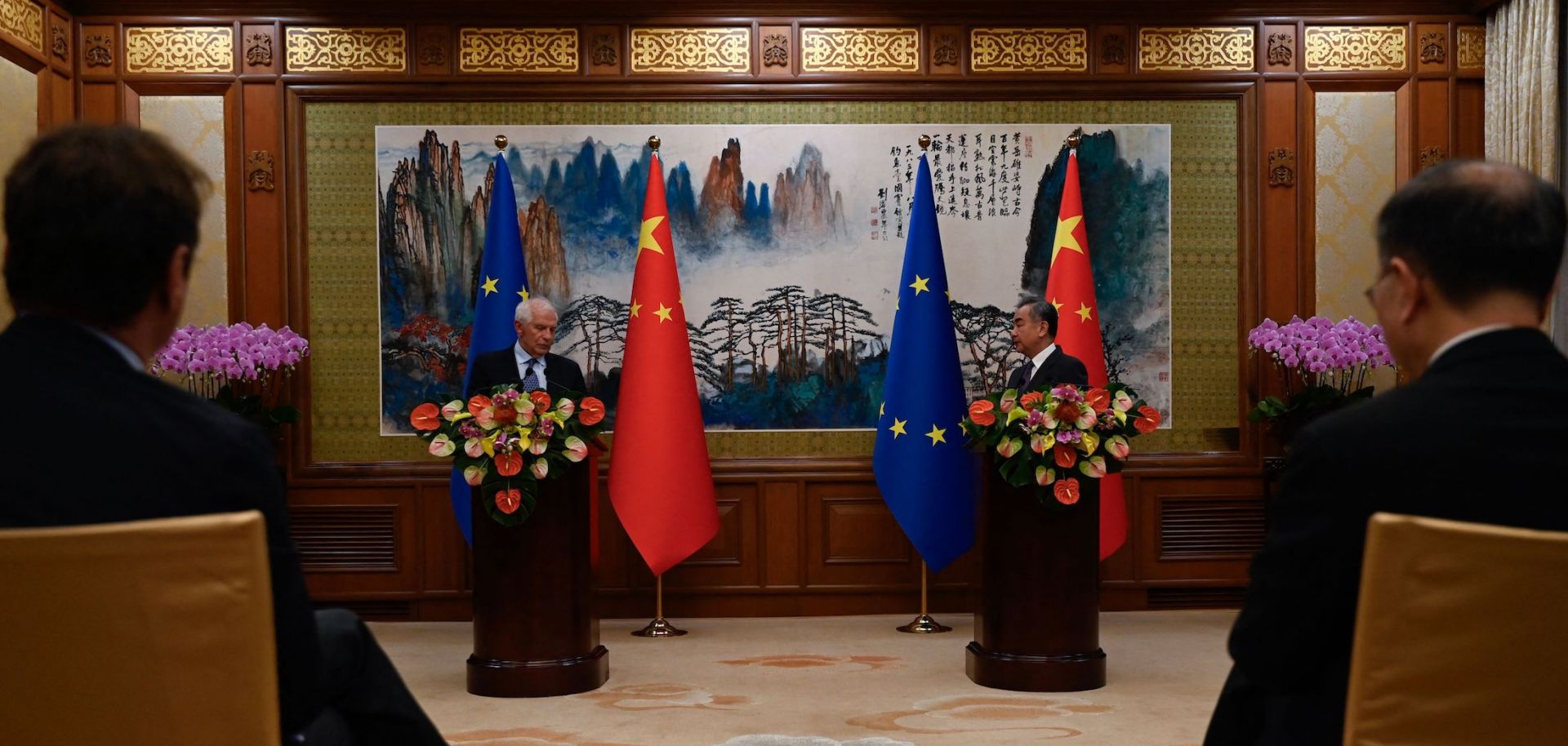
The European Union's de-risking strategy toward China will remain only partially aligned with that of the United States, which will raise the costs of doing business in both Europe and China but won't upend trade and investment relations between the two. In recent months, the European Union and some of its key member states have announced a series of China-focused strategies and policy measures that show the bloc's growing assertion in pursuing its ''de-risking'' strategy toward Beijing. In June, the European Union unveiled its first-ever economic security strategy, which proposed steps to curb EU exports and outbound investment in highly sensitive technologies toward adversarial countries, as well as reduce EU member states' reliance on such countries for economic growth and strategically important goods. While China was not explicitly mentioned in the strategy, it was heavily implied as the main target. In July, the German government published its first-ever China strategy, which focused on lowering the country's reliance on the Chinese market both as a supplier of critical raw materials and technologies and as a key export and investment destination. Berlin's plan also seeks to reduce the presence and influence of Chinese companies in Germany's critical infrastructure, as well as curtail sensitive technology transfers to China that could increase its country's intelligence and military capabilities. In October, the European Union formally launched an anti-subsidy investigation into Chinese electric vehicles (EVs) that, in European Commission President Ursula von der Leyen's words, are ''distorting'' the European Union market.
- The European Union's economic security strategy proposed introducing new tools (such as outbound investment screening) and strengthening existing ones (such as export controls and inward investment screening).
- Following the launch of an anti-subsidy probe into Chinese-made EVs, the European Union is now reportedly considering opening similar investigations into imports of Chinese wind turbine components and Chinese steel, which could see Brussels impose higher import duties.
- On Oct. 3, the European Parliament approved the Anti-Coercion Instrument, which will enable the European Union to retaliate against countries that try to economically coerce its member states into changing their policies. The European Commission first proposed the instrument in December 2021 after China restricted trade with EU member Lithuania following the Baltic country's decision to establish a Taiwan Representative Office.
The European Union's increased focus on ''de-risking'' in its relations with China is primarily motivated by strategic and security imperatives but also by an increasingly imbalanced trade and economic relationship. China's growing authoritarianism, human rights violations, increasingly aggressive posture in the Taiwan Strait and the South China Sea, and deepening ties with Russia have prompted a rethink of Europe's relationship with Beijing in recent years in both Brussels and EU capitals. This comes on top of long-standing concerns in Europe over unfair Chinese economic and trade practices, including China's use of coercive economic and trade policies to exert geopolitical influence on countries in Europe and elsewhere, its limited market openness to European companies, and its known practices of property theft and economic espionage. Moreover, while China's rapid economic growth and increased consumer demand over the past two decades made the country both an attractive destination for European exporters and a source of cheap goods, growing trade and investment imbalances have started to erode that attractiveness. Today, the European Union remains reliant on imports from China in several strategic sectors (including key components of critical infrastructure like telecommunications, healthcare and energy) — a dependency that has become even more apparent with the energy transition, given China's dominant position in the global supply of critical raw materials and green technologies. Meanwhile, though China remains a key export and investment destination for several European industries, this relevance has seemingly started to decline. This is partly due to China's rapid industrial transformation, which has enabled the Asian country to compete with Europe in a growing number of sectors, thus reducing its need for imports. European companies are also investing less in China, mostly because of market access and regulatory barriers, as well as non-transparent policy shifts in Beijing.
- Both economic and security considerations regarding relations with China feed into the European Union's broader ambition to pursue greater strategic autonomy, which has put security considerations at the center of the bloc's economic and industrial policies. The strategic autonomy goal became more pressing following the trade and supply chain shocks brought on by China's COVID-19 lockdowns, and the energy and inflation crisis brought on by Russia's war in Ukraine, which highlighted the risks associated with Europe's overreliance on third countries, particularly non-democratic ones (like Russia and China).
- European (and particularly German) industries in the automotive, technology and chemical sectors became heavily reliant on Chinese exports and investments in the Chinese market after the 2008-09 global financial crisis, which the fallout from the 2010-11 eurozone crisis then further exacerbated. However, this dependence has gradually declined, particularly since the onset of the COVID-19 pandemic in 2020, with Chinese imports from the European Union and Germany shrinking even after China's economy started reopening to the world in 2022. The European Union's trade deficit with China has continued to expand since the early 2000s, reaching a record high of $396 billion in 2022.
- Imports of critical raw materials and technologies needed for the energy transition have exacerbated the European Union's trade dependencies on China, which currently supplies nearly all (98%) of the bloc's rare earth materials, as well as 97% of its magnesium supplies, 79% of its lithium supplies, 71% of its gallium supplies, 67% of its scandium supplies, 45% of its germanium supplies, 40% of its graphite supplies, and 32% of its tungsten supplies. The European Union also relies heavily on Chinese imports of green technologies such as photovoltaics (89%), lithium-ion batteries (82%) and wind turbines (64%).
- Since 2019, the share of EU foreign direct investment into China has been growing more slowly than global foreign investment flows, which suggests EU investors may be becoming more conscious of the risks and obstacles of investing in the Asian country.
The European Union's de-risking efforts are only partially aligned with the United States' campaign against China as Brussels is still seeking to preserve critical trade and business ties with Beijing. Fundamental disagreements among EU members regarding the bloc's relations with China make it difficult for Brussels to develop a unified, strong and coherent approach to Beijing. While Brussels is increasingly aligning its China-related rhetoric and policy objectives with Washington's, EU member states such as Germany tend to favor a more balanced approach due to fears excessive restrictions could have an outsized negative impact on its economic relations with Beijing. Europe relies heavily on China for imported intermediate goods, which it uses to produce manufactured products that support exports and create added value. The Asian country also still represents a key export market for many European industries. For these reasons, Europe does not see China only as a source of competition, but also as integral to its economic success. While reducing dependencies on trade with China is precisely the main goal of the European Union's de-risking strategy, such dependencies are still too high for the bloc to pursue policy measures that would risk excessively alienating Beijing. As a result, the European Union's strategic rebalancing on China has so far mostly consisted of inward-looking protectionist policies aimed at bolstering the bloc's economic defenses and increasing its competitiveness vis-a-vis China. This contrasts with the United States' China strategy, which seeks to actively obstruct the advancement of the Asian country's technological capabilities.
- Brussels has so far avoided announcing outright bans on investment in China's technology sector (like those recently implemented by Washington), instead proposing only targeted measures on Chinese sectors where there are clear military implications. On Oct. 3, the European Commission published a list of critical technologies to protect from adversarial countries like China, which only included semiconductors, artificial intelligence, quantum computing and biotechnologies. This short, uncontroversial list of technologies exemplifies the European Union's cautious approach amid divisions within the bloc regarding restrictions on China.
- Compared with the European Union, the United States has similar trade dependencies with China. But countering Beijing's economic and technological rise is a strategic priority for Washington, making it more willing than Brussels to face the economic costs associated with reducing ties.
Moving forward, the European Union will likely adopt increasingly protectionist and interventionist industrial policies, some of which will directly target Chinese competition. But Brussels will continue to refrain from imposing extensive export controls and investment restrictions. Growing protectionist trends in the European Union will translate to more anti-dumping and -subsidy investigations against Chinese investment and companies in the coming years, which may lead to higher import duties, the revocation of import or export licenses, and constraints on services and public procurement for a number of Chinese firms. The European Union will also likely raise indirect trade barriers to limit the rise in imports of certain Chinese goods (such as EVs, wind turbines and steel). However, while Brussels will eventually adopt some of the China-focused economic restrictions requested by the United States (such as export controls and outbound investment screening tools), these will largely remain limited to dual-use technologies. By contrast, EU member states will be more inclined to adopt new inbound investment screening regulations and/or strengthen existing ones. This will facilitate the blocking or downsizing of Chinese acquisitions of companies in sectors of the economy considered of strategic importance and prohibit critical infrastructure operators from using Chinese equipment. As a result, the number of blocked Chinese takeovers and mergers in Europe will grow, along with cases of nationalizations and forced sales of Chinese-owned strategic assets. Still, restrictions will largely be limited to the semiconductor sector — where Europe can more easily exclude Chinese investors by attracting investment from other countries such as the United States and Taiwan — and other, smaller high-tech industries. Neither the European Union nor any of its member states will likely push for broader restrictions that explicitly prohibit Chinese investment in other high-growth, job-creating industries (such as the EV sector), as European companies will continue to welcome Chinese capital and inputs — especially if it gives them an edge against U.S. competitors.
- The implementation of export controls and investment restrictions will ultimately fall to EU member states, which further indicates that the use and scope of such tools in the bloc will likely remain limited, as most EU governments will continue to refrain from enacting measures that would restrict their access to the Chinese market and/or could trigger excessive Chinese retaliation.
- A growing number of European governments are adopting tighter inbound investment screening measures. France, Germany and Italy all have regulations in place to screen foreign investments in sectors deemed of strategic importance (such as ports, transport infrastructure, telecom networks and semiconductor fabrication plants), and are also all actively working to expand their power to vet those investments.
- At the same time, the European Union remains an increasingly important destination for Chinese foreign direct investment — particularly in the form of greenfield investment, the bulk of which has been going into Europe's EV value chains (especially, battery production). Despite its growing concerns regarding China, Europe will remain interested in attracting this sort of investment.
European economic restrictions and Chinese retaliation, though limited, will increase costs for European companies in both markets, yet trade and investment flows between the two will not drop dramatically. Stricter regulations on Chinese investments in the European Union and various other supply chain adjustments to diversify away from China will likely raise input and production costs for EU companies in sectors subject to restrictions. Meanwhile, falling Chinese participation in public procurement will raise the costs of some public tenders in the European Union (though it will also create new opportunities for local companies). In response to EU indirect trade barriers and limited export controls, China will likely impose targeted retaliatory measures against the countries adopting restrictions. This may include boycotts, customs challenges, stricter regulatory requirements and increased regulatory delays for firms operating in China, and limited restrictions on key exports of critical raw materials — all of which will increase the compliance costs and other costs of doing business in China for European companies. The European Union's less hawkish stance on China compared to the U.S.' and more narrow approach to enacting countermeasures (like export controls), however, will limit Beijing's retaliation. As a result, growth in trade and investment flows between Europe and China will dip but not plummet. Still, as pressured European companies diversify supply chains, both the European Union and China will further increase efforts to boost trade relationships with emerging markets, seek alternative export markets, secure access to raw materials and technologies, and forge closer ties with like-minded partners for greater market access and joint research and development efforts, creating new opportunities in regions like Southeast Asia, North Africa, Eastern Europe and South Asia.
- Brussels and Washington will seek greater cooperation ahead of U.S. presidential and EU parliamentary elections in 2024, which could yield a more protectionist White House (especially if former U.S. President Donald Trump is re-elected), as well as a more protectionist European Parliament and European Commission. Beyond 2024, however, the outcome of elections in the European Union and the United States, as well as future economic developments in both Europe and in China — combined with geopolitical events, technological developments and other factors — could significantly alter the trajectory of transatlantic cooperation with China.
