
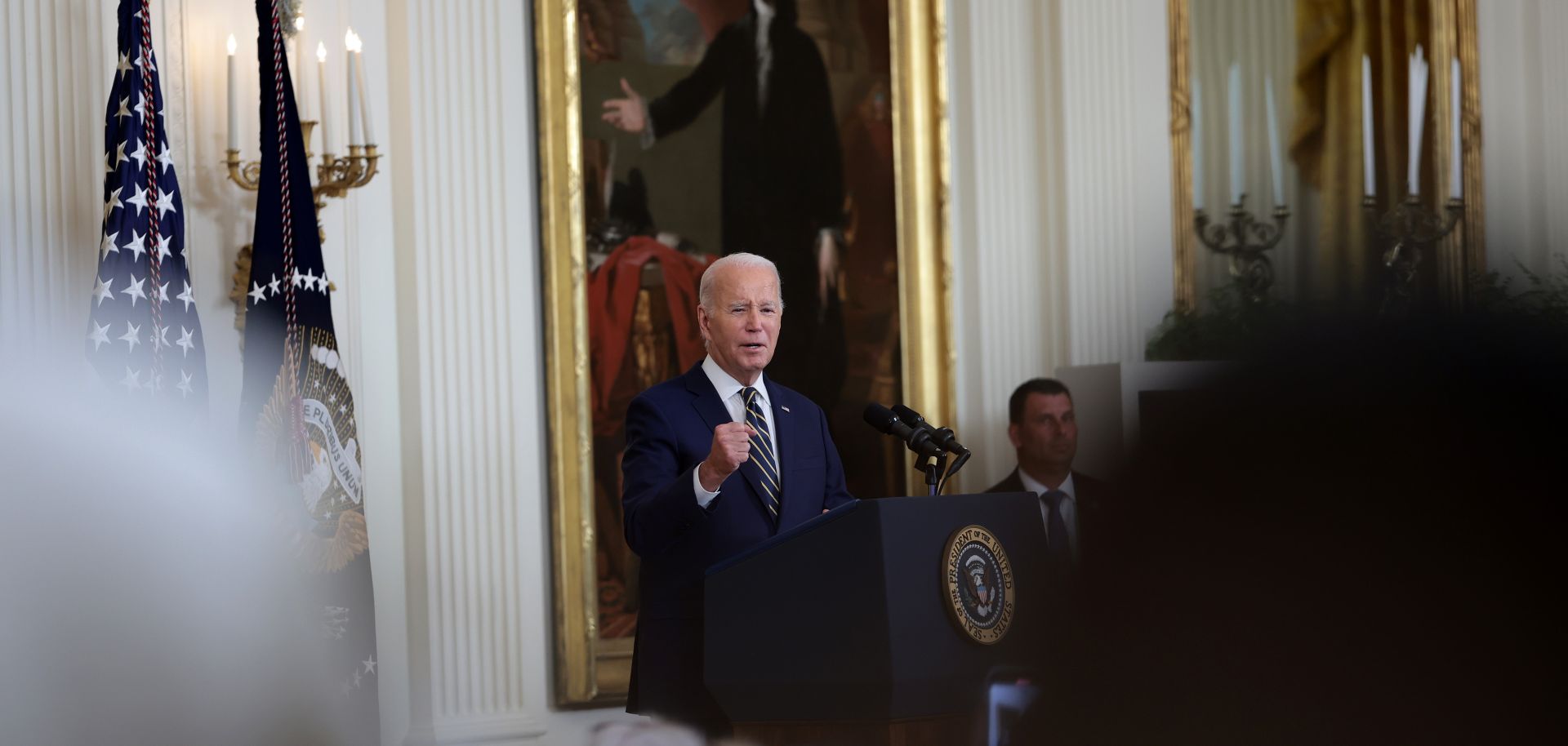
While a new U.S. executive order restricting AI, quantum and semiconductor investments in China is alone unlikely to have a significant impact, it is probably only a harbinger of future such restrictions that together could hamper China's technological rise. After many delays, U.S. President Joe Biden signed an executive order on Aug. 9 that will eventually restrict some overseas investments by U.S. companies into China's technology sector. The regulations are more narrow in scope than the initial proposals and only cover certain investments into China's artificial intelligence (AI), quantum information technologies and semiconductor sectors. Even within those sectors, the restrictions do not cover the entire industry and instead focus on specific sub-technologies, such as investment into AI software for military purposes. For broader investments in those three sectors, as well as a list of other sectors, the mechanism merely sets up a notification process.
- Concurrently with the executive order, the U.S. Treasury Department published an Advance Notice of Proposed Rulemaking (ANPRM) detailing its proposed scope of the regulations that the order directed the department to create, opening up a 45-day comment period on the proposal.
- The ANPRM defines subsets of the technologies and products within the three sectors covered by the order:
- For semiconductors, the rules cover electronic design automation software, chipmaking equipment and the packaging of advanced semiconductors.
- For quantum information technologies, the rules cover the production of quantum computers and certain components, quantum sensors and quantum communication systems.
- For AI, the rules only relate to software designed for military or intelligence organization applications that pose a national security risk. The Treasury is also requesting comments on how to prohibit investment into software that utilizes AI and is also designed to have military or intelligence end-use.
- In addition, the ANPRM's scope only includes transactions that convey intangible benefits, like greenfield investments, joint ventures and the acquisition of equity interests (such as mergers and acquisitions, private equity and venture capital). The scope of transactions the regulations cover would also not include passive portfolio investments into stocks and bonds.
This executive order is part of the growing U.S. campaign to stifle China's development of its AI, semiconductor and quantum computing sectors and ensure that U.S. companies are not financing that development. In Washington, U.S. private equity and venture capital (VC) investments in China have become a source of growing scrutiny amid fears that such funding is bolstering Chinese startups in emerging technologies. A February report published by Georgetown University's Center for Security and Emerging Technology found that between 2015 and 2021, U.S. investors were involved in $40.2 billion worth of transactions involving Chinese AI companies, accounting for about 37% of the $110 billion raised by those companies during that time period. Moreover, 91% of those transactions were at VC investment stages — the exact type of transactions that Biden's executive order appears designed to block. In July, the House Select Committee on the Chinese Communist Party (CCP) sent letters to four U.S.-based VC firms — GV Capital, GST Ventures, Qualcomm Ventures and Walden International — expressing ''serious concern'' about their investments into Chinese startups. Last month, the U.S. Senate also voted 91-6 to amend the annual must-pass National Defense Authorization Act requiring companies to notify the Treasury when they invest in sensitive technologies (including semiconductors, AI and quantum computing, as well as satellite-based communications and hypersonics) in adversary countries like China. While the Senate's amendment does not outright block transactions like Biden's executive order, it covers a wider range of investments, including passive investments and debt transactions.
Given the narrow scope of the executive order, the investment restrictions will likely only modestly disrupt the development of China's AI, quantum computing and advanced semiconductor industries. Still, they may curb some funding and knowledge transfer opportunities for Chinese startups. Overall, U.S. investment in China's AI, semiconductor and quantum computing sectors remains small and is dwarfed by Chinese investment in those technologies. For large Chinese companies, export controls on U.S. technology — such as on advanced chipmaking technology and chips utilized in the training and operation of large AI models — will likely have a much more significant impact on China's technology sector as China is investing heavily in those sectors. But compared with passive investments, early-stage investments from U.S. companies can yield significant benefits for Chinese start-ups beyond the funding itself, including opening up opportunities for collaboration with other established entities, management and technology transfers through a more hands-on role. Attracting VC in an early stage from prominent investors can also boost a startup's reputation, further facilitating support to help the company succeed. Because Biden's new executive order only prohibits investments into AI for military use, it is unclear how many investment opportunities into Chinese AI startups will now be blocked. In many cases, it can be difficult to disentangle Chinese startups' relationships and client base, including any connections they may have to the military. But at a minimum, the executive order will force firms to increase scrutiny over the startups they invest in. Such increased scrutiny, however, will prove challenging amid China's ongoing crackdown on due diligence firms, which has made thorough investigations into Chinese companies, especially ones with murky connections to the military, more difficult. Some VC and private equity firms may take an expansive approach, given how the line between military use and civilian use for AI is difficult to discern.
- China's National Integrated Circuit Industry Investment Fund Co. (also known as ''Big Fund'') — which serves as a major source of capital for the country's semiconductor companies — raised about $45 billion after it was founded in 2014. In its report published earlier this year, Georgetown University's Center for Security and Emerging Technology also found that 71% of the transaction value in Chinese AI companies between 2016 and 2021 came from Chinese investors with no U.S. participation. This confirms that overall, U.S. VC and private equity capital is relatively small beyond the early stages for start-ups.
- The startup path has previously proven to be successful for certain Chinese AI companies, such as facial recognition Chinese AI company SenseTime, which arguably became the world's most valuable startup five years after its 2014 founding.
But the new executive order may only be the first step toward larger restrictions as policymakers in the United States consider broader measures to curb investments in China amid the two countries' escalating rivalry. The order represents, arguably, the most narrow restrictions the United States could implement. Other proposals have ranged from higher restrictions on the three sectors affected to the creation of a CFIUS-like review committee that would have the power to block outbound investments if the committee finds that they harm U.S. national security. It's likely that Congress — and potentially a new presidential administration if Biden isn't re-elected in 2024 — adopt expanded outbound investment restrictions over the next few years. While the three sectors highlighted in the executive order (semiconductors, AI and quantum computing) will remain a key focus of escalating U.S.-China tensions, competition in other technology areas — including biotechnology and increasingly EV battery technology — will likely be just as fierce and could represent expansion areas in the future. Washington and Beijing's intensifying rivalry will, in turn, likely see more U.S. policymakers support expanded restrictions on China's tech sector. However, corporate lobbyists will probably remain somewhat effective in keeping those restrictions narrow, slowing down the process and contributing to some delays (as was the case with the recent executive order). U.S. regulations on outbound investment have always been a difficult sell in Washington due to the U.S. government's typically hands-off approach to such matters, barring very specific national security considerations. But Biden's executive order suggests that the taboo may be breaking, which could pave the way for future Congressional leaders and administrations to expand restrictions to other sectors in China.
- As the Aug. 9 executive order was being drafted and debated, Congress in December 2022 requested the U.S. Treasury and Commerce departments to determine the funding and staffing they would need for an outbound investment screening program.
