
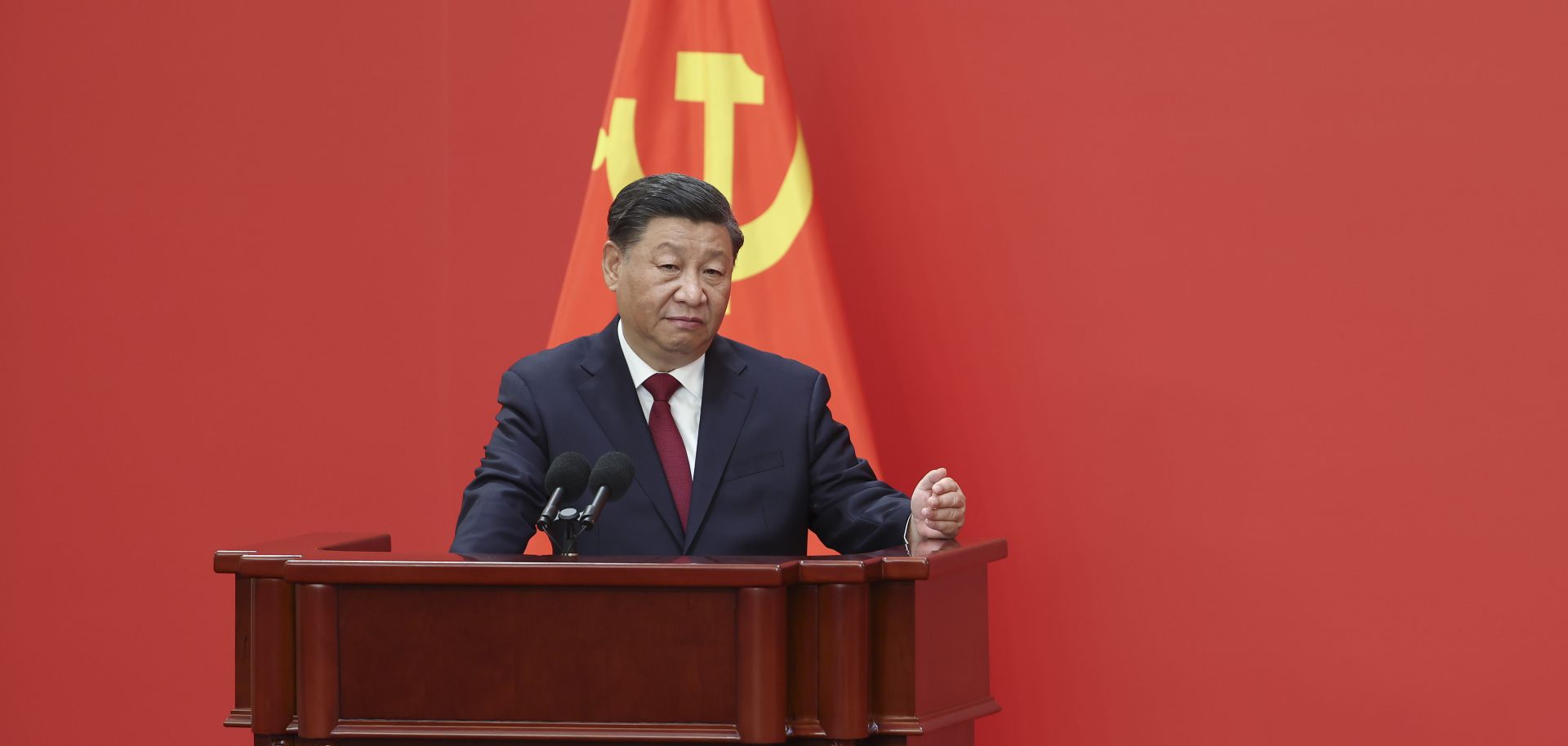
Chinese President Xi Jinping speaks during the meeting between members of the 20th Politburo Standing Committee on Oct. 23, 2022, in Beijing, China.
Recent political developments suggest that Chinese President Xi Jinping's preferred policies are underperforming, and that Xi is wielding anti-corruption investigations and curbing information flows to manage this challenging environment — a strategy that risks increasing policy uncertainty and creating an even more opaque operating environment for businesses in China. On June 7, the Central Commission for Discipline Inspection (China's anti-corruption watchdog and President Xi Jinping's primary tool for purging political rivals) published an article in the Chinese Communist Party (CCP) Central Committee's official newspaper, The People's Daily, pledging to strictly enforce discipline in the Party. The article also promised to ''resolutely prevent the wrong expectation of changing our direction'' (i.e. on policy), as well as fight against ''political cliques'' and ''political conspiracies'' to ''eliminate political hazards that endanger the party's unity.'' Meanwhile, Bloomberg reported on June 7 that the 20th Politburo (Beijing's top decision-making body) had failed to publish a readout for its monthly meeting in May, marking the third missed report in the eight months since this Politburo was formed in October 2022. The current pace of missed readouts is much faster than the previous (19th) Politburo, which missed a total of three readouts in its five-year tenure from 2017-2022.
- The 20th Politburo's first missed a readout in November amid the massive nationwide protests against China's strict COVID-19 restrictions, which were the largest the country had seen since the 1989 Tiananmen Square Massacre. In response to the demonstrations, Beijing abruptly ended its ''zero COVID'' policy in December, which then led to a massive COVID-19 resurgence the next month that, according to some officials' estimates, infected 80% of Chinese citizens — which may have contributed to the Politburo's missed readout in January.
The calls for stricter party discipline and the missing Politburo readouts come as some of Xi's signature policies are producing only modest results. In recent months, a number of the Chinese president's high-profile policies have yielded limited or even negative results, including the ''zero COVID'' pandemic management system, a financial reform plan for China's embattled real estate sector, a regulatory crackdown on the tech sector and an industrial self-reliance campaign to combat Western tech restrictions. Furthermore, China's consumption-driven economic recovery from the COVID-19 pandemic has been slow to manifest, with the country reporting underwhelming economic data so far this year, and with youth unemployment and social unrest also on the rise.
- China's post-COVID consumption recovery has been much slower than Beijing anticipated and the country's export sector has rapidly decelerated. In a central bank survey conducted in April, 58% of Chinese citizens said they favored saving their money over investing it or spending it on goods and services — a notable uptick from the 45% who said so in early 2019 (before the pandemic). Customs data for May, released on June 7, showed that China's exports were down 7.5% year-on-year (much higher than the expected 0.4% drop), despite May 2022 being a low month for production given China was in the midst of one of its most economically disruptive lockdowns, centered around the Shanghai outbreak.
- China's youth unemployment (ages 16-24) hit a record 20.1% in May 2023 and is expected to continue rising through July 2023, when a new cohort of over 11 million college graduates enters the labor market.
- Social unrest in China remains elevated following the protests in November, with bank depositors, factory workers, and pensioners engaging in sporadic (and sometimes violent) demonstrations. But so far, such unrest has remained locally isolated.
The CCDI article suggests Xi and his closest advisors will lean harder on anti-corruption investigations to purge policy dissent, while the missed Politburo readouts suggest Xi may be using information blackouts to manage the CCP's public image as a problem solver. Against the backdrop of disappointing policy performance, Xi and the Politburo may resort to tools like CCDI anti-corruption investigations to silence policy dissent. Though Xi has already used the CCDI to purge the upper ranks of the CCP of all but his staunchest policy supporters in the past decade, there inevitably are many lower-level cadres who disagree with Xi's policies, and they may be quietly impeding policy implementation at the local government and ministerial levels. Thus, the CCDI's pledges to root out sources of policy change or disunity suggest Xi will respond to this quiet dissent by purging lower-level naysayers. In the meantime, Beijing's refusal to publish even its usual highly curated Politburo meeting readouts suggests that the government is covering up how few solutions the body has for China's complex policy issues. The absence of readouts could also indicate internal Politburo divisions on policy solutions, but this is unlikely since Xi staffed the Politburo with ''yes men'' in October 2022.
With more anti-corruption investigations on the horizon, rapid policy changes may unfold in China, and information blackouts will worsen operating environments for foreign businesses. The CCP's next campaign to purge ''political conspiracies'' and ''political cliques'' may take place in a 12-18 month-long wave, as previous Xi-led CCDI anti-corruption campaigns have done. During this time, senior officials in areas key to managing China's policy challenges (e.g., the industry ministry, financial regulators or the foreign ministry) will be embroiled in investigations for ''breaches of party discipline.'' Nervous officials in sectors targeted by CCDI campaigns may abruptly realign policies with Beijing's prescriptions, making local policy less suited to local conditions and binding up bureaucratic processes. These potential policy changes will complicate business operations in China, and constricted information flows — as seen in the absence of Politburo meeting readouts — will exacerbate these issues by making it harder for foreign governments and companies to understand political dynamics in China. As a result, these entities will increasingly move to minimize risks, including by implementing policies to protect national security or by delaying investment decisions until Beijing's stance is clear. Furthermore, despite sectoral policy changes in response to the CCDI's scare tactics, local governments' abilities to meet Beijing's central policies may actually decrease over time as intractable policy challenges (like Western tech restrictions) mount and weariness with Xi's political campaigns spurs local cadres to meet the bare minimum for policy implementation. These opposing forces on local policy will further complicate China's operating environment and may even prolong the CCDI campaign. As for Xi himself, his position at the top of the CCP hierarchy is secure for now, but if policy failures continue amid China's challenging domestic and foreign environment, political factionalism may revive to weaken Xi's grip on power.
- One way local governments may change policy as the CCDI's anti-corruption campaign progresses is by withholding approval of tax breaks for foreign firms in industries in which Beijing is prioritizing self-reliance.
