
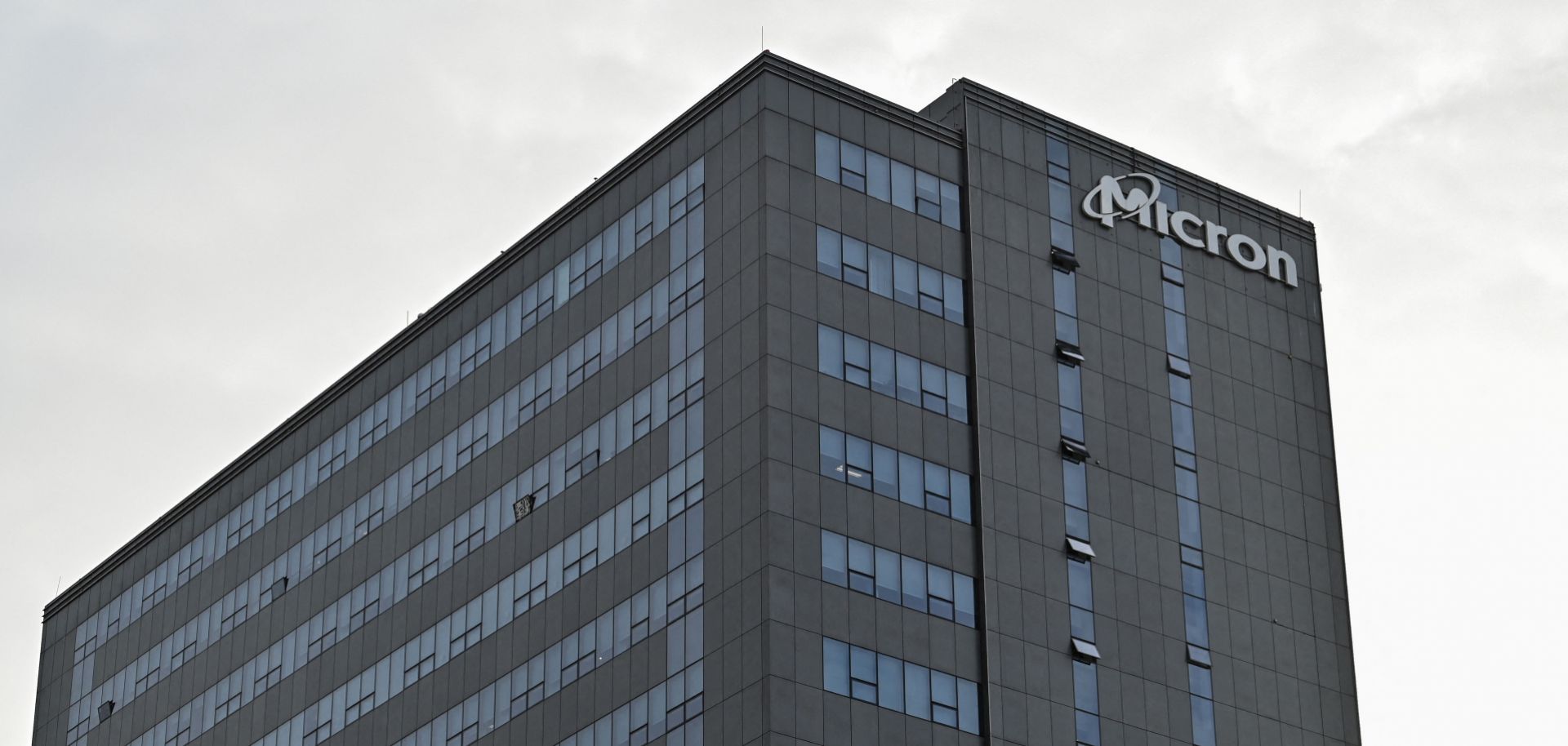
The offices of U.S. semiconductor manufacturer Micron in Shanghai, China, are seen on May 22, 2023.
China's ban on the U.S. chipmaker Micron signals Beijing's willingness to use more aggressive legal tools against Western technology companies in response to the United States and its allies' expanding export restrictions, which will only further compel foreign firms in the sector to reduce their exposure and sales to China. Following an investigation that appears to have lasted less than two months, the Cyberspace Administration of China (CAC) announced on May 21 that it would ban China's critical infrastructure operators from using chips produced by U.S. semiconductor manufacturer Micron. According to the CAC, Micron's products had ''serious network security risks'' that ''pose significant security risks to China's critical information infrastructure supply chain, affecting China's national security.'' The restrictions are narrower than the blanket ban some had feared, and Micron's memory chips are primarily used in consumer electronics devices (such as smartphones and laptops). But Chinese technology companies seeking to maintain high or receive increased political support from Beijing will likely still phase out Micron's memory chips. By contrast, electronics assemblers based in China installing Micron's chips in products exported abroad may not be as affected.
- The CAC announced on March 31 that it was initiating a cybersecurity review of Micron's products. The investigation is believed to be China's first against a foreign technology firm since it introduced new cybersecurity rules in 2020, which were subsequently updated in 2021.
- The timing of the announcement of the results appears to be tied to the May 19-21 Group of 7 (G-7) summit in Hiroshima, Japan, where the G-7 agreed to increase cooperation in technology export controls and condemned China's use of ''economic coercion'' for political purposes.
- Micron is the world's third-largest memory chip manufacturer after South Korea's Samsung and SK Hynix. The U.S.-based semiconductor company produced about a quarter of the world's DRAM memory chips in 2022. For fiscal year 2022, mainland China accounted for 10.8% of Micron's sales.
The restrictions against Micron appear to be a result of Beijing's security establishment tightening its control over the country's regulatory investigation processes and a reaction to growing U.S. success in convincing its allies to adopt some restrictions against China, particularly on semiconductors. The United States first unveiled its sweeping restrictions cutting off China's access to advanced semiconductor technology in October 2022. Since then, Washington has started to have some success in convincing its allies to implement similar restrictions on China, including a January 2023 agreement with Japan and the Netherlands to increase export controls on semiconductor manufacturing equipment exports. The G-7 summit's joint statement on China was a culmination of U.S. efforts to convince the bloc to take more efforts against Beijing. Since China held its Two Sessions plenary sessions in March 2023, Chinese authorities appear to have intensified their scrutiny over data security and cybersecurity concerns. In recent months, officials have raided several Chinese offices of U.S. consulting and due diligence firms (including Bain and Co., Capvision and the Mintz Group), questioning staff and taking away computers and phones. Reportedly, Chinese President Xi Jinping has put Security Minister Chen Yixin in charge of the investigations into foreign companies' Chinese operations. Over the past few months, Xi also appears to have appointed similar security-focused figures to other key positions. These appointments signal China's increasing focus on data sovereignty and willingness to alienate foreign companies in the name of security, as so far there have been few powerful and high-profile Chinese officials making any statements designed to assuage investor fears during the crackdown.
- In addition to implementing technology restrictions, the United States is also intensifying scrutiny over forced labor in China under the Uyghur Forced Labor Prevention Act, which U.S. President Joe Biden signed into law in December 2021. In February 2023, for example, the U.S. Customs and Border Protection began issuing ''detention notices'' for Chinese aluminum suspected of being the product of forced labor. To avoid a seizure and evaluate the supply chain in China, foreign companies often use U.S. due diligence firms (like the Mintz Group) to investigate these types of issues, highlighting a potential motive behind Beijing's recent crackdown on such firms.
- Over the last few years, China has adopted a number of new regulations to increase data sovereignty and stop the export of valuable data overseas. Such legal mechanisms include the 2021 Data Security Law, which prohibits exporting data without a cybersecurity review, and the 2021 Personal Information Protection Law (PIPL), which seeks to increase restrictions on processing personal data. In late 2022, Wind Information Co., a leading Chinese financial data provider, also began limiting the use of its platform outside mainland China due to some of these restrictions.
- The U.S.-Japan-Netherlands export control agreement is significant as U.S., Japanese and Dutch companies together produce virtually all of the world's semiconductor manufacturing equipment in certain key segments. The Netherlands' ASML, for example, has a monopoly on the world's most advanced lithography machines that are used to fabricate advanced logic chips. Beyond the Netherlands and Japan, Germany is also reportedly considering restricting exports to China of chemicals used in the production of semiconductors.
The Chinese government's growing use of these tools and prioritization of data sovereignty over easing foreign investor concerns will accelerate companies' efforts to reduce their exposure to China, both as a market and a supplier. But Beijing will likely tailor its future scrutiny to avoid significant blowback from foreign firms. The string of investigations since the Two Sessions has seen more companies express fears about China's future market. In a mid-April survey conducted by the American Chamber of Commerce in China, 87% of respondents said that they were slightly pessimistic or pessimistic about U.S.-China relations moving forward, an increase from the 73% who said so in a February 2023 survey. China appears poised to wield these tools more frequently, though it will probably still be somewhat surgical in the way that they are applied. The ban against Micron, for example, appears to be targeted as it only explicitly forces critical infrastructure operators to stop buying the U.S. chipmaker's products. While Micron produces nearly a quarter of the world's DRAM memory chips, the memory chip market is extremely commoditized and standardized, making it far easier for Chinese companies to switch from using Micron's chips to those produced by Samsung and SK Hynix. This contrasts with the market for logic chips, which are highly specialized and designed for use in a single specific device or set of devices. Even if China's securocrats are now dominating the review process, the narrower ban for Micron — along with the relatively successful start to the U.S. Public Company Accounting Oversight Board's (PCAOB) agreement with Chinese officials on inspecting auditors based in China and Hong Kong — suggest China will maintain some level of pragmatism amid its escalating tech rivalry with the United States. This will help reduce the risk of China banning imports of foreign-made tech products that Beijing has few alternatives to. But it also means Western firms selling products that China deems non-essential and can source elsewhere, like Micron, will face a greater risk of investigations and restrictions.
- In a May 2023 poll conducted by Fortune, 41% of Fortune 500 companies said they were reducing exposure to China, compared with just 35% and 23% that said so in similar surveys conducted in 2022 and 2021, respectively.
- In its first inspection reports, the U.S. PCAOB found a number of deficiencies at KPMG Huazhen LLP in mainland China and PricewaterhouseCoopers in Hong Kong. The PCAOB noted this was not unusual for initial investigations, but said the fact it found such deficiencies suggested the process worked.
Politically, Beijing's more aggressive moves are unlikely to deter many governments from joining Washington in announcing more concrete restrictions, with the potential exception of South Korea and other countries that are highly exposed to the Chinese market. The G-7's criticism of China's economic coercion demonstrates that the G-7 itself intends on increasing cooperation on such matters. Indeed, the U.S.-EU Trade and Technology Council (TTC) is scheduled to hold its fourth meeting May 30-31, where a draft statement prepared reportedly says the two sides will agree to hold regular talks on efforts to stop the export of technology to ''strategic rivals'' (i.e. China and Russia) through outbound investment. In Europe, there are certainly disagreements over how much to pressure China, as French President Emmanual Macron has warned that the European Union should not take such action against Beijing just because the United States wants it to. But over the last six months, there has been a clear shift in European policy overall, as exemplified by the United States reaching agreements with both the European Union and individual member states like the Netherlands to take concrete action against China. Still, China is likely to find some success in convincing countries highly exposed to China to at least limit their cooperation with the United States. For example, U.S. officials reportedly pressured South Korea to ask its memory chip manufacturers not to replace Micron in the event of a possible ban. But on May 22, after the ban was announced, South Korea's First Industry Vice Minister Jang Young-jin said that ''it is actually up to [both] Samsung and SK Hynix, with global operations, [to] make a judgment on this.'' Jang's statements are interpreted as Seoul declining to get involved and instead giving the two South Korean tech giants the freedom to do what they want, including potentially increasing sales to China to replace lost market share by Micron. They will likely do so as South Korean companies in the past have been targeted by Beijing for helping the United States implement its national security strategy.
- In 2017, South Korean conglomerate Lotte Group faced a boycott in China after agreeing to a land swap in South Korea that would allow for the United States to deploy the THAAD anti-ballistic missile system outside of Seoul.
