
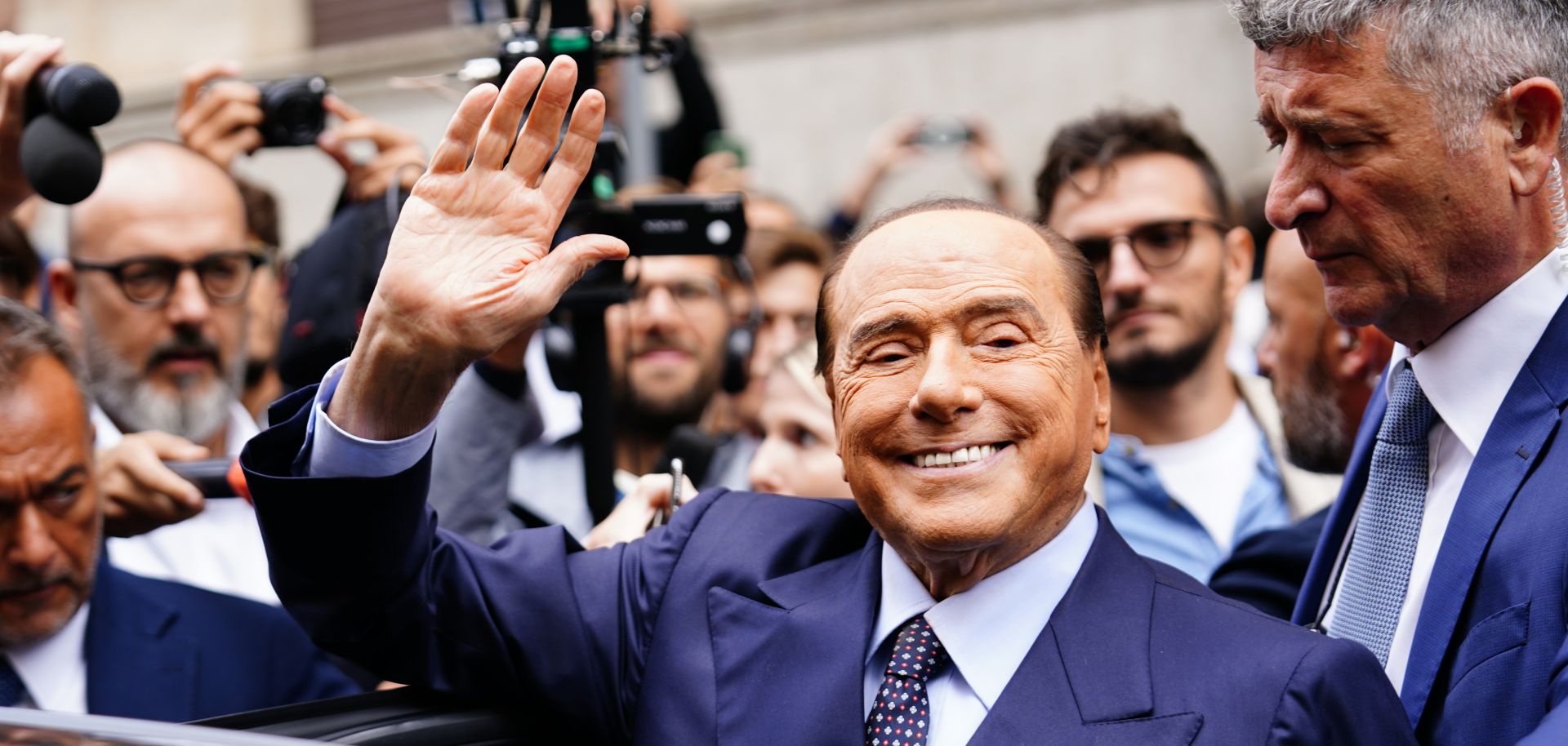
Silvio Berlusconi leaves a polling station after voting in Italy's September 2022 snap election. The former prime minister died on June 12, 2023, at the age of 86.
Silvio Berlusconi was a polarizing figure who lived many lives: media tycoon, successful real-estate developer, owner of the popular Italian football team AC Milan and, most notably, Italy's longest-serving prime minister. His 30-year political career was marred by controversy, scandals and legal battles over various fraud and corruption allegations. But it was also characterized by radical innovations in political strategies and communication, as well as an incredibly loyal support base. While his death marks the end of an era, Berlusconi's complicated legacy will live on through his enduring impact on Italian and European politics.
Berlusconi's Entrance Into Politics
Berlusconi was Italy's longest-serving prime minister in the post-war period, holding the post in three non-consecutive terms for a total of nine years — something unusual in a country like Italy, where governments tend to be short-lived and political allegiances elusive. His entry into Italy's political arena in March 1994 (when his center-right coalition won the general election by a landslide) marked a seismic shift in Italian politics, the final collapse of the country's Cold War-era political landscape and the beginning of Italy's so-called second republic.
Since the end of World War II, Italy's politics had followed a rigid pattern in which the centrist Christian Democrats, a Catholic catch-all party, held a central position in governing coalitions, while the Communist Party consistently found itself in the opposition. When Berlusconi secured his sweeping electoral victory in 1994, the Communist Party (which had already changed name by then) was the only large party that hadn't been disbanded or heavily restructured in the aftermath of the Mani Pulite (Clean Hands) anticorruption investigations in 1992.
On the campaign trail, Berlusconi ran as an anti-establishment candidate under a newly established political movement called Forza Italia that was largely centered around his own charismatic persona. As the owner of four of Italy's largest private television stations, he positioned himself on the campaign trail as a successful businessman who was entering politics to end decades of corruption and mismanagement by professional politicians.
Upon winning the 1994 general election, Berlusconi's Forza Italia then formed a coalition with previously marginalized right-wing parties — like the post-fascist National Alliance and the relatively new Northern League — and introduced a set of political proposals previously unheard of in Italy. For years, socioeconomic policy programs in the country had been gradually shifting toward the left, with all parties across the political spectrum favoring a sizable state role in the economy. But that changed when Berlusconi took office and presented a libertarian platform that pledged to revitalize Italy's stagnant economy through liberalization and market-oriented reforms, drawing heavily from the experiences of U.S. President Ronald Reagan and U.K. Prime Minister Margaret Thatcher.
Berlusconi's free-market policies largely failed to deliver on his promise of economic revival. But his reign nonetheless left a lasting imprint on politics and governance in Italy and elsewhere. Over his three terms in office, Berlusconi created Italy's political center-right by advocating for smaller government and free-market economics, as well as anti-immigration policies and strong law and order, through a unique blend of libertarian, conservative and populist ideologies. He also revolutionized political communication by using his media empire to promote his image, control the narrative and directly engage with his supporters, which enabled him to shape public opinion and maintain a strong connection with his base (but not without creating concerns for democratic values). Berlusconi's style of governance and his success in portraying himself as a wealthy, charismatic outsider challenging the political establishment (and yet connected to the hopes and aspirations of the ordinary citizen) would later serve as a blueprint for other populist movements and leaders in Europe, the United States and elsewhere.
Comebacks and Downfalls
Berlusconi's first term lasted only nine months due to a judicial inquiry for corruption in his business activity, which abruptly forced him to resign in December 1994. He then made a strong comeback in the 2001 general election, where he secured another landslide victory and went on to serve a full five-year term as prime minister — a true rarity in Italian politics.
He was re-elected in 2008, but his term ended three years later at the height of the eurozone's sovereign debt crisis after he failed to implement economic and fiscal reforms needed to shield the country from a crisis that threatened to collapse the entire currency area.
Upon being ousted from office in 2011, Berlusconi's influence on Italian politics then gradually waned as his legal problems eventually caught up with him. Over the years, Berlusconi had survived dozens of trials and even more investigations from Italian prosecutors over the years on charges ranging from embezzlement, corruption, false accounting, illegal party financing and sexual misconduct. But in 2013, he was finally convicted on charges of tax fraud, which stripped him of his seat in Italy's parliament and barred him from holding political office for six years. As soon as those six years were up, however, he made yet another quick comeback in 2019 by being elected as a member of the European Parliament at the age of 82.
Berlusconi's sway over Italian politics gradually faded over the last few years of his political career (and life). But he was nonetheless able to remain relevant by capitalizing on Italy's fraught political landscape and proportional parliamentary system (according to which alliances between several parties are needed to pass legislation). In the midst of the COVID-19 pandemic in February 2021, he backed a national unity government led by former European Central Bank president Mario Draghi, only to withdraw his support in July 2022 in a move coordinated with the right-wing Lega party that triggered snap elections in the fall of the same year. A right-wing landslide victory in September 2022 eventually saw Berlusconi's Forza Italia party become a junior partner in a government led by Prime Minister Giorgia Meloni's far-right Brothers of Italy party.
Berlusconi and Meloni didn't always see eye-to-eye — particularly when it came to Russia's war in Ukraine, where Meloni's firm support for NATO and Kyiv often placed her at odds with Berlusconi, who was a long-time friend of Russian President Vladimir Putin and who blamed Ukraine's president for the ongoing invasion. But despite this, the governing alliance between Forza Italia and the Brothers of Italy remained stable.
The Impact of Berlusconi's Death
In the immediate term, Berlusconi's death will not significantly impact Italy's coalition government or its policy priorities. In fact, if anything, the government will be more internally cohesive when it comes to its support for Ukraine and for sanctions against Russia.
When it comes to Forza Italia, Italian Deputy Prime Minister and Minister of Foreign Affairs Antonio Tajani is the most likely candidate to replace Berlusconi as the party's leader. Tajani — who also served as president of the European Parliament from 2017 to 2019 and as European Commissioner from 2008 to 2014 — is widely seen as a reliable and uncontroversial figure both domestically and abroad. But while Tajani may help with the initial transition to a post-Berlusconi future, Forza Italia's popularity is still set to plummet in the coming years, as a huge part of its appeal was directly tied to its late charismatic founder.
The governing majority seats within parliament are still unlikely to change any time soon. With Berlusconi gone, more Forza Italia members will migrate to Meloni's Brothers of Italy party (which is currently very popular) on top of the large number who have already done so in recent years. Some will also likely switch their allegiances to Lega. But over time, this fragmentation of Forza Italia could weaken the Italian government and threaten its cohesion by fueling infighting within the ruling coalition and complicating the overall policymaking process. Other Forza Italia lawmakers could also eventually decide to join smaller centrist opposition parties (or create new ones), adding to the discord.
The upcoming EU elections in 2024 will offer a first electoral test to determine the speed and scale of Forza Italia's likely downfall at the polls. In the long run, the party will then most likely cease to exist, particularly in light of its dependency on financial and media support from Berlusconi's media companies. While the Berlusconi family has pledged to continue to provide financial support to Forza Italia, this is clearly not a given in the medium-to-long term.
As Berlusconi's party appears unlikely to survive long without him, Meloni's Brothers of Italy — a political heir to the post-fascist National Alliance party that Berlusconi initially partnered with in 1994 — will probably absorb most of Forza Italia's votes (which comprised 8% of the total at the last general election). As Meloni's nationalist party takes over the more centrist political terrain left by Forza Italia, this shift in Italian politics could reverberate across Europe by enabling Brothers of Italy to further consolidate its position as the most powerful far-right party on the Continent at a time when similar parties elsewhere are gaining popularity and entering a growing number of governments — in a way, completing the process of normalizing far-right politics in Italy and Europe that Berlusconi began when he first took office a nearly 30 years ago.
