
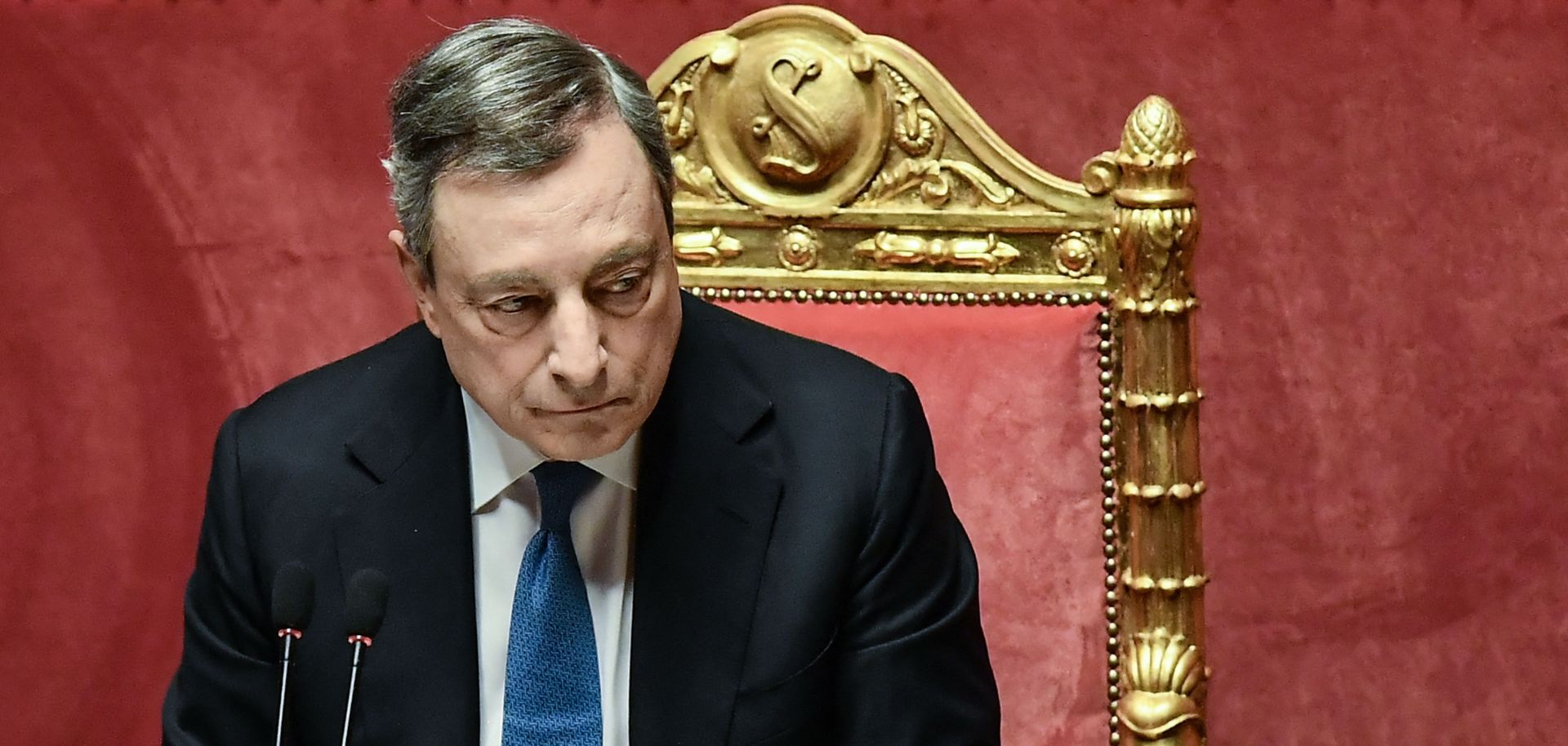
Italian Prime Minister Mario Draghi looks on after addressing lawmakers in Parliament in Rome on June 21, 2022.
Italy has entered a phase of political turbulence that will slow down the pace of economic reform and raise questions about its financial stability, exposing it to an eventual debt crisis. On July 14, Italian Prime Minister Mario Draghi presented his resignation to President Sergio Mattarella, who rejected it and asked Draghi to stay in power. The prime minister’s move was a reaction to a decision by the populist Five Star Movement party (FSM), earlier that day not to participate in a vote of confidence in Draghi’s government connected to a package of stimulus measures to help Italians cope with the cost of living crisis. While Draghi won the vote thanks to support from other political parties, the FSM’s decision virtually put an end to the national unity government that backed Draghi since February 2021. Draghi is scheduled to speak at the Italian Parliament on July 20, when he could ask again for a vote of confidence.
- Draghi, a well-respected former president of the European Central Bank, became prime minister in February 2021 with the main goal of spending billions of euros in grants and loans from the European Union’s COVID-19 relief fund to reinvigorate the Italian economy. His premiership was backed by a heterogeneous coalition of parties including the center-left Democratic Party, the far-right Lega and the populist FSM.
- Italy must hold a general election in the first half of 2023. According to opinion polls, the Lega and the far-right Brothers of Italy party will perform strongly, while support from the FSM is in decline. The FSM’s decision to trigger a political crisis on July 14 is probably part of a strategy to distance itself from Draghi’s government (which, according to the party, does not have an environmental agenda), and try to increase its popularity.
- Italian presidents have largely ceremonial roles in normal times. But during political crises, they become central figures by acting as arbiters between the parties in Parliament and facilitating the dialogue to form governments. Presidents also have the power to dissolve the Parliament and hold early general elections.
Even if Italy manages to avoid an early general election, the government will become increasingly fragile as political parties distance themselves from each other, resulting in higher political volatility. In the coming days, the following scenarios are possible:
- Draghi restores his original coalition. If Draghi convinces the original members of his coalition to continue supporting him, he will likely remain prime minister. But some of the parties, such as the FSM and the Lega, are likely to ask for concessions in exchange for their continued support for the government, which could result in incoherent policymaking. Even this continuity scenario would not completely restore political stability in Italy, as the parties that back Draghi are still likely to trigger new crises in the future to try to improve their popularity as the general election approaches.
- Draghi leads a smaller coalition. If Draghi fails to restore his original coalition, he may still lead a smaller coalition (potentially without the FSM). This scenario would result in a fragile government that would constantly be on the verge of collapse and risk complete policymaking paralysis as it would struggle to win support for its agenda. In this scenario, another government crisis or a second resignation attempt from Draghi is highly likely in the short-to-medium term.
- Parliament appoints a new prime minister. If Draghi fails to restore his original coalition and refuses to lead a smaller coalition, President Mattarella will still try to avoid an early general election and would ask another politician or technocrat to form a government. This scenario is similar to the previous one in the sense that the new prime minister will likely lead a fractured coalition that is prone to instability and infighting.
- Italy holds an early general election. This is the least likely scenario because only Mattarella has the power to dissolve Parliament and call an election. The president will try to avoid this outcome at a time when Italy is facing a cost of living crisis. Many of the parties in Parliament will also be interested in avoiding an election considering Italy’s worsening economic situation and would prefer for Draghi or another technocratic premier to pay the political cost of unpopular reforms. An early general election would prevent Italy from implementing structural reforms, while also raising concerns about a potential far-right and mildly euroskeptic government.
While a debt crisis is unlikely in the short-to-medium term, the combination of low growth, an inefficient government and rising debt-servicing costs could eventually produce one if Rome fails to send reassuring signals to markets. In the coming weeks and months, political turbulence will make it harder for Rome to absorb billions of euros in EU grants and loans, pass legislation to make the economy more competitive, and approve a budget for 2023. This will happen as the European Central Bank’s recent decision to hike interest rates and phase out its bond-purchasing programs will make it more expensive for governments, companies and households in the eurozone to borrow. This combination of a fragile Italian government and higher borrowing costs will raise questions in financial markets about Italy's ability to service its massive sovereign debt (which is close to 3 trillion euros) and generate enough economic growth to reduce its very high debt-to-GDP ratio (which is above 150% of GDP). A debt crisis is improbable in the short-to-medium term because Italy’s borrowing costs are still manageable. But the unique combination of rising political and economic risk in a country with the highest debt levels in absolute terms in the eurozone makes Italy one of the weakest links in the currency area.
- On July 14, the spread between Italy’s 10-year government bonds and their counterparts from Germany (which are seen as the safest in the eurozone) reached the highest level in a month as investors started dumping Italian assets. Separately, Italy’s 10-year government bond yields stood at 3.23% on July 15. While this is still very far from the peaks they reached during the eurozone crisis in the early 2010s, Italy’s borrowing costs are currently three or more times higher than those of countries in northern Europe that investors perceive as safer.
- In June, the ECB said it was working on a plan to use proceeds from maturing bonds in northern European countries to buy debt from southern countries (including Italy) and reduce their borrowing costs. However, the plan has yet to be implemented and, when it does, it will likely come with strings attached because northern European countries are likely to demand fiscal discipline from countries in the south in exchange for the help. A fractious and inefficient Italian government may struggle to meet this conditionality.
