
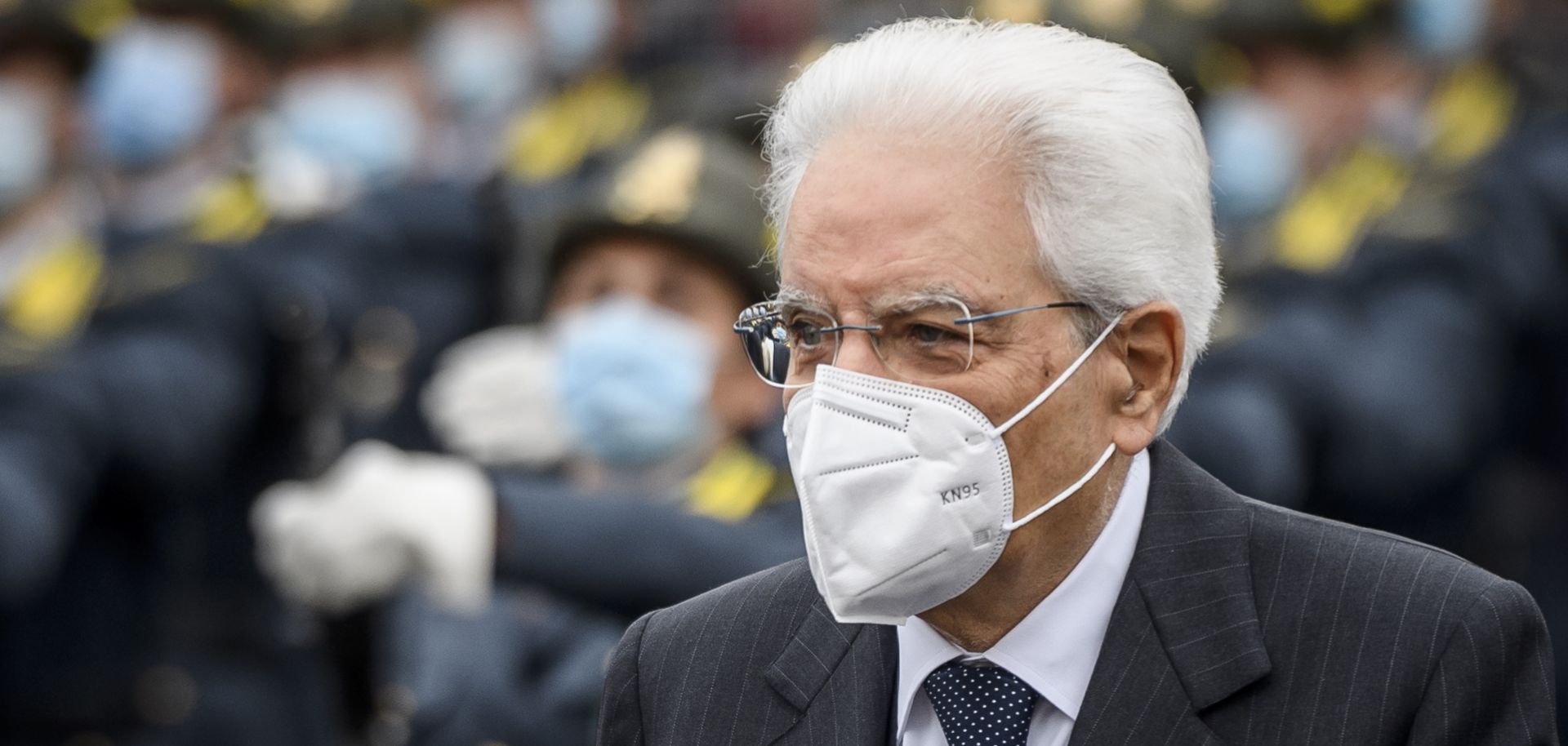
Italian President Sergio Mattarella attends celebrations for Italian National Unity and Armed Forces Day in Rome, Italy, on Nov. 4, 2021.
Sergio Mattarella’s reelection as Italy’s president will avoid a political crisis and give the Italian government several more months of stability to implement institutional and economic reforms. But the government will likely weaken as the 2023 general election approaches, which will reignite fears about Italy’s ability to grow out of its debt. After weeks of speculation and several rounds of voting, Italy’s Parliament reelected Mattarella for a second seven-year presidential term on Jan. 29. Prime Minister Mario Draghi, who had shown interest in becoming president, will now keep his post and Parliament will not have to appoint a successor. This prevents a political crisis since Italian lawmakers would have struggled to appoint a new prime minister, which would have increased the probability of an early general election.
- While the role of the Italian president is mostly ceremonial, it takes the center stage after general elections and during political crises. Presidents organize the negotiations between parties to appoint a prime minister. They also have the power to dissolve Parliament and can veto cabinet positions.
- Mattarella, whose first presidential term ends on Feb. 3, had said several times that he did not want reelection. Draghi, meanwhile, had hinted he was interested in the position. After seven rounds of voting in the Italian Parliament between Jan. 24-29 failed to appoint a winner, representatives from most political parties urged Mattarella to accept a second term.
Draghi’s continuation as prime minister means his diverse coalition government of center-right and -left parties will implement reforms and invest billions of euros from the European Union’s COVID-19 relief fund for most of 2022, which will provide some degree of stability to the eurozone’s third-largest economy. Financial markets and EU officials were worried that Draghi’s appointment as president would jeopardize the disbursement of EU funds in Italy and potentially derail the country’s ongoing process of economic and institutional reforms by triggering a chaotic process to appoint a new prime minister or an early general election. Mattarella’s reelection and Draghi’s confirmation in his post have avoided this scenario, at least temporarily. Draghi’s continuation as prime minister also means that Italy will continue to support France’s push to reform the European Union’s fiscal deficit and sovereign debt rules to make them more flexible. If approved, more flexible rules would open the door to prolonged periods of high public spending in the eurozone, but may also increase market concerns about a new sovereign debt crisis in the currency area.
- Draghi, who is a former head of the European Central Bank, became prime minister in February 2021 with the twin goals of combatting the spread of COVID-19 in Italy and investing the roughly 200 billion euros in grants and loans that the European Commission had allocated to Rome as a part of the bloc’s COVID-19 relief fund. Most parties in Italy’s Parliament back Draghi, but a successor would have struggled to receive the same level of political and social support.
- Over the past year, Draghi’s coalition government implemented a successful vaccination campaign and relatively strict social distancing measures. Rome also introduced reforms to make the judicial system faster and to streamline Italy’s tax system. For 2022 and beyond, Draghi has promised to increase investment in the country’s physical and digital infrastructure, as well as its education system and energy transition.
Political infighting, however, will likely weaken Draghi’s government between late 2022 and early 2023, once again raising questions about Italy’s long-term economic trajectory. In 2020, Italy approved a constitutional reform that will reduce the number of lawmakers in Parliament by a third after the next general election, which is currently scheduled for early 2023. Given that many will lose their seats in the next legislature, current members of Parliament are thus not interested in an early general election. This will be a strong incentive for helping Draghi complete his term, which should bring political stability to Italy for most of the year. However, parties will likely start distancing themselves from Draghi as the date for the 2023 election approaches and they start drafting their campaign platforms. In particular, some lawmakers will likely oppose any potentially unpopular measures, such as tax hikes or spending cuts, or reforms in other areas for political gain in the lead-up to the ballot. This means that by the end of the year, political uncertainty — one of the main reasons behind Italy’s often meager economic growth — is likely to return, along with questions about the sustainability of Rome’s debt.
- The Italian economy has barely grown over the past decade. Italy’s sovereign debt reached 155% of GDP in 2021 — the second-highest in the European Union after Greece in relative terms, and the highest in the bloc in absolute terms.
- Under Draghi, Italy’s GDP rose by 6.5% in 2021, but this came after a contraction of 8.9% in 2020.
