
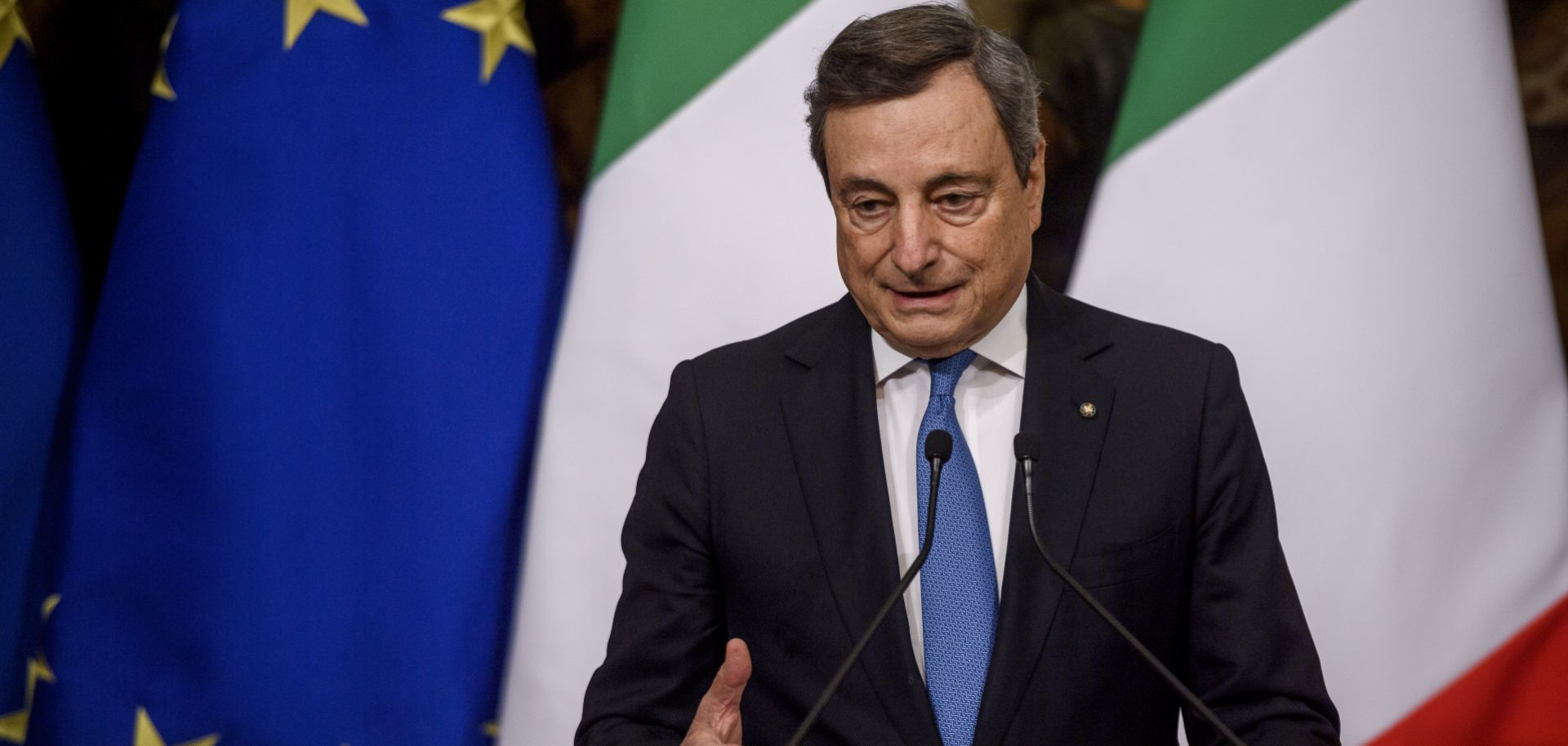
Italian Prime Minister Mario Draghi holds a press conference in Rome, Italy, on Dec. 20, 2021.
Should Italy’s prime minister become the country’s next president in February, political uncertainty could increase and the fate of Italy’s EU funds could be at stake as the Parliament struggles to appoint a successor. Italian President Sergio Mattarella has suggested he will not seek reelection after his term expires in February. In recent weeks, speculation has grown in Italian media that the country’s current prime minister, Mario Draghi, is interested in the presidency. Draghi, the former head of the European Central Bank, currently leads a heterogeneous coalition of center-right and -left parties whose main goal is to implement some 200 billion euros in EU funds to make Italy’s economy more competitive and accelerate the energy transition. Because of his domestic and international prestige, Draghi would probably secure the presidency should he aim for it.
- In January, the members of the Italian Parliament and a group of selected regional representatives will appoint a new president in a secret ballot (the exact date of the vote will be announced on Jan. 4).
- The position of the president is mostly ceremonial in Italy, where the real political power is in the hands of the government. But the role increases significantly during periods of political turmoil because the president is in charge of organizing talks between political parties to appoint a government. Italy’s president also has the power to dissolve Parliament and call an early general election if a political crisis does not end.
If Draghi remains prime minister, Italy will continue implementing economic and institutional reforms during most of 2022, though the pace of reform could slow as the next general election approaches. Should Draghi stay where he is, his government is likely to complete the parliamentary term in February 2023. This would result in a slow but steady process of economic reform and see Italy continue to cooperate with Germany and France in the federalization of the European Union. But for this to happen, center-right and -left forces in the Italian Parliament would need to agree on a compromise candidate for the presidency. A potential problem connected to Draghi remaining as prime minister is that the coalition that currently backs him would probably distance itself from him as the campaign for the February 2023 general election approaches, progressively weakening his government. This would severely slow down the pace of economic and institutional reform in the final months of 2022.
- A compromise solution to allow Draghi to remain as prime minister could involve convincing Mattarella to stay for another term. Another compromise solution would be for the next president to resign early and be succeeded by Draghi at some point in 2023 or 2024.
- Other potential presidential candidates include Justice Minister Marta Cartabia, former president of the Chamber of Deputies Pier Ferdinando Casini and former Prime Minister Romano Prodi. None of these political figures, however, would have the same level of support as Draghi. The center-right has also expressed support for former Prime Minister Silvio Berlusconi, though he’s a controversial figure and there are concerns about Berlusconi’s health.
If Draghi becomes president, appointing a new prime minister could increase political and economic uncertainty in Italy as there are no obvious candidates to replace him. If Draghi becomes president in February, the parties that back his government would need to agree on a new prime minister, which could prove problematic because there are no other Italian politicians who currently command such a degree of consensus. Even if a new prime minister is appointed, there is no guarantee that they will hold the same level of public support and political clout (both domestically and abroad) as Draghi. As a result, this scenario would increase political and economic uncertainty in Italy, especially if it leads to greater fragmentation in Parliament. As president, Draghi would still have a significant degree of influence in Italian politics, which could mitigate the impact of a weaker prime minister. In the case that Draghi becomes president but Parliament fails to appoint a prime minister, an early general election would have to take place. This would slow down the process of economic reform and could derail the investment of Italy’s EU funds, as the new government that emerges from the election may decide to draft new spending plans (which would require EU approval). Moreover, opinion polls suggest that a euroskeptic, right-wing coalition could take over the next Italian government, which would disrupt the current nearly total cooperation between Rome and Brussels. However, lawmakers will seek to avoid holding an early general election at a time when Italy is still dealing with the economic and social repercussions of the COVID-19 pandemic. Political parties are pleased to have a non-politician like Draghi (or a successor with a similar technocratic background) implement unpopular decisions like lockdowns and painful economic reforms. Most parties thus prefer to hold the election as scheduled in February 2023, which will likely compel Parliament to appoint a prime minister if Draghi leaves his current post for the presidency.
