
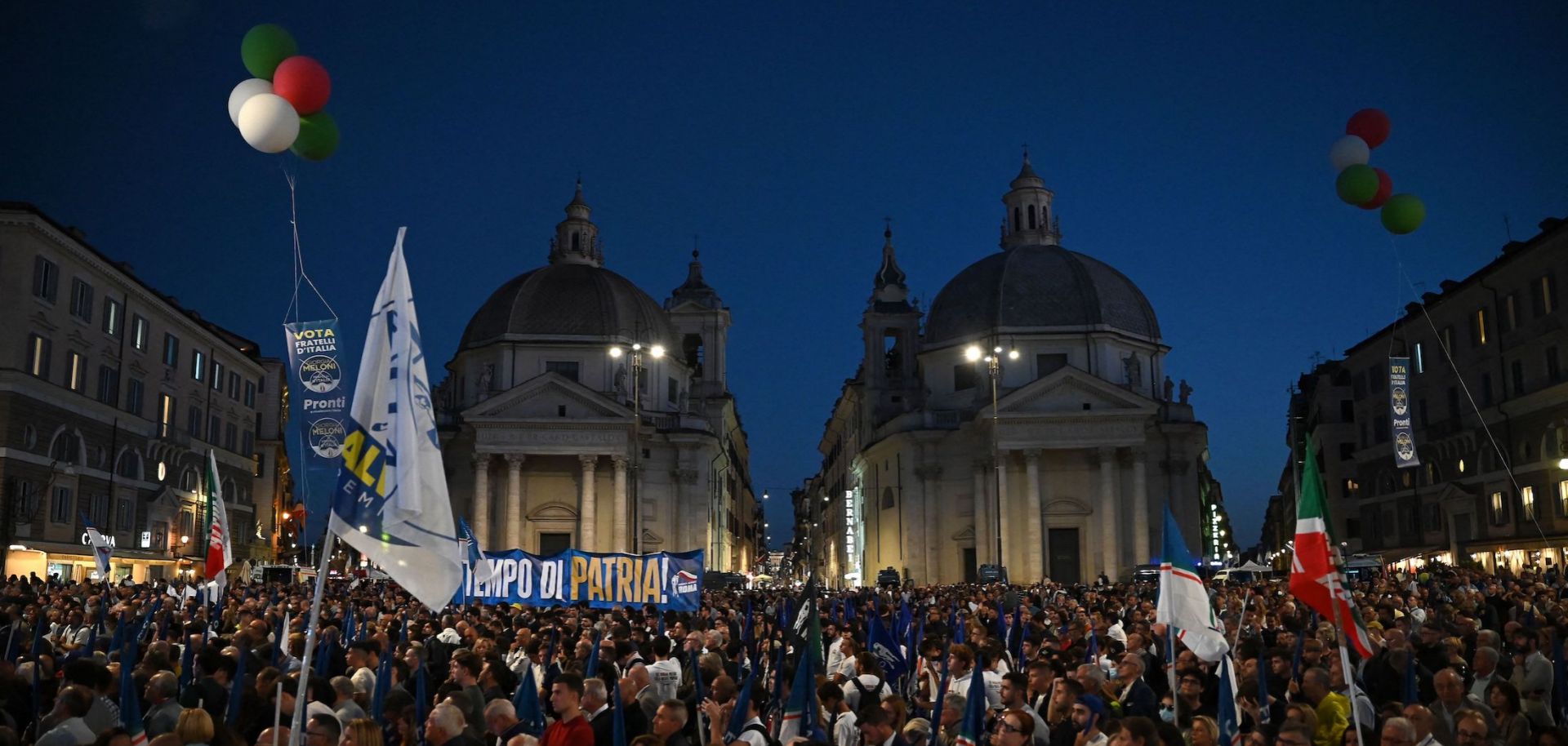
While a right-wing victory in Italy's upcoming elections may make financial markets nervous about Rome's future policies, the new government is unlikely to drastically move away from the current path of reform, even if selective clashes with the European Union are probable. Italy will hold a general election on Sept. 25 in a vote that is expected to see the right-wing Brothers of Italy party led by Giorgia Meloni seizing the premiership, in a coalition with Matteo Salvini's populist Lega and Silvio Berlusconi's center-right Forza Italia. After breaking its alliance with the populist Five Star Movement and failing to secure an alliance with the centrist Third Pole, the center-left coalition led by Enrico Letta's Democratic Party is not expected to win enough seats to defeat the right-wing bloc, which is running under a single ticket. Compared with a Letta-led government, a government led by Meloni and her Brothers of Italy party would see a greater shift away from the policies imposed by the administration of outgoing Prime Minister Mario Draghi. But a combination of political, economic and financial constraints both at home and abroad will still force Rome's next executive not to stray too far from their predecessor's policies, regardless of who wins the upcoming vote.
- A Tecne poll published Sept. 19 projects 252 to 262 out of 400 available seats for the right-wing coalition in the lower house and 125-133 seats out of 200 in the upper house.
- An Ipsos poll for Corriere della Sera published Sept. 7 shows Brothers of Italy leading with 25.1% of preferences, followed by the Democratic Party with 20.5%, the Five Star Movement with 14.5%, Lega with 12.5%, Forza Italia with 8%, and Third Pole with 6.7%.
- Some polls suggest the right-wing coalition between Brothers of Italy, Forza Italia and Lega may even control a two-thirds majority of seats in Parliament, which, at least on paper, would result in the strongest Italian coalition in decades. In reality, however, ideological differences between the members of the coalition and personal electoral calculations between party leaders could still result in some degree of intra-government turbulence despite its oversized majority.
The political turmoil that surrounded the collapse of outgoing Prime Minister Mario Draghi's government exposed the fragility of Italy's economy, forcing candidates to focus on boosting Italy's international credibility during their campaign. The Sept. 25 election is the result of a political crisis that began earlier in the year and put an end to the government led by Draghi, who previously served as president of the European Central Bank (ECB). Italy's national unity government collapsed on July 20 when right-wing lawmakers from Lega and Forza Italia walked away from a confidence vote on Draghi, ending a rare period of political stability in Rome that enabled debt reduction and economic growth. The collapse of Draghi's government generated uneasiness among investors regarding Italy's political future and ability to reform its economy and service its huge public debt. Concerns over Italy's high dependency on Russian gas imports coupled with the ECB's decision to reverse a decade of ultra-loose monetary policy that had so far sustained the country's large debt market have caused investors to wager against Italy, sending borrowing costs up in recent weeks.
- The confidence vote on Draghi was called in the wake of a government crisis triggered by Giuseppe Conte's Five Star Movement that, a week prior, abstained from a crucial parliamentary vote due to disputes with the government over its response to Italy's economic crisis.
- Italian financial markets sold off after Draghi's resignation, sending government bond yields close to the 4% threshold above at which the debt ratio would remain stable.
- The total value of Italy's bonds borrowed by investors betting on a fall in prices in the country (a build-up in short positions against Italy) reached over 39 billion euros — the highest level since the 2008 financial crisis in August.
- Italy's public debt amounts to around 150% of GDP, while the outlook for growth has weakened due to soaring energy prices, rising inflation and tighter financial conditions.
- A paper published by the International Monetary Fund in July estimates the impact of an eventual full Russian natural gas shut-off would lead to an aggregate GDP loss of about 3.7% between 2022-23 for Italy, given the country's high reliance on natural gas for electricity production.
In recent months, nationalist premier candidate Meloni has moderated some of the positions of her Brothers of Italy party, committing to economic and fiscal prudence and affirming Italy's geopolitical alignment with the West. Given Italy's fragile economic and fiscal position, along with the worsening global economic climate brought by the war in Ukraine, both Meloni and her center-left rival, Enrico Letta, had to campaign on a mix of promises to address the country's cost of living crisis and reassurances to international audiences about fiscal responsibility. Despite Meloni's statements about greater state intervention, promises of expansionary fiscal policies, and a history of Euroskeptism among members of both her Brothers of Italy party and its coalition partners (Lega and Forza Italia), a right-wing government is thus likely to prioritize international credibility once in office, at least in the short-to-medium term.
- Meloni and Letta have both held campaign speeches in multiple foreign languages, highlighting the outsized attention the two candidates' campaigns are giving international audiences.
- Meloni confirmed on Sept. 4 that she would not be in favor of ''widening the budget deficit because [Italy is] way too indebted,'' adding that supporting Western sanctions against Russia amid the ongoing war in Ukraine was needed to maintain Italy's ''international credibility.''
Despite electoral promises of expansionary fiscal policies, the policy options of Italy's likely new right-wing government will be limited by political and economic constraints. On the campaign trail, the right-wing coalition between Brothers of Italy, Forza Italia and Lega have proposed several expansionary fiscal policies, including introducing a flat tax, increasing pension benefits, lowering Italy's retirement age, and enacting a possible tax amnesty. However, if the coalition wins the general election as expected, these overly ambitious proposals would likely be significantly watered down at the implementation stage or abandoned altogether due to various political, economic and financial constraints. On the other hand, to offset the cost of any new measures it does indeed decide to pursue, a new right-wing government would likely scale back some of the policies introduced by previous administrations (such as the monthly ''citizens income'' for unemployed Italian citizens, which cost the Italian state almost 20 billion euros between 2019 and 2021) — thereby limiting the overall impact on public spending.
- Both populist Lega and center-right Forza Italia have strong ties with Italy's economic elites, particularly in the northern industrial powerhouse, which will deter them from pushing for any policies that could severely damage financial markets' confidence in the sustainability of Italy's debt or risk a financial crisis that may take the country out of the eurozone. And while Brothers of Italy remains a nationalist party, in recent years it has attracted voters and party members from the more centrist Forza Italia, which has led to the assimilation of more moderate views into the party's base.
- With public debt set to remain high over the coming years and given 10-year government bonds at around 4% coupled with a weak economic growth outlook, fiscal space for Italy's next government will also remain very limited. This means that the next government in Rome is unlikely to cut taxes or increase spending so much that state revenue would markedly decrease markedly without fiscal policy adjustments elsewhere.
The need to access billions of euros in EU funding and fears of a debt crisis will probably prevent the new Italian government from drastically modifying the reform agenda that Rome agreed with Brussels. Even if a nationalist government is formed, Rome will remain interested in receiving the 192 billion euros from the European Union's COVID-19 recovery fund that Italy is set to receive through 2026. This will strongly incentivize the new government to follow through with the implementation of the reforms that Draghi's administration promised to Brussels in 2021, upon which funds are conditional. While the right-wing coalition led by Meloni's Brothers of Italy party has called for some revisions to Italy's recovery program to fund measures aimed at easing the energy crisis, it has ruled out a complete overhaul of the EU-approved plan. In addition, the evolution of yields on Italian government bonds will continue to dictate Rome's policy decisions. ECB intervention in sovereign bond markets to assist Italy in case of a spike in borrowing costs would only be possible if the government sticks to prudent fiscal policies, which will further compel Rome to avoid any policies that could derail its reform plans.
- Italy is receiving the biggest chunk of the European Union's COVID-19 recovery funds, consisting of 192 billion euros in cheap loans and grants (equivalent to almost 10% of the country's GDP). Receiving such funds is conditional on Italy enacting a series of structural reforms approved by Brussels in 2021 and partially implemented during the Draghi administration.
- The ECB's new Transmission Protection Instrument (TPI) bond-buying program is meant to prevent eurozone countries' bond yields from increasing beyond what is justified by economic fundamentals and diverging too much from one another, which could tip them into a financial crisis. The scheme is attached with conditions designed to prevent it from encouraging fiscal lassitude. To be eligible, EU countries must meet four criteria: compliance with the European Union fiscal framework; no severe macroeconomic imbalances; sustainable public finances; and ''sound and sustainable'' macroeconomic policies.
Compared with its predecessor, however, a new right-wing government led by Meloni would likely take a more protectionist approach to key sectors of Italy's economy, which could still prevent the full implementation of some reforms and potentially lead to legal disputes with the European Union. A government led by Meloni may prove reluctant to fully open up closed sectors of the Italian economy — including tourist beach concessions and taxi drivers — to international competition by organizing public tenders in compliance with EU law, which was a key reform demanded by Brussels to receive recovery funds. In fact, Brothers of Italy lawmakers had opposed the measure approved under Draghi's government, and Meloni may refrain from fully and/or timely implementing the law once in office. As for industrial policy, a new right-wing government would also likely not shy away from state intervention by, for example, bailing out struggling national large firms, tightening regulation for foreign investment, or buying controlling stakes in companies running critical infrastructure. This could cause attrition with EU competition laws and trigger infringement procedures from the European Union, which could eventually result in financial sanctions against Rome.
- Meloni avoided taking an explicit position during her campaign on single cases but has called in the past for the state to retain ownership, for instance, of Italy's struggling airline Alitalia (now ITA Airways) and broadband network owner Telecom Italia (now majority-owned by French group Vivendi).
- The right-wing coalition's program also includes a requirement for non-EU businesses to file a bank guarantee before investing in the country and the extension of a mechanism that allows the Italian government to exert extra supervision on (or even veto) foreign investment (including from EU countries) concerning ''strategic'' industrial sectors. The mechanism is supposed to expire on Dec. 31, but Meloni is proposing to extend it for at least another year.
The new government will remain committed to supporting Ukraine and Western sanctions against Russia but may selectively challenge the European Union on migration and social policies. During the electoral campaign, Meloni has taken a clear pro-NATO stance and pledged to continue supporting Ukraine and sanctioning Russia. However, Meloni's junior coalition partners — and in particular, Lega leader Salvini — have been more critical of sanctions against Russia and have taken pro-Moscow positions in the past. This means that while a right-wing government is likely to support the continuation of the European Union's current policy on Russia, Rome may struggle to support any significant expansion of the current sanction regime that could hurt Italy economically. In addition, while a right-wing government will not try to take Italy out of the European Union or the eurozone, it will be willing to take unilateral action on issues such as migration and social policy to meet expectations from its voting base. This may lead to tensions between Italy and EU institutions, but it is unlikely to result in any concrete disciplinary action against Rome as these issues are receiving significantly less attention in the wake of the invasion of Ukraine.
- In the opposition, Meloni's Brothers of Italy party has consistently backed Italy's military support to the Ukrainian government under outgoing Prime Minister Draghi, as well as the overall EU and NATO response to Russia's invasion of Ukraine.
- Relations could still deteriorate between a right-wing government and the country's EU partners given coalition members' strong populist tendencies, particularly on issues such as immigration and social policy, as well as on the bloc's common budget rules. The likelihood of this increases if Italy's public opinion becomes less pro-European amid the country's worsening energy and economic crises.
