
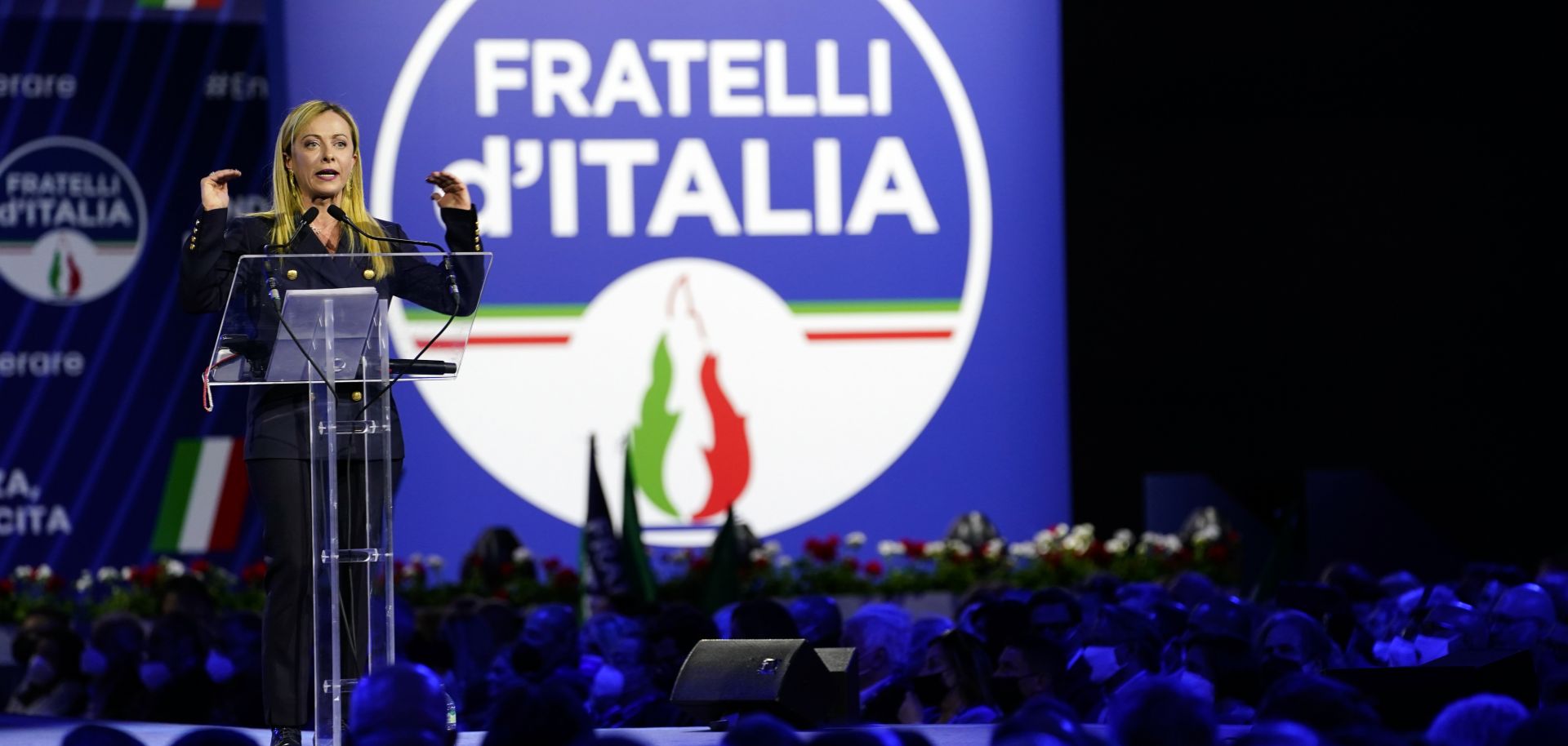
Giorgia Meloni, the leader of the right-wing Brothers of Italy (Fratelli d’Italia) party, gives a speech at a political rally in Milan on April 29, 2022.
The far-right’s expected victory in Italy’s upcoming early election is increasing uncertainty over the country’s political and economic outlook. However, a new right-wing government is unlikely to diverge completely from its predecessor’s foreign and economic policies. Italy will hold an early general election on Sept. 25 after President Sergio Mattarella accepted Prime Minister Mario Draghi’s resignation and formally dissolved parliament on July 21. Draghi’s resignation, which happened after most of the parties backing his premiership withdrew their support for his government, coupled with the European Central Bank (ECB)'s same-day decision to lift its deposit rate by 50 basis points, led to a selloff in Italian bonds and stocks. The ECB also recently announced a new bond purchase scheme to tackle rising government bond spreads in the eurozone, which has somewhat tempered the rise in Italian 10-year government bond yields. However, market reactions in recent weeks signal an overall uneasiness regarding Italy’s political future.
- Draghi first offered his resignation on July 14 after a coalition partner, the populist 5-Star Movement, abstained from a confidence vote in support of Draghi’s government due to disputes over how to respond to Italy’s economic crisis. Mattarella rejected Draghi’s first resignation, asking him to remain in power and appeal to parliament for unity. Draghi's coalition ultimately fell apart on July 20, when three of his main partners (5-Star, along with the right-wing League and Forza Italia parties) boycotted a confidence vote he had called to try to restore the cross-party alliance.
- The new government crisis led to a selloff in Italian bonds and stocks, with Italian 10-year government bond yields rising by more than 20 basis points to 3.7% on July 21. This, however, was partially offset by the ECB’s announcement on rate hikes and a new anti-spread facility, after which Italian bond yields were still lower than the above 4% levels they had reached in June.
Polls suggest that the center-left Democratic Party and the far-right Brothers of Italy party will both perform strongly in the general election. But the latter’s alliance with other right-wing parties increases its chance of forming a government. Draghi’s government essentially collapsed due to strategic calculations from party leaders for a new electoral campaign after local elections in June confirmed that the 5-Star and League parties were losing support to the Democratic Party and Brothers of Italy (the latter of which was the only large party in Italy that had not joined the ruling coalition). In the September election, voters may punish the 5-Star and League parties for bringing about the collapse of Draghi’s government. The Democratic Party, for its part, will seek to capitalize on its unfaltering support for Draghi and campaign on a promise of continuity with the outgoing government’s policies. Brothers of Italy, meanwhile, will benefit from having remained the only major political force in the opposition. In the upcoming election, the Brothers of Italy, League and Forza Italia will run united as an alliance, which is currently projected to win around 60% of the seats in the next parliament. If, as the latest polls suggest, Brothers of Italy gains the most votes within the coalition, the party’s leader Giorgia Meloni would likely become Italy’s new prime minister. But regardless of who’s in charge, Italy’s next government will still be greatly constrained by soaring inflation, rising borrowing costs and growing energy supply disruptions — all of which are being driven by external factors largely out of Rome’s control.
- The Brothers of Italy is currently projected to secure 24% of the vote in the September general election, followed by the Democratic Party at 22% and the League at 14%. 5-Star and Forza Italia are expected to capture only about 11% and 7% of the vote, respectively.
- The alliance between the Brothers of Italy, League and Forza Italia is positioned to win a comfortable majority in Italy’s parliament, according to an election simulation recently conducted by the YouTrend and Cattaneo Zanetto & Co polling forms. The simulation saw the right-wing bloc winning up to 221 seats in the 400-member lower house and 108 seats in the 200-member upper house, which is enough to form a government.
The prospect of a far-right victory will lead to further turbulence in debt markets by casting doubt on the future of Draghi’s economic reforms. But a Brothers of Italy-led government would likely still maintain some policy continuity to avoid further rattling markets and jeopardizing Rome’s access to EU funds. In its almost 18 months in power, Draghi’s government managed to stabilize the Italian economy, sign supply deals with several gas exporters to diversify away from Russia, and carry out long-overdue structural reforms — all while keeping debt on a downward path. Draghi’s resignation, however, has left Italy without a fully functioning government for the next two months until elections are held. This will severely hamper Rome’s ability to continue implementing those crucial reforms at a time when Italy is facing an economic slowdown and a looming energy crisis, as well as market turbulence characterized by lower confidence and rising borrowing costs. Investors’ concerns about Italy's fiscal sustainability will only deepen if the September election yields a new government led by the far-right Brothers of Italy party, which has pledged to impose expensive measures like tax cuts that risk driving Italy deeper into debt. After taking office, however, a Brothers of Italy-led executive would most likely hurry to boost its credibility with political pragmatism. To that end, its first priority would be approving a new budget law before the end of the year. The new government would likely also seek to quickly resume Draghi’s reforms to secure the next 21.8 billion tranche of EU recovery funds. Early elections and the formation of a new executive, however, may still delay Rome’s ability to deliver policies and reforms in the near term. The Brothers of Italy, League and Forza Italia have also all pledged to implement fiscal relief efforts aimed at helping Italians battle the rising cost of living. But their ability to fulfill those promises will be limited by the reality of Italy’s tight public finances. Finding the funding for the expensive new measures proposed by the right-wing parties (like major tax cuts and pension increases) would likely see the new government scale back previous policies, such as the 5-Star’s “citizens income” — thus limiting the overall impact on public spending.
- Migration is the main policy area where Brothers of Italy leader Giorgia Meloni would be most likely to reflect her party’s nationalist and identitarian roots as Italy’s new prime minister, probably resulting in restrictive immigration policies like the ones adopted by League leader Matteo Salvini during his tenure as interior minister in 2018-19.
- The European Commission’s latest macroeconomic forecast for Italy sees GDP growth significantly slowing down in the fourth quarter of 2022, as the economy is hit by the ongoing war in Ukraine. Growth is projected at 2.9% in 2022, supported by a strong recovery from the pandemic, but only 0.9% in 2023.
- Spreads between Italian 10-year government bonds (BTPs) and 10-year German bonds reached 2.53% in May 2018, when a populist and eurosceptic coalition between the League and 5-Star parties took power in Rome — up from 1.22% in April before a new government was announced.
While a right-wing government is likely to clash with the European Union and disrupt the bloc’s policymaking process, Rome will not seek to exit the eurozone or drastically change its policy vis-a-vis Russia or NATO. The Brothers of Italy, League and (to a lesser extent) Forza Italia all have eurosceptic positions that see the bloc as an alliance between sovereign nation-states. This means that if they are in charge, Rome is likely to selectively challenge Brussels’ plans to deepen economic and political integration in the European Union, and will threaten to act unilaterally if it disagrees with the European Commission. However, the three parties’ links with Italy’s economic establishment mean that Rome is unlikely to take any measures that would jeopardize its membership in the European Union or the eurozone (in fact, both the League and Brothers of Italy have abandoned their threats to exit the European Union). The measures promised by the right-wing parties also portend increased public spending. This will likely see Rome step up efforts to negotiate new debt and deficit rules for the euro area, looking to revamp its partnership with France on this front. Finally, a right-wing government will likely reassure Italy’s allies that it will not deviate from Draghi’s strong stance against Russia’s invasion of Ukraine. Meloni has been careful to position herself as firmly pro-NATO and -Ukraine despite her coalition partners, Salvini and Berlusconi, expressing more pro-Russia views.
- Italy’s approach to anti-Russia policies over its invasion of Ukraine may still change once war fatigue fully sets in this winter, which could be further exacerbated by a complete cutoff of Russian natural gas supplies to the European Union.
- It will take time for Meloni to eclipse her traditional eurosceptic positions. If elected, her new administration would probably take office by November at the earliest. Until then and (likely for short while after), Italy will remain lodged in a period of sustained political instability at a time of mounting economic instability.
