
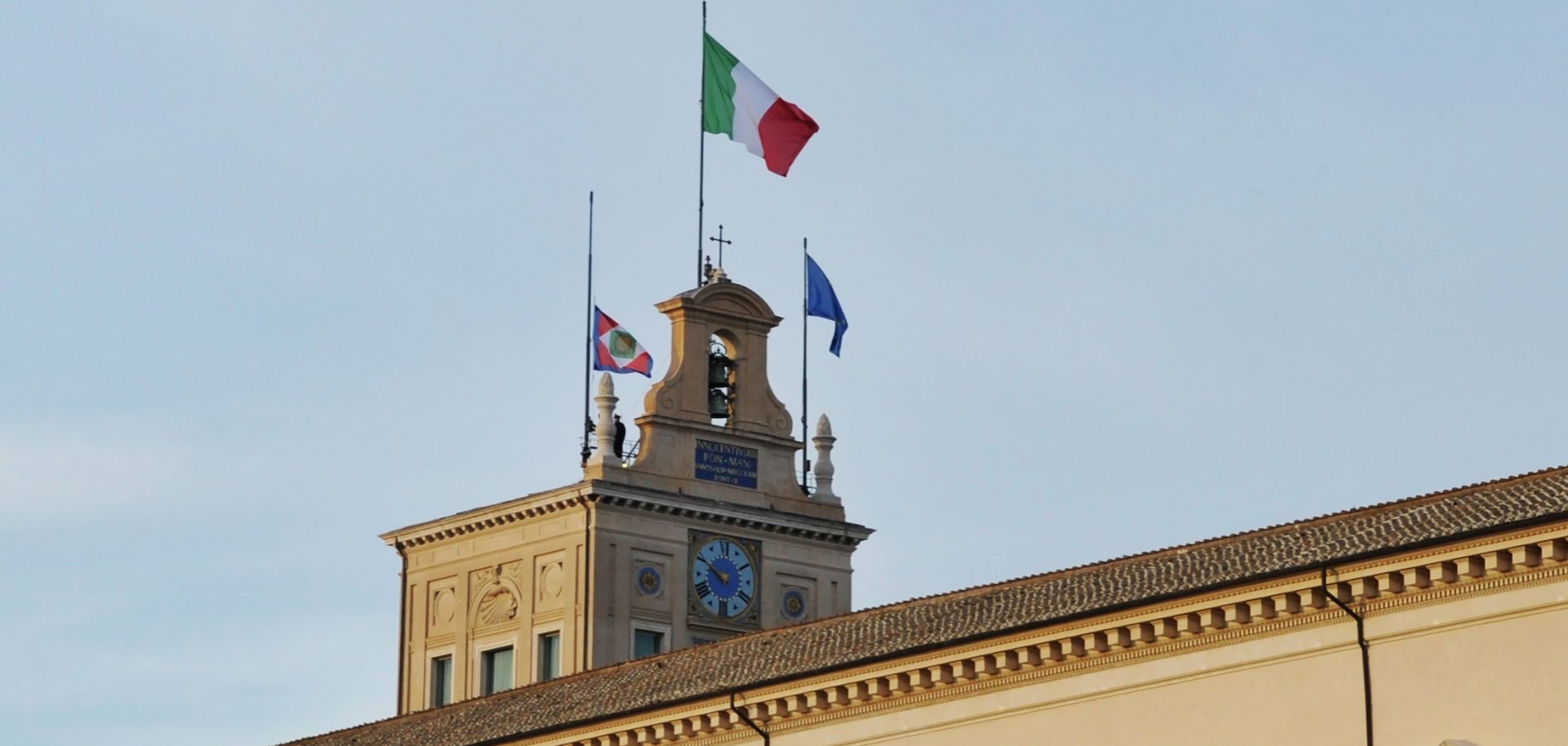
A photo taken on Feb. 3, 2022, shows flags being raised outside the Quirinale in Rome, Italy, for the arrival of newly re-elected Italian President Sergio Mattarella.
In Italy, the strong performance of right-wing parties in the first round of municipal elections confirms a trend that could define the 2023 national election and increase economic and political risk in the country. Right-wing parties emerged as the main winners in the first round of local elections on June 12 in 981 municipalities across Italy, including in 26 provincial and regional capitals. The coalition that includes the right-wing Brothers of Italy and Lega parties surpassed the threshold needed to elect a mayor in the first round in three out of six major cities (Genoa, Palermo and L’Aquila). Ahead of the June 26 runoff, the center-left alliance has gained a majority in Parma and Verona, while the center-right coalition is leading in Catanzaro. Overall, 13 cities will elect their majors in the second round. The total vote count across the country saw Brothers of Italy and the center-left Democratic Party gain most of the preferences, while Lega and especially the Five Star Movement (a formerly anti-establishment force that has been trying to reinvent itself as a center-left party) lost ground compared to the 2017 local elections. A national referendum concerning changes to the country’s justice system was held alongside the local elections but failed to reach the 50% threshold needed for the result to be valid.
- Local elections were characterized by a low turnout, with only 54% of Italians going to the polls to elect their mayors, compared to 61% in 2017.
- The referendum saw an even lower turnout, with only 20.9% of eligible voters expressing their opinion on the five referendum questions.
The local elections confirmed the lead of the right-wing bloc and of the Brothers of Italy party within it, but also highlighted inter-coalition tensions that could hamper right-wing unity ahead of the 2023 national vote. The votes marked the last major electoral test before the national parliamentary election scheduled for 2023. According to the most recent polls, the right-wing coalition is supported by more than 40% of voters at the national level. Brothers of Italy, which is the only major party not to be part of Prime Minister Mario Draghi's national unity government, is currently polling as the leading party within the right-wing bloc at around 22%. The right-wing coalition has proven to be particularly successful when running united, but the results in the first round of the local elections illustrate the balance of power has shifted also within the right-wing bloc. Brothers of Italy have overcome Lega as the first party within the coalition — even in the northern regions, Lega’s historic strongholds. This could lead to increased tensions between the two parties’ respective leaders, Matteo Salvini and Giorgia Meloni, as Meloni seeks to confirm her position as the alliance’s leader and as Salvini's popularity continues to decline in opinion surveys. Salvini has also suffered a significant political defeat as the referendum he had championed generated the lowest ever turnout in Italy. As a result, while Brothers of Italy’s leader Meloni is currently the most likely candidate to lead a right-wing government in 2023, this may change if her relationship with Salvini deteriorates further prior to the vote, which could complicate forming functioning alliances in parliament after the election.
- The Democratic Party, polling at around 21% at the national level, is the only government force to have remained solid in polls, with the Five Star Movement and Lega losing support for having compromised on some of their positions as part of Draghi’s government.
- The Five Star Movement has lost ground across all municipalities compared with the previous local elections. This, however, only partially reflects its overall support in the country as the party tends to perform worse in local elections than in national votes.
- Brothers of Italy has seen its popularity grow in recent years, due largely to the party’s decision not to join government coalitions.
- Prior to the vote, Salvini accused Meloni of trying to divide the coalition by choosing to run alone in several northern municipalities.
A victory by the right-wing coalition in the 2023 election would raise political and economic risk in Italy by increasing uncertainty over policy direction, as the new government may selectively challenge EU policy and privilege unilateral action. The final months of Draghi’s government in the lead-up to the election will likely be characterized by ungovernability, as some of his coalition partners may be less willing to compromise as the national vote approaches. Italy’s next government is unlikely to completely overturn Draghi’s recent policies and reforms. But nationalism, anti-immigration sentiments and euroskepticism will feature prominently in the right-wing parties’ campaigns. A Meloni/Salvini-led government may also prove to be a challenge for EU unity, as well as Italy’s economic stability in the form of likely fiscal loosening, anti-reform stances and a protectionist attitude toward foreign investment. Moreover, while in a prospective coalition government Brothers of Italy will inevitably have to soften some of its stances in order to accommodate different sensitivities within the right-wing spectrum, the party will still stick to at least some of its key priorities — most likely adopting stricter immigration policies and, possibly, more unilateral action at the EU level. Finally, the local elections highlight how Italy’s current government is resting on weak foundations. The final months of Draghi’s premiership will likely be characterized by ungovernability (which is not an uncommon scenario for Italy) as some of his coalition partners will attempt to regain right-wing voters’ support prior to the national vote. Should Draghi fail to complete his reform agenda before the end of his government’s term, particularly key reforms related to pensions and justice, it is unlikely a right-wing government would show a similar level of commitment to the implementation of structural reforms long sought by the European Union.
- Only a week after the local vote certified the party’s fall in approval ratings, there is widespread speculation that former prime minister and leader of the Five Star Movement Giuseppe Conte may pull his party out of Mario Draghi’s ruling coalition over internal divisions on government support for Ukraine, in an effort to halt the movement’s slide in opinion polls. While this would not deprive Draghi of a majority in both chambers, it may still cause instability by fundamentally changing the balance of power within the government coalition.
- Italy is currently battling slowing economic growth, soaring inflation, high government debt and rising borrowing costs. Within this context, a likely future right-wing coalition government formed by Brothers of Italy, Forza Italia and Lega may (at least initially) spook investors and upset markets, raising doubts over the country’s debt sustainability and fears of a new Eurozone debt crisis.
- At the EU level, a new right-wing Italian government may try to take a more assertive position building on the alliance with similar euroskeptic forces, such as Hungary’s Fidesz party and Poland’s Law and Justice party.
