
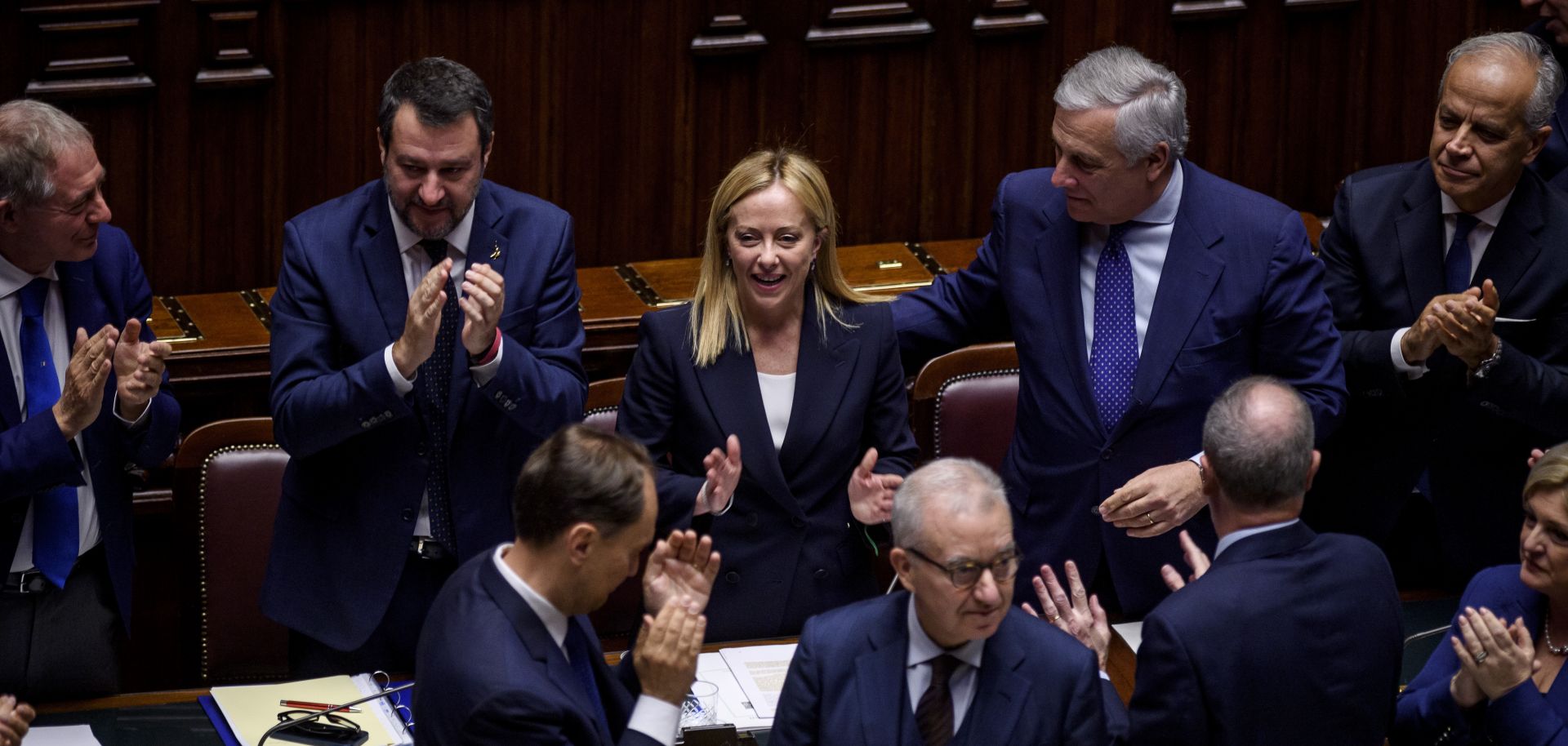
Italian Prime Minister Giorgia Meloni and members of her newly appointed cabinet attend a debate in Italy’s Chamber of Deputies ahead of the confidence vote on the new government on Oct. 25, 2022.
While more protectionist, Italy's new government will largely remain on the path of economic reform, fiscal prudence, and support for sanctions against Russia set out by outgoing Prime Minister Mario Draghi. Political instability is likely to increase after the winter as intra-coalition rivalries emerge and the popularity of the country's new prime minister starts waning. Italy's new right-wing government led by Prime Minister Giorgia Meloni was sworn in on Oct. 22 following weeks of negotiations between coalition parties to assign key cabinet positions. Her team, unveiled on Oct. 21, includes nine ministers from her far-right Brothers of Italy party, five ministers from each coalition partner (the right-wing Lega and Forza Italia parties), and various technocratic figures.
- Giancarlo Giorgetti has been appointed finance minister. Georgetti is a moderate and relatively pro-European member of Lega and previously served as industry minister under Mario Draghi's outgoing government. He is close to Italy's financial and industrial elites, and pushed for the use of the country's so-called Golden Powers rules — a special regime that allows the Italian government to apply conditions on, or veto, foreign investments in strategic sectors of the economy — against a number of Chinese takeover bids under Draghi's government.
- Antonio Tajani has been appointed foreign minister. Tajani is a dovish pro-European member of Forza Italia. He served as president of the European Parliament between 2017 and 2019 and as European Commissioner, first for transport and then for industry, between 2008 and 2014.
- Matteo Piantedosi has been appointed interior minister. Piantedosi is a former civil servant with no party affiliation. He remains a close ally of Lega leader Matteo Salvini after serving as his chief of staff when Salvini led Italy's interior ministry in 2018-19.
- Guido Crosetto has been appointed defense minister. Crosetto is the co-founder of Brothers of Italy and head of the aerospace and defense lobby AIAD.
- Lega leader Salvini has been appointed infrastructure minister, where he'll oversee the largest chunk of Italy's National Recovery and Resilience Plan (which totals 40.4 billion euros of EU funds in addition to the 21 billion euros from Italy's National Complementary Fund).
- Adolfo Urso has been appointed industry minister. Urso is a member of Brothers of Italy and served as president of COPASIR — an influential parliamentary committee on national security — during the last parliamentary term, where he advocated for a strengthening of Italy's Golden Powers rules.
- Maria Roccella has been appointed minister of family, birthrates and equal opportunities. A Brothers of Italy member, Roccella is a staunch defender of ''traditional family'' values and is firmly against abortion and LGBTQ rights.
The new government's composition confirms that Rome will seek to preserve international credibility while simultaneously pursuing limited protectionist economic policies. The decision to appoint Giorgetti, already minister under Draghi's government, as finance minister suggests continuity with the previous administration on budget and key economic reforms to secure EU funds. Nevertheless, a more protectionist approach to industrial and agricultural policies, as well as foreign investments (especially those from China) — can be expected. A moderate, gradual expansion of military and security spending is also likely under the leadership of newly appointed defense minister Crosetto, who will probably seek greater collaboration with Italy's own defense industrial base wherever possible. Foreign Minister Tajani will likely attempt to negotiate minor changes to the country's plan for using its share of EU recovery funds to allow for some tweaks on spending priorities. In separate negotiations in Brussels, Tajani will likely also seek to create a common front with France and other EU member states to push for a new EU fund to finance energy relief support, as well as revise the bloc's common budget rules to allow for more flexible fiscal targets. When it comes to energy, the new government in Rome will continue efforts to further diversify supply, seeking new bilateral supply deals while increasing the country's import and regasification capacity for liquefied natural gas (LNG) through infrastructure development. And in regards to immigration, the right-wing coalition will likely enact more restrictive rules (with Libya remaining the main focus abroad to contrast illegal immigration at the source), but the new government will likely avoid repeating Salvini's hard-line approach in 2018-19 in order to maintain good relations with the European Union.
- On Oct. 23, Crosetto told the Italian newspaper Repubblica that, if necessary, the new government would invoke Italy's ''Golden Power'' law to veto foreign investments.
- On Oct. 21, Tajani said that his first act as Italy's new foreign minister will be to call his Ukrainian counterpart and assure him of Italy's continued support amid Russia's ongoing war against Ukraine.
Same Ministries, New Names (and Priorities)
Meloni's renaming of some ministries also signals her government's future policy priorities. The country's Ministry of Economic Development has been rebranded as ''The Ministry of Companies and Made in Italy,'' while the Ministry of Agriculture has been rebranded as ''The Ministry of Agriculture and Food Sovereignty'' — highlighting a likely more protectionist turn under the new government. Italy's Ministry of Ecologic Transition, meanwhile, has been renamed as ''The Ministry for Energy Security,'' which indicates the new government will likely prioritize the more immediate need of securing Italy's energy supplies — even if it comes at the cost of delaying the country's longer-term carbon-cutting goals and transition to clean energy.
Italy's new government will prioritize financial and economic stability while balancing between electoral promises and commitments taken by the previous government. The new government's most immediate priorities will be addressing the country's high inflation and soaring energy bills, as well as drafting a budget law for 2023 (which is expected to see a marginal increase in the budget deficit from the previous government's projections). Many of the several expansionary fiscal policies the coalition partners promised on the campaign trail (including the implementation of a flat tax, increased pension benefits, a lower retirement age and a tax amnesty) will likely be watered down at the implementation stage, offset by policy adjustments elsewhere or abandoned altogether due to a very limited fiscal space for the new government — thereby limiting the overall impact on public spending. The Meloni administration's second most urgent priority will be unlocking the next 19 billion euro tranche of EU recovery funds, which is contingent on Italy achieving 55 policy objectives (21 of which were already achieved by Draghi's outgoing government) by the end of 2022. To ensure it secures that much-needed funding from the European Union, the new government is unlikely to depart from the set of reforms already approved by Brussels under Draghi's premiership. Finally, the coalition will also have to accelerate work for a new LNG terminal to be set up in the port of Piombino, Tuscany, with the goal of having it operational by the end of March 2023.
- Former Prime Minister Draghi allocated 66 billion euros in 2022 for tax breaks and subsidies to support energy-intensive firms and low-income households facing soaring energy bills; these aid measures are due to expire in November.
- Under Draghi, the Italian Treasury in September projected Italy's budget deficit to reach 3.4% of GDP in 2023, down from a previous 3.9% target announced in April. To fund new relief measures, the Meloni administration will likely either restore the April deficit target or slightly increase it.
- A $400 million investment plan for the Piombino terminal is part of a wider strategy designed by Draghi's government for Italy to phase out Russian gas supplies.
Internal disputes within Italy's new government are likely, particularly on sanctions against Russia and military support for Ukraine. But the urgency of the country's energy crisis and the need for financial stability will probably prevent any major political crises until at least the spring. Frictions within the government coalition that first emerged during the electoral campaign were confirmed during negotiations to assign key cabinet positions in the weeks following the Sept. 25 election. In the coming months, the most likely point of friction will concern the country's military support for Ukraine and sanctions against Russia. Salvini has criticized sanctions against Russia for negatively impacting Italy's economy while Berlusconi, a long-time personal friend of Russian President Vladimir Putin, has recently accused Ukrainian President Volodymyr Zelensky of triggering the war. While Prime Minister Meloni has explicitly promised that her government will continue to support EU sanctions, she may struggle to keep the coalition united on sanctions against Russia, particularly as war fatigue becomes more prominent over the winter months. Members of the ruling bloc are also likely to clash over spending priorities and fiscal reforms, especially given that Meloni's coalition partners will push for tax cuts. However, external economic pressures in the form of high inflation, rising borrowing costs and global economic uncertainty will force the coalition not to abandon fiscal prudence, key economic reforms, and international cooperation with Italy's EU and NATO partners. Tensions between Meloni and her two coalition partners (Salvini and Berlusconi), however, will likely continue to create political instability and may eventually force the new prime minister to enact major policy changes. Once the weather starts warming up in the spring and eases natural gas demand (thereby easing Italy's energy crunch), such internal power struggles will carry a greater risk of triggering a larger government crisis — particularly if Meloni's support starts waning and Salvini and Berlusconi start making calculations about a potential early election.
