
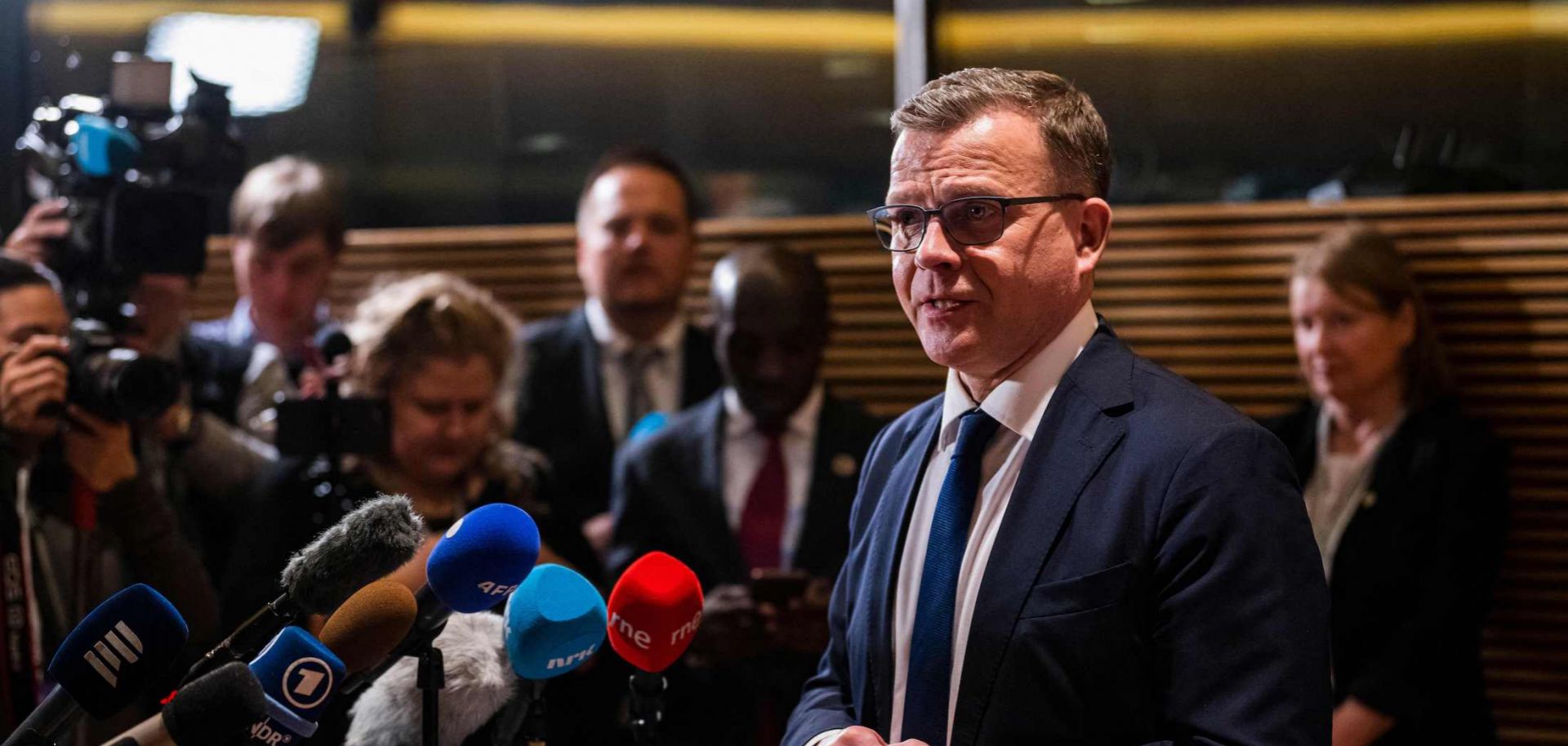
Petteri Orpo, the leader of Finland’s National Coalition party, speaks to the media in Helsinki following parliamentary elections on April 2, 2023.
While the next Finnish government will not dispute the country's membership in NATO, a right-wing coalition could increase tensions with the European Union on issues like fiscal integration and immigration. On April 2, Finland held a general election to vote in the 200 members of its unicameral parliament. The conservative National Coalition party won 48 seats, followed by the right-wing populist Finns Party with 46 seats and outgoing Prime Minister Sanna Marin's center-left Social Democratic Party with 43 seats. Marin conceded defeat hours after the results were announced. In the coming days, National Coalition leader Petteri Orpo will begin consultations with other political parties to form a new government, most likely with him as Finland's new prime minister. There are two main scenarios regarding the formation of the new government: the National Coalition could form either a right-wing coalition with the Finns Party and other smaller political forces, or a centrist coalition with the Social Democratic Party and other smaller parties. Because of the complexity of the negotiations in either scenario, it could take weeks before a government is formed.
- Marin became prime minister in December 2019, leading a coalition of five political parties. While she was popular during most of her tenure and her Social Democratic Party gained three more seats in the 2023 general election compared with the previous election in 2019, her political rivals criticized her government's expansive fiscal policies and their negative impact on Finland's debt levels. During Marin's administration, Finland's debt-to-GDP ratio rose from 64% to 73%. Orpo, a former finance minister, campaigned on a promise of fiscal restraint.
- Immigration was another central issue during the electoral campaign, which explains the strong performance of the anti-immigration and euroskeptic Finns Party. The party has been popular since the 2010s and obtained its best-ever results in the April 2 election, both in the percentage of the votes and the number of seats in parliament.
Regardless of the result of coalition talks, Finland's accession to NATO and overall support for Ukraine are not at risk. Finland applied to join NATO shortly after Russia invaded Ukraine in February 2022, putting an end to the country's decades-long policy of neutrality. This was a particularly notable decision considering that center-left political forces (which were in government when Helsinki applied) had traditionally been skeptical of NATO membership, while the conservative parties tended to support the Western security alliance. Finland will formally join the alliance on April 4, after Turkey ratified Helsinki's membership in late March, the last NATO member to do so. Since most people and political parties in Finland currently support NATO membership, the result of the upcoming coalition talks will not jeopardize the country's participation in the alliance. Even the Finns Party, which campaigned on a promise to severely reduce immigration, said that it would continue to open Finland's doors to Ukrainian nationals escaping the war.
- In a foreign policy statement published on the National Coalition's website in September, Orpo expressed his full support for Ukraine and his party's desire to intensify security cooperation with the United States, NATO and Sweden. According to Orpo, as “Russia is openly threatening peace in Europe, we need to look at all means to improve our own as well as Europe's overall security," adding that a "lasting detente in the short term or a return to multilateral cooperation with the current Russian regime seems very unlikely."
- On March 22, Finns Party leader Riikka Purra said her party was "extremely committed" to supporting Ukraine and welcoming Ukrainian refugees to Finland. According to Purra, "Ukraine has to win this war...we must be committed to helping Ukraine, both with heavy weapons, humanitarian aid and other kinds of mechanisms to help Ukraine fight and win."
- Still, some members of the Finns Party expressed skepticism about transferring weapons to Ukraine that could weaken Finland's defense capabilities. In early March, Finns Party member Jari Ronkainen criticized Marin's promise to Ukraine that Finland would donate aging Hornet fighter jets (which Finland is currently replacing with American F-35 fighter jets) to Kyiv. According to Ronkainen, the Hornets are a “significant part of Finland's defense capabilities until the end of their life cycle. We cannot promise them to anyone without considering Finland's own defense capabilities or even the operational capability of the Hornets at the end of their life cycle."
If a right-wing coalition is formed, it will likely clash with the European Union on fiscal and immigration issues, though Finland's position within the bloc is not at stake. While the outcome of the upcoming coalition talks will not significantly impact Finland's foreign policy, a right-wing government is likely to take a more hawkish position on fiscal policy (one of the National Coalition's main campaign promises was to cut spending to reduce the country's fiscal deficit and sovereign debt levels). This, in turn, would result in a Finnish government that is skeptical about fiscal integration plans in the European Union, including the issuing of jointly-backed EU debt to pay for bloc-wide policies. This is likely to result in direct clashes between Finland and southern European governments that defend expansive fiscal policies backed by joint debt, and could delay the implementation of large, continent-wide programs on issues ranging from the energy transition to the integration of Europe’s banking sectors. A right-wing government is also likely to push a more hawkish position on immigration, especially from non-EU countries. Under such a government, Helsinki would defend policies to strengthen the protection of the bloc's external borders and would be skeptical of proposals to distribute asylum seekers and economic migrants more equally between EU member states. Under a right-wing government, Finland may also oppose countries like Romania and Bulgaria joining the bloc’s passport-free Schengen Area out of fear that these countries are not doing enough to protect their external borders. While these positions will likely result in intra-EU friction, the disputes will not jeopardize Finland's membership in the European Union or the eurozone, as most of the country's political spectrum supports both organizations.
- Even the Finns Party, which expressed strong anti-EU views in the past, has progressively evolved to euroskeptic positions that do not necessarily involve exiting the bloc. The party continues to defend leaving the European Union as a long-term goal, but the issue is not particularly prominent in its current agenda.
