
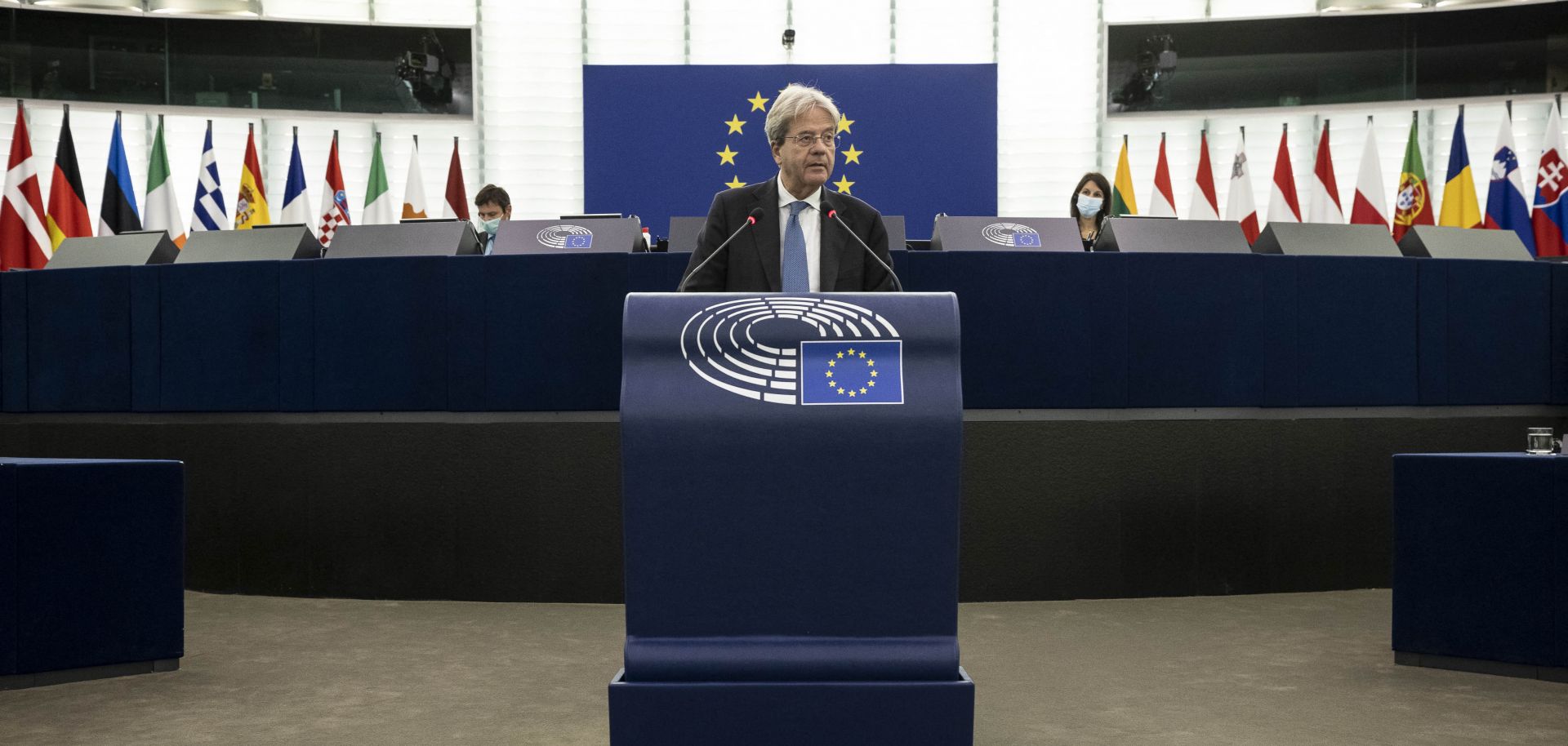
EU Economy Commissioner Paolo Gentiloni addresses the European Parliament in Strasbourg, France, on Oct. 6, 2021.
The debate over the European Union’s debt and deficit rules will reignite north-south tensions in 2022 and will be crucial for the pace of fiscal consolidation after the pandemic. Looser fiscal rules could promote growth but open the door to new debt crises, while tighter rules could lead to social unrest and political upheavals in Southern Europe. On Oct. 19, the European Commission formally launched the process to reform the bloc’s Stability and Growth Pact (SGP), which establishes sovereign debt and fiscal deficit limits for member states. EU officials will hold conversations with national governments and civil society organizations for several months, with the goal of implementing the new rules in 2023. In a press conference, European Commission Vice President Valdis Dombrovskis said that fiscal rules should not constrain economic growth, and that the new rules will be applied “in a gradual, sustained and growth-friendly way."
- According to the SGP, EU countries are required to keep fiscal deficits below 3% of GDP and sovereign debt below 60% of GDP. The European Commission has the power to launch corrective measures against countries that fail to meet these targets.
- The commission suspended the SGP in early 2020 to allow member states to increase public spending to cope with the COVID-19 pandemic. Brussels has said that the suspension of the pact will continue during 2022, with the goal of introducing a new set of rules by 2023.
- Because of the pandemic, fiscal deficits have risen significantly across the European Union over the past two years. Debt levels have risen as well, and are particularly high in Greece (209% of GDP), Italy (160% of GDP) and Portugal (137% of GDP).
In the coming months, the European Commission will have to find a balance between seemingly irreconcilable fiscal positions among EU member states. Southern European countries including France, Italy, Spain and Greece are pushing for more flexible fiscal rules so that they are not under pressure to reduce their debt and deficit levels quickly, which would undermine growth. The European Commission seems to support this point of view, as EU Commissioner for the Economy Paolo Gentiloni said that Brussels will try to “square the circle” and find a balance between reducing member states’ fiscal deficits while simultaneously keeping high levels of public investment. Brussels’ position is partially explained by the fact that its climate policies will require significant public spending over the next three decades, which strict fiscal rules would limit. But northern European countries including Austria, the Netherlands, Denmark and Sweden are pushing for a quick return to fiscal discipline out of fear that debt levels in the European Union could spiral out of control and lead to another debt crisis in Europe.
- In September, the governments of Austria, Denmark, Latvia, Slovakia, the Czech Republic, Finland, the Netherlands and Sweden issued a joint position paper calling for EU member states to reduce their debt burdens and return to fiscal discipline.
- Countries including Italy have proposed that “green” investments should not be considered when calculating a country’s fiscal deficit. While creative solutions like this could open the door to a compromise between northern and southern EU member states, they would not change the way that institutions like the International Monetary Fund or financial markets calculate the risks associated with a country’s fiscal deficit.
The outcome of these negotiations will largely determine the pace of fiscal consolidation in the European Union after the high-spending policies implemented during the pandemic. Should Brussels adopt a more flexible approach to debt and deficit reduction, governments will have more room to continue spending and borrowing. This would open the door to higher levels of economic growth, but at the risk of worsening debt burdens across the Continent. Greater debt levels would not be particularly problematic as long as borrowing costs in the bloc remain low. But should interest rates increase significantly (which could happen if the European Central Bank ends its bond-purchasing programs), the probability of another debt crisis would increase. If, on the contrary, northern European countries win the debate and the European Union introduces stricter fiscal consolidation measures, EU governments would be under pressure to cut spending and raise taxes, which would severely slow down post-pandemic growth and open the door to social unrest and anti-establishment sentiments, particularly in Southern Europe.
