
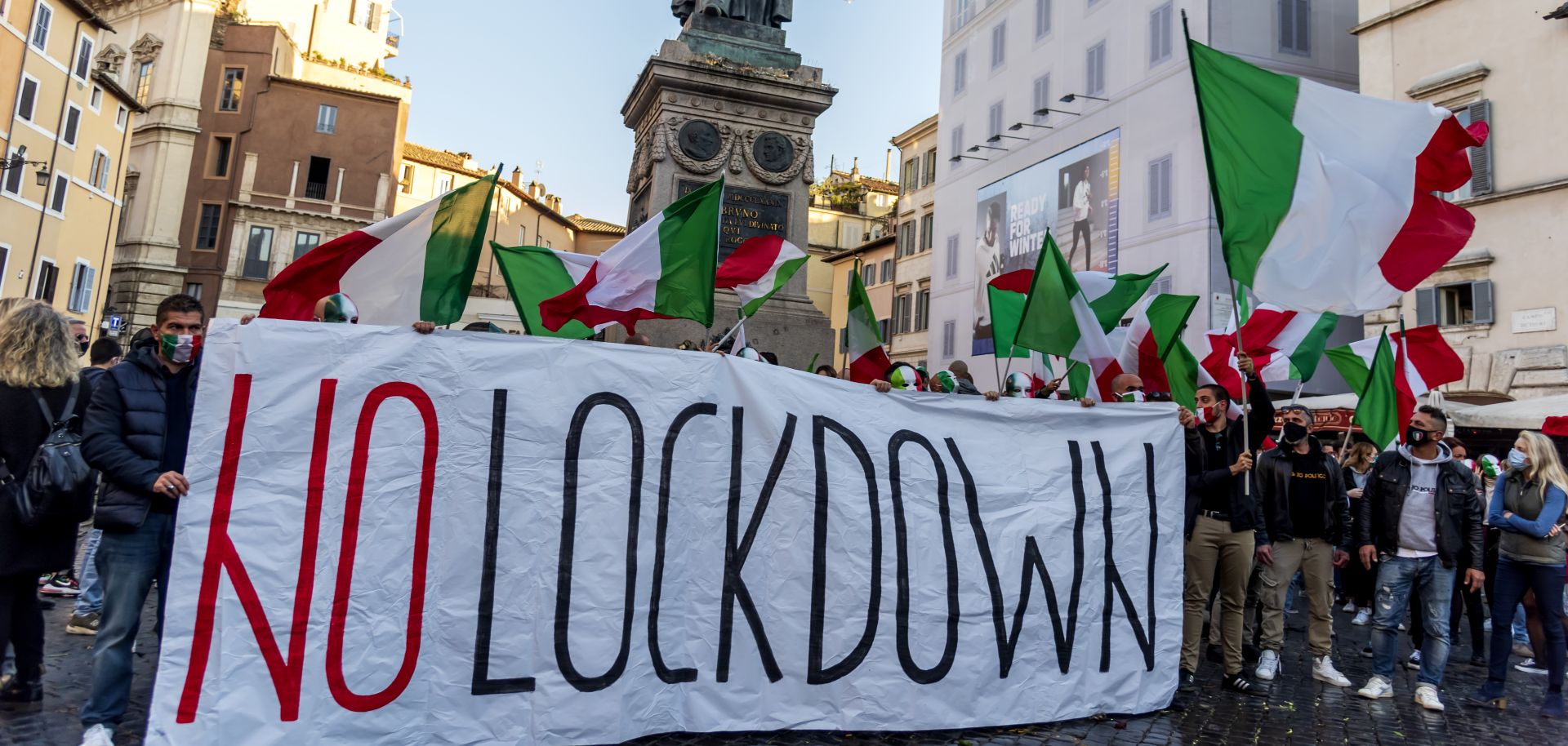
People protest against the reintroduction of COVID-19 lockdown measures in Rome, Italy, on Oct. 31, 2020.
The European Commission’s latest economic report foresees steeper GDP contractions in the south and milder contractions in the north in 2020, followed by an overall slow rebound for the entire bloc in 2021. This means that the risk of bankruptcies, private credit defaults and sovereign defaults, as well as protests and the collapse of governments, will persist and be particularly high in Southern Europe. On Nov. 5, the European Commission released its autumn economic forecast, which is the bloc's most comprehensive economic report since the spring forecast in May. According to the commission's updated predictions, the economic rebound that took place in the European Union in the third quarter will be short-lived due to the reintroduction of economically disruptive lockdown measures to contain rising COVID-19 cases across the bloc. The commission also expects economic activity in the European Union to improve in the first quarter of 2021, but to remain constrained by lingering virus containment measures.
- The autumn forecast revises down the economic recovery for the entire European Union in 2021, from an original prediction of an expansion of 6.1 percent to an updated prediction of an expansion of 4.1 percent.
- For Southern Europe, the autumn forecast revises down GDP predictions for 2020 compared with the spring forecast: Italy is now expected to contract by 9.9 percent (from a previous prediction of 9.5 percent), Spain by 12.4 percent (from 9.4 percent), France by 9.4 percent (from 8.2 percent), and Portugal by 9.3 percent (from 6.8 percent).
- The commission also expects that contractions in many northern European countries in 2020 will not be as deep it predicted in the spring: Germany is now expected to contract by 5.6 percent (from a previous 6.5 percent contraction prediction), the Netherlands by 5.3 percent (from 6.8 percent), Finland by 4.3 percent (from 6.3 percent), Denmark by 3.9 percent (from 5.9 percent), and Sweden by 3.4 percent (from 6.1 percent).
Such an uneven recovery will lead to diverging priorities within the European Union, making it harder for the bloc to reach consensus on economic policies. A modest rebound in economic activity will allow northern governments to start lifting their stimulus measures and work to reduce their fiscal deficits faster than their peers in the south. But it will also lead to growing divergences with southern governments about additional rounds of EU stimulus.
As economic conditions weaken, private credit defaults will increase and will put additional pressure on banks in Southern Europe. A slow economic recovery also means that the risk of bankruptcies will remain high, particularly in those sectors of the economy that are directly affected by lockdown measures, such as tourism and hospitality. The European Central Bank’s bond-purchasing programs reduce the probability of sovereign debt defaults in the eurozone, but high levels of debt and deep fiscal deficits mean that financial crises in Southern Europe cannot be ruled out.
- According to the European Commission, “the number of corporate defaults and the volume of non-performing loans are set to rise, particularly in the sectors most affected by the containment measures.”
- The commission believes that the stability of Europe’s banking sector will be “tested” in the coming months.
- The commission also warned that debt and deficit levels are rising sharply across the European Union, and admitted that “the possibility of financial market stress [could] not be excluded.”
Unemployment levels will continue to increase in Southern Europe in the coming months, opening the door for more anti-government protests. This will test the stability of fragile government coalitions in countries such as Italy and Spain, and could lead to renewed unrest in France. In recent months, furlough schemes across the European Union have somewhat masked the real impact of the COVID-19 pandemic on the Continent, but these programs will eventually be lifted. This, together with lockdown fatigue in some sectors of the population and persistent anti-government sentiment, could lead to renewed episodes of social unrest that will test the stability of governments. Some of the places where social unrest could be high are Italy and Spain (where the government coalitions are fragile), as well as France (where the government is unpopular).
- The European Commission expects unemployment in Spain to reach 17.9 percent in 2021 from 16.7 in 2020, 11.6 percent in Italy from 9.9 percent, and 10.7 percent in France from 8.5. Unemployment is only expected to fall in these countries in 2022.
- Spain is governed by a minority center-left government that depends on support from other parties in parliament to pass legislation, while Italy is governed by a coalition of populist and center-left parties that is constantly having internal disputes. Both countries have also already experienced anti-lockdown protests.
- While France’s presidential system has been designed to be stable, the country faced widespread protests between late 2018 and early 2019.
