
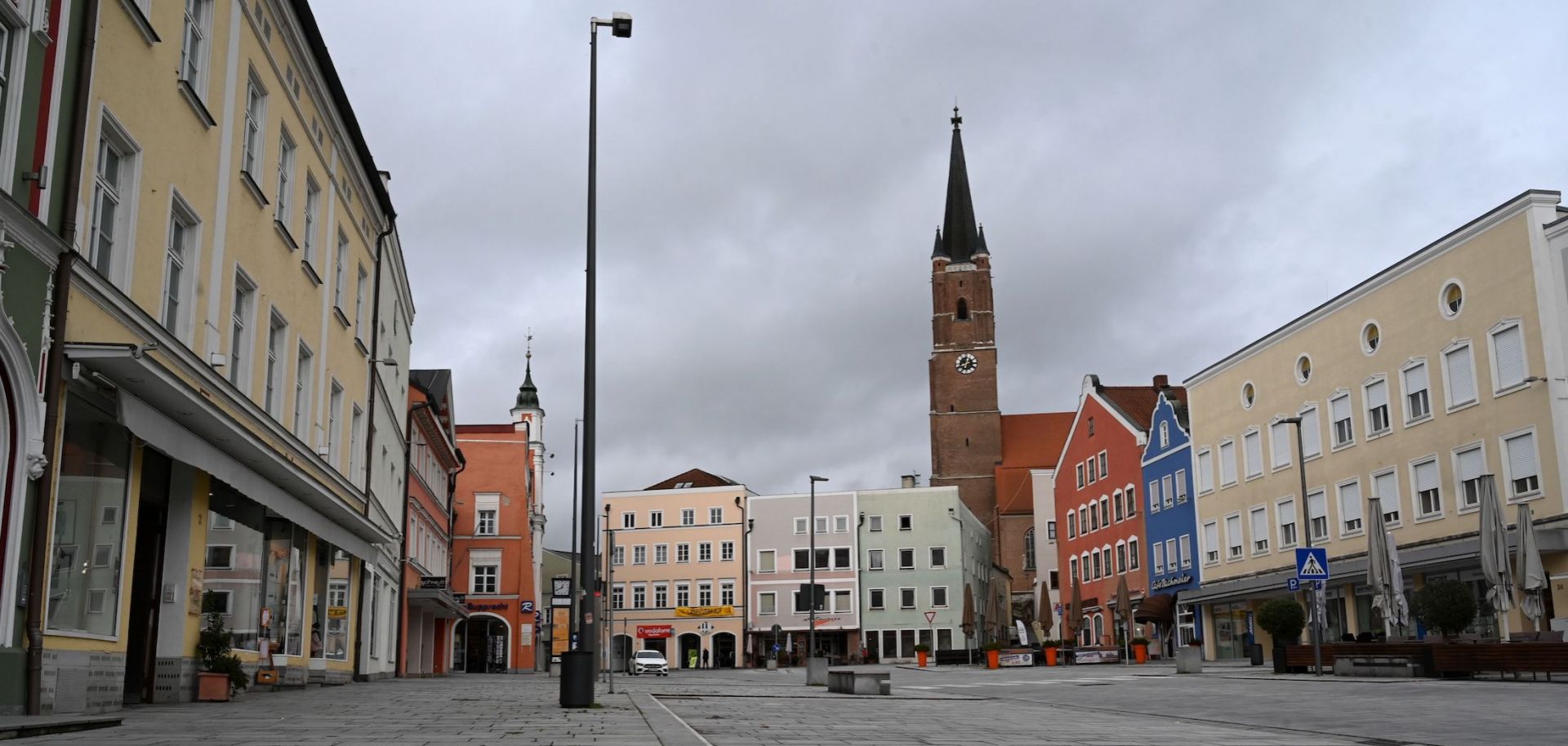
A photo shows an empty plaza with closed stores in the German city of Eggenfelden on Oct. 27, 2020, after a local lockdown was imposed to contain the spread of COVID-19.
Germany and France’s new COVID-19 lockdown measures are less strict than those implemented in April and May, but will still harm their already struggling economies. Similar measures elsewhere in the eurozone will lead to a slower recovery across the currency area and open the door to social unrest, as well as long-term financial instability. Germany and France have announced nationwide lockdown measures in an attempt to slow down the rate of COVID-19 infections in their countries and prevent their hospitals from being overwhelmed. They are also trying to reduce infections during November so that the movement restrictions can be softened before Christmas. While Berlin and Paris have said the measures are time-limited, extensions are possible considering the high number of infections in both countries.
- German Chancellor Angela Merkel announced the introduction of a partial lockdown that will enter force on Nov. 2 and will last for a month. Restaurants and bars will close, large events will be banned, non-essential travel will be discouraged, theaters, cinemas and gyms will be closed, and people will be asked to work from home if they can.
- French President Emmanuel Macron announced lockdown measures that will begin on Oct. 30 and will end on Dec. 1. Cafes, restaurants and shops will shut down unless they sell essential products (such as supermarkets and pharmacies) and people will be required to stay at home.
- Unlike the previous lockdown, schools and places of worship will remain open in both countries, and no border closures were announced.
The German and French governments will introduce additional stimulus measures to mitigate the economic impact of the lockdowns, though this will come at the price of long-term financial risks. Since the beginning of the pandemic, Berlin and Paris have announced billions of euros in stimulus packages (such as cheap credit and furlough schemes), but the new restrictions will necessitate additional measures. This will further worsen their fiscal deficits and sovereign debt levels, creating financial problems for 2021 and beyond. It will also force the European Central Bank to come up with new measures to boost economic growth in the eurozone.
- The German government has promised that small- and medium-sized enterprises affected by these measures will receive state support.
- In mid-October, France announced up to 100 billion euros ($117 billion) in loans for struggling companies.
- Borrowing costs for eurozone countries are low because of the European Central Bank (ECB)’s asset-purchasing programs. After an Oct. 29 meeting of its governing council, the ECB left its monetary policy unchanged, but said it could take new stimulus measures in December.
As other countries in the eurozone also tighten their lockdown measures, the risk of social unrest will remain high for several more months, especially in the south. In addition to Germany and France, the governments of other eurozone countries will probably introduce additional lockdown measures in the coming weeks to contain their own rising COVID-19 infection rates, which means that the economic recovery of the currency area as a whole will slow down. Because of structural factors, the negative economic impact of the new restrictions will probably be stronger in southern European countries such as Italy and Spain. Right-wing opposition parties across the eurozone have criticized their governments for their management of the pandemic and anti-lockdown protests have taken place in several countries. Both trends are likely to continue, especially in the south.
- On Oct. 29, the Spanish parliament approved a state of alarm until May 9 due to the country’s rising COVID-19 cases. The central government will allow for regional governments to decide the kinds of lockdown measures they want to implement.
- Ireland introduced a six-week nationwide lockdown on Oct. 22, while countries including Italy, Belgium and Greece have introduced night curfews to limit social mobility. The night curfew in Italy, in particular, led to protests across the country on Oct. 26-28, some of which turned violent.
- The right-wing Vox party in Spain launched an unsuccessful no-confidence vote against the Spanish government on Oct. 21-22, while members of the right-wing Alternative for Germany party heckled Merkel in the German Bundestag on Oct. 29.
