
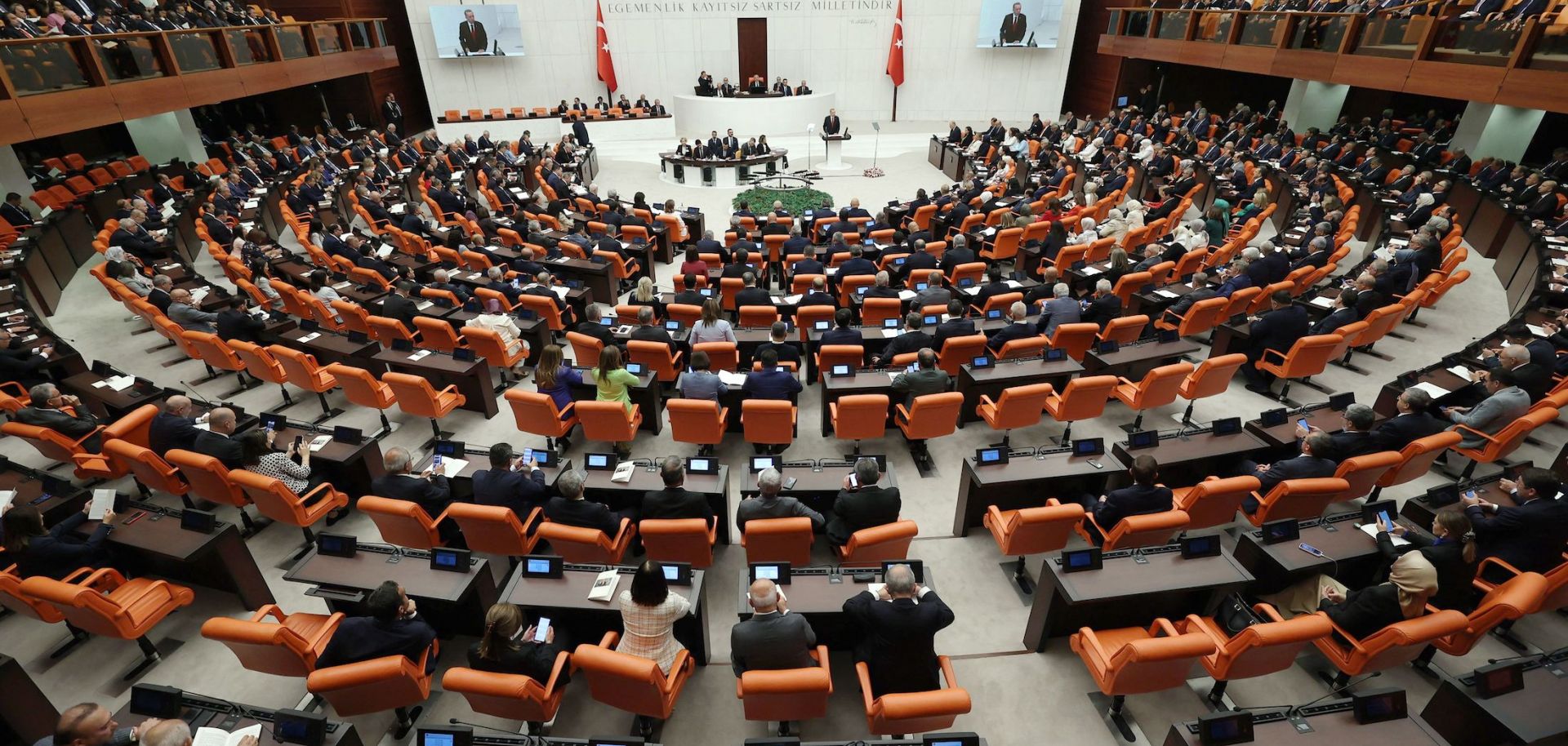
Turkish President Recep Tayyip Erdogan (C) on Oct. 1, 2022, addresses parliament in Ankara, Turkey.
A breakthrough in NATO accession negotiations between Turkey and Sweden and Finland is unlikely before Turkey's national elections later this year, hampering the U.S. sale of F-16s to Ankara and reinforcing those in the West questioning Turkey's place in the military alliance. Political calculations in Turkey are slowing negotiations between the country and would-be NATO members Sweden and Finland, as Ankara redoubles its call for Stockholm and Helsinki to take politically difficult (and legally questionable) steps to target individuals on their soil whom Ankara accuses of supporting Kurdish militancy. On Jan. 16, Turkish President Recep Tayyip Erdogan added a fresh demand: Finland and Sweden must extradite some 130 publicly unnamed individuals before the country's parliament would ratify their accession to NATO. The comments came just days after Turkey demanded that Sweden prosecute protesters who hanged Erdogan in effigy during a protest. After that incident, Turkey canceled a visit by Sweden's speaker of parliament, Andreas Norlen, to Ankara. Despite the Turkish demands, a Swedish prosecutor said that there would be no investigation into the incident, which Swedish politicians said was protected by the country's free speech laws.
- Both Sweden and Finland applied to join NATO in the spring of 2022, just weeks after the Russian invasion of Ukraine shifted their neutral stances on East-West confrontations. But Turkey objected, citing alleged Swedish and Finnish political support for groups like the Kurdistan Workers' Party (better known by its Kurdish initials, PKK), and demanded the two Nordic countries take stronger steps against the group before Ankara would support their accession to the alliance (which requires unanimous support from all members). Turkey's ruling Justice and Development Party (known by its Turkish initials, AKP) is using the issue to win over nationalists in the upcoming national polls — which are likely in May, though they are currently scheduled for June — in which the AKP is competing with opposition parties for the nationalist vote to control parliament.
- NATO states like the United States have informally committed themselves to defending the Nordic countries' borders regardless of their status as NATO members. This has diminished the urgency of bringing the two nations into the alliance, giving Turkey time to drag out the accession process in the pursuit of concessions.
Because of their constitutional systems, the Finns and Swedes will be unable legally to take further steps against public expressions of support for Kurdish militants, while Turkey is unlikely to step back from its maximalist demands so long as they benefit the AKP's political strategy ahead of the elections. This makes a breakthrough before the Turkish national elections unlikely. Finland and Sweden both already outlaw the PKK as a terrorist organization, but as constitutional democracies, they are unable to take further steps demanded by Turkey, like prosecuting individuals for general pro-Kurdish, anti-Turkish sentiment — sentiments only growing stronger because of Turkey's obstruction of the ongoing accession process. Meanwhile, dropping its demands ahead of the national elections without these major Nordic concessions could cost the AKP swing voters. Such voters could switch to the opposition nationalist Iyi Party, abandoning the AKP and its ultranationalist ally the Nationalist Movement Party, which is struggling to stay above the 7% electoral threshold needed to enter parliament.
- Turkey has not always provided specific names for extradition, causing some observers to speculate Ankara wants to use the issue as a talking point for domestic politics rather than a major attempt to force a sentiment change in Finland and Sweden.
- In December 2022, a Swedish court blocked the extradition of Bulent Kenes, a Turkish journalist demanded by the Turkish government because of his alleged ties with the now-outlawed Gulenist government. Kenes accused Erdogan of demanding his extradition because he was a known opposition journalist rather than having a specific, strong case against him.
The United States is likely to keep its upcoming F-16 sale to Turkey tied to the entry of Finland and Sweden into NATO, while Turkey's blocking policy will also reinforce general Western sentiments that Ankara's policies are undermining the effectiveness of the alliance. In the long term, this will translate into greater political pressure for the United States to try to force Turkey to shift policies and better align with the alliance. In January 2023, The Wall Street Journal reported that the Biden administration was preparing to notify Congress of a long-sought F-16 sale to Turkey to modernize the country's air force, but that the sale would be contingent on both congressional approval and Turkey's acquiescence to the Nordic countries entering NATO. In Congress, Sen. Robert Menendez — who often delays arms sales through his position as chairman of the Armed Services Committee — also threatened to hold up the sale based in part on Turkey's position regarding accession and because of Ankara's human rights record. Such positions appear likely to harden if, after the elections later this year, a breakthrough on the entry of the Nordic countries to the alliance still does not occur.
- Turkish-Western ties are also strained by other Turkish policies, including its relative neutrality on the Russia-Ukraine war, where Ankara has so far refused to enact sanctions against Moscow to avoid hurting Turkey's unstable economy. Turkey and the United States have also long been at odds over Washington's close relationship with the Syrian Democratic Forces, which use Kurdish fighters Turkey accuses of being terrorists; Turkey's purchase of the Russian S-400 air defense system; and Turkey's general human rights record.
- In September 2022, U.S. and EU officials quietly pressured Ankara to end the use of Russia's Mir payment system in order to isolate Russia's economy, a step Turkey had initially resisted in an attempt to retain economic relations with Moscow. These threats did not emerge into forceful sanctions, but were indicative of the West's increased willingness to pressure Turkey to move away from its neutral position on the Russian-Ukraine war.
