
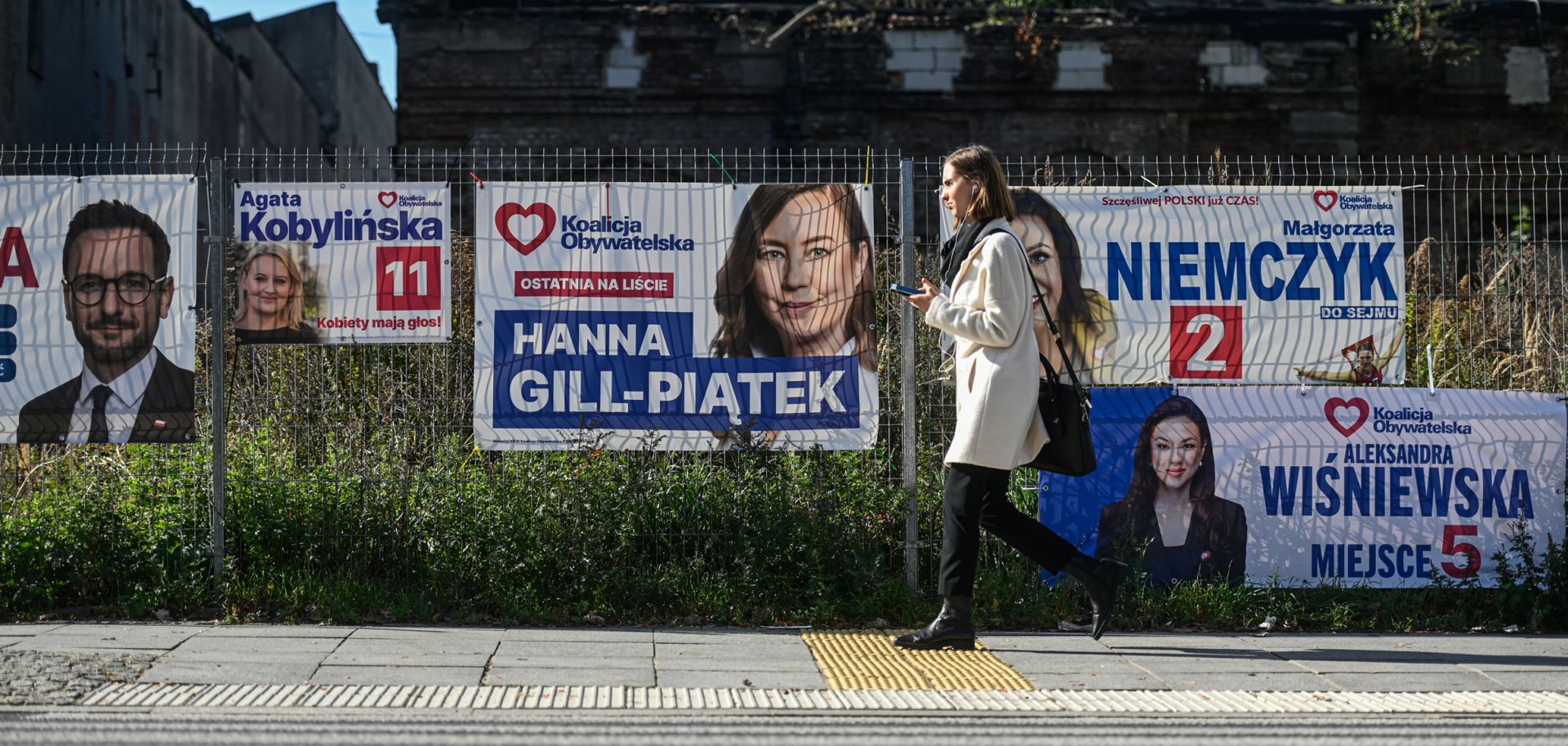
The new centrist government likely to emerge from Polish elections would significantly improve relations between Warsaw and the European Union, allowing the country to continue playing an increasingly central role within the bloc and enhancing EU unity in the face of common challenges. Early results from Poland's parliamentary election Oct. 15 indicate the ruling right-wing Law and Justice (PiS) party of Prime Minister Mateusz Morawiecki has won the most votes, ahead of the main opposition party, the centrist Civic Coalition (KO) of former Prime Minister and former European Council President Donald Tusk. While both parties claimed victory, KO appears more likely to be able to form a coalition government than PiS because of expected support from two smaller opposition parties, the left-wing Lewica and the center-right Third Way (PL2050/PSL) coalition, which together should control a majority in parliament. By contrast, PiS' preferred coalition partner, the far-right Confederation party, did not win enough votes to give the two a parliamentary majority. A coalition including KO, Lewica and the Third Way could be ideologically out of sync, particularly on social issues such as abortion or same-sex marriage, but the common goal of removing PiS from power and restoring positive relations with the European Union should allow them to form a working majority by the end of the year.
- With around 80% of the votes counted, PiS was first with 36.7% of the vote, followed by KO with 30%, Third Way with a higher-than-expected 14.5% and Lewica with 8.4%. Confederation largely disappointed expectations, securing only 7.2% of the vote. With these results, the three opposition parties are projected to win around 248 out of 460 seats in the Sejim, the lower house of the Polish legislature.
- Polish President Andrzej Duda is expected to grant an initial government formation mandate to Morawiecki, who will seek to convince Third Way to join an alliance with PiS and Confederation. While the Third Way shares similar conservative views with PiS on social issues such as LGBTQ rights and immigration, they also firmly oppose PiS' strict control of the country's media and judiciary as well as its policy of confrontation with the European Union. As Morawiecki's attempt at forming a working majority is likely to fail, Tusk is thus expected to be given a mandate to form a government. This means Tusk could return to power (he was prime minister between 2007 and 2014) in late December or early January.
- Meanwhile, a four-question referendum called by PiS and held in parallel with the parliamentary election failed to cross the necessary 50%-turnout threshold to be considered binding. Compared to a record-high 73% turnout for the elections, according to Ipsos, only 40% of Poles voted in the referendum. The referendum asked Poles questions concerning migration, border defenses, the privatization of state-owned companies and raising the retirement age.
PiS' eight-year rule led to a deterioration in Warsaw's relations with Brussels as questions emerged about the rule of law in Poland and government pressure on the media and the judiciary. PiS took power in 2015 capitalizing on voter discontent with the pro-business, pro-EU reforms adopted by the preceding KO administration. During its two terms in power, PiS implemented popular welfare programs (notably a program of child benefits payments) but also increased government control over the judiciary and pressured the independent media. This put it on a collision course with the European Union, which has accused Warsaw of undermining democratic values and the rule of law in the country. This resulted in the European Commission imposing record fines on Poland and withholding billions of euros in post-pandemic recovery funds and cohesion funds earmarked for the country. Despite frictions with Brussels, Warsaw took a central role in shaping the EU response to Russia's invasion of Ukraine by providing key humanitarian aid and asylum to Ukrainians fleeing the invasion and guiding logistical efforts to deliver Western military support to Kyiv. At the same time, Warsaw increased its own defense spending far more than other EU countries. Despite this, relations with Kyiv have also soured in recent months due to Warsaw's decision to unilaterally extend an import ban on Ukrainian grains to protect Polish producers from cheaper competition.
- In 2018, Poland created a controversial disciplinary chamber to supervise the work of judges and prosecutors as a part of broader judicial reforms the European Union argues undermine the independence of the country's judiciary. Poland's refusal to comply with a 2021 European Court of Justice order to abolish the chamber resulted in the EU imposing a daily fine, initially set at 1 million euros (about $1.05 million) and later reduced to 500,000 euros when the chamber was replaced with a "chamber of professional responsibility." As Poland has yet to pay such fines and comply with the required changes, Brussels decided to withhold about 35 billion euros worth of COVID-19 recovery funds destined for the country as well as the transfer of 76.5 billion euros in funds included in the 2021-27 EU budget.
- Following Russia's invasion of Ukraine, Kyiv began exporting grain via land through the European Union as its traditional Black Sea routes became unusable. Most of that grain, however, began piling up in neighboring EU countries due to bottlenecks and various logistical issues, driving down prices for local producers. As a result, Brussels allowed Poland, Hungary, Slovakia, Romania and Bulgaria to temporarily ban imports of wheat, maize, rapeseed and sunflower from Ukraine while still letting the grain transit their territories to reach other markets in and outside the European Union. But Poland, followed by Hungary and Slovakia, decided to unilaterally extend the ban beyond the original deadline Sept. 15, to which Ukraine responded by filing a complaint with the World Trade Organization.
A KO-led government would prioritize improving relations with Brussels to unlock billions of frozen EU funds while maintaining support for Ukraine in its war against Russia and strong ties with the United States. Should opposition parties succeed in forming a coalition government, this would lead to a rapprochement between Poland and the European Union, with the new government in Warsaw prioritizing improving ties with Brussels after years of souring relations. While a KO-led government would still face institutional obstacles to dismantling some of the PiS-promoted reforms — notably because President Andrzej Duda, a PiS supporter, has limited veto powers over legislation — Warsaw would still work to resolve its rule of law dispute with Brussels, opening the door to billions of euros in stalled EU funds. Moreover, a KO-led government will likely abandon PiS's strategy of using its veto power on EU decisions to block or delay reforms on issues ranging from migration to climate. Relations between Poland and the United States would also remain strong, with the new government likely to continue seeking closer ties with Washington, including through purchases of U.S. weapons, liquified natural gas and nuclear technologies. Such a government would also remain strongly committed to supporting Ukraine in its war against Russia both politically and militarily through EU mechanisms, while seeking to de-escalate recent tensions with Kyiv surrounding the grain dispute. Although grain imports will likely remain a domestic issue in Poland for the foreseeable future, Warsaw would be more willing to seek dialogue with Kyiv and Brussels on the matter than the previous government. Finally, the fiscal agenda of the main opposition parties largely includes maintaining most existing social spending programs (from increased defense spending to higher social benefits), so no radical differences should be expected from the PiS-proposed 2024 budget besides minor spending adjustments across various areas. More generally, fiscal policy will likely remain expansionary in light of upcoming local and EU elections in 2024 and, most importantly, presidential elections in 2025.
- Besides the presidential veto power, a centrist government would also face resistance from a strong 200-seat opposition from PiS in parliament and a number of key PiS-appointed officials in key institutions, including the National Bank of Poland, the Constitutional Court and the National Media Council.
